


Bangladesh’s state apparatus and decision-making mechanisms continue to fail to reflect true pluralism, despite renewed public aspirations for a more inclusive society following the mass uprising, analysts and legal experts warned on Saturday.
Speakers argued that the systemic exclusion of ethnic and religious minorities, women, and marginalised communities, alongside an institutional tendency to enforce a single national identity, keeps the state fundamentally alienated from genuine pluralistic governance.
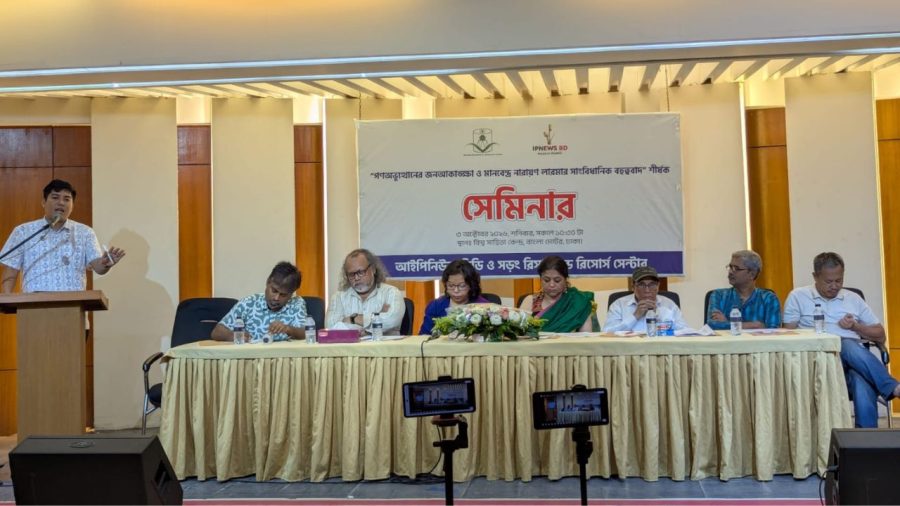
The observations were made at a seminar titled “People’s Aspirations after the Mass Uprising and Manabendra Narayan Larma’s Constitutional Pluralism”, hosted by IPNews BD and the Sorong Research and Resource Centre at the Bishwo Shahitto Kendro in Dhaka.
Presenting the keynote paper, researcher Pavel Partha highlighted that Manabendra Narayan Larma’s philosophy of a pluralistic state extended far beyond regional advocacy for the Chittagong Hill Tracts. Partha noted that Larma’s political thought encompassed ethnic and religious diversity, the rights of women, farmers, and workers, alongside environmental justice and biodiversity.

Recalling Larma’s opposition to the Kaptai Dam, Partha stressed that the controversy was not merely about forced displacement, but about resisting top-down development projects imposed without local consent. “The people displaced by the Kaptai Dam, which fuelled Bangladesh’s development, have still not been properly rehabilitated,” he said. “The dam effectively broke our backbone.”
Partha also urged the state to recognise indigenous and agricultural knowledge systems, asking why traditional farmers remain excluded from institutions like the national rice research institute. He emphasised that jum farming should be understood not merely as a production method, but as an intrinsic component of indigenous identity, culture, and life.




Journalist Sohrab Hassan criticised the persistent absence of pluralism in state policymaking, questioning the representation of minority communities within ongoing reform initiatives. He pointed out that the National Consensus Commission lacked any religious or ethnic minority representation, while the special committee on constitutional reform similarly excluded these groups, despite including women.
“Pluralism is widely discussed, but it remains absent from our actual administrative structures,” Hassan remarked. Criticising the 1972 Constitution’s imposition of “Bengali” identity on all citizens and the 2011 15th Amendment’s use of the term “small ethnic groups”, he asserted that the state must not dictate community identity.
Bakhtiar Ahmed, a professor of anthropology at the Independent University, Bangladesh, argued that public aspiration should not be reduced to a static list of demands, but must involve reimagining the state itself. He warned against narrowing Larma’s legacy solely to the hill tracts, noting that events like the Kaptai Dam project and the disappearance of Kalpana Chakma illustrate how state power expanded its control over local populations through militarised infrastructure and checkpoints.
Jurist Sara Hossain emphasised that women’s rights and participation must be central to state reform. She noted that Larma actively championed gender equality, a principle embedded in the Constitution’s anti-discrimination provisions. While the Constitution prohibits discrimination based on religion, race, caste, sex, or birthplace, Hossain called for effective enforcement mechanisms to guarantee meaningful inclusion for women, persons with disabilities, and marginalised groups within the post-uprising framework.
Adding a cultural dimension, poet Sakhawat Tipu highlighted the necessity of linguistic diversity. He argued that languages such as Chakma and Marma require formal recognition, as language carries a community’s history and identity. A truly democratic state, Tipu concluded, must guarantee equal dignity and security for all groups, noting that a majority population cannot thrive if minority communities remain disenfranchised.
Falguni Tripura, general secretary of the Bangladesh Indigenous Women’s Network, and Dipayan Khisa, a central member of Parbatya Chattagram Jana Samhati Samiti, were also present at the seminar.