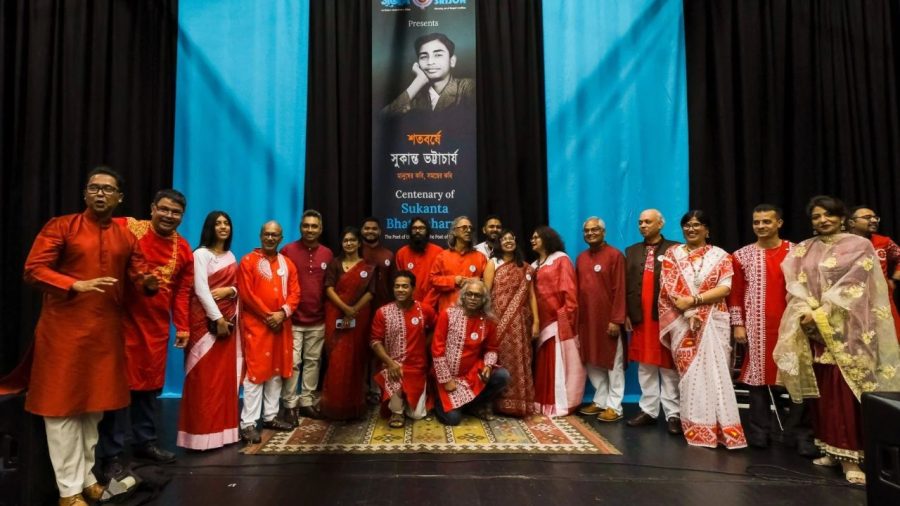



A hundred years after his birth and eight decades since his untimely passing at just twenty, the rebellious voice of poet Sukanta Bhattacharya resonated across the British capital in an evening of evocative song, dance, recitation, and poetry theatre.
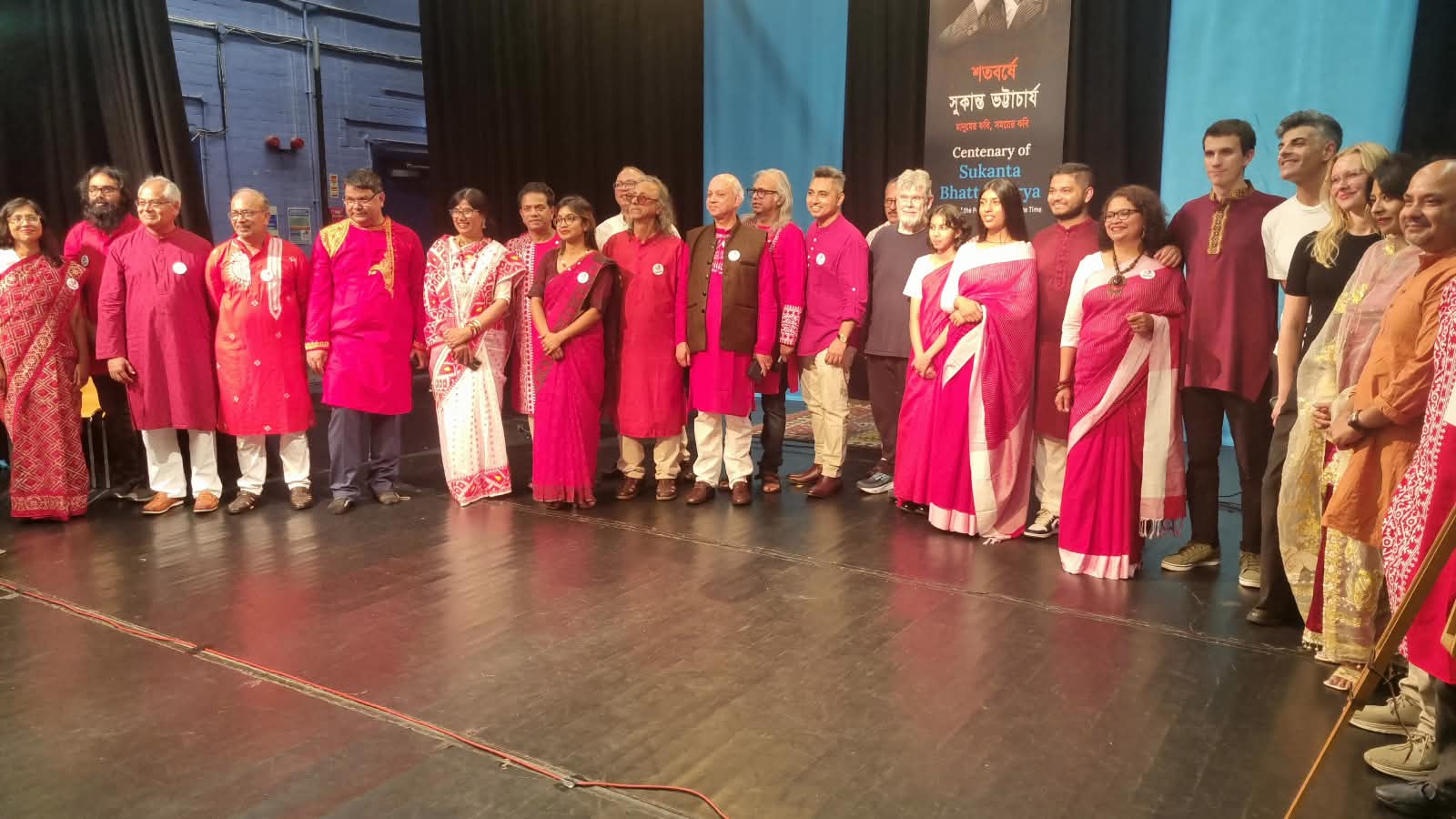
Gathering at six in the evening on 27 September in a packed auditorium at the Brady Arts Centre in Whitechapel, London, audiences attended the inaugural event of Srijon, a newly established UK-based cultural organisation, reads a press release.
Tower Hamlets, an area deeply entwined with the history of Bengali migration and cultural identity, provided a symbolic backdrop for the centenary commemoration.
Opening the programme, Srijon’s President Shahab Ahmed and General Secretary Lenin Haque explained that the organisation seeks to introduce Bengali language, literature, music, art, and heritage to younger generations while fostering intergenerational connections.
Selecting the birth centenary of Sukanta Bhattacharya—born on 15 August 1926—for their debut set the tone and direction for the platform’s journey.

The artistic performances commenced with a presentation of Sukanta’s celebrated poem Runner. London-based singers Sanjoy Dey, Gouri Choudhury, and Laboni Barua brought the piece to life in chorus, complemented by the expressive choreography of Monirul Islam Mukul and Niharika Bhowmik.
Instrumental accompaniment was provided by Amit Dey on keyboard, Piyas Barua on tabla, and Harvey Gibbons on cello, alongside dramatic lighting and sound work by Suna Miah and Samsul Zaki Swapan.




A dedicated discussion reflected on the historical environment that forged the poet’s voice. UK-based educator, author, and researcher Dr Palto Datta raised fundamental questions regarding how colonial rule, the Second World War, extreme social inequality, and the devastation of the 1943–1944 Bengal famine shaped Sukanta.
Poet and fiction writer TM Ahmed Kaysher examined the social forces behind the rebellious young poet, while young moderator Ropita recontextualised Sukanta’s motif of “hunger” to encompass modern struggles against social exclusion, inequality, and the denial of human dignity.
Generational continuity was further highlighted when teenage performers Cleopatra Pal and Raha Dewan-Syed rendered Sukanta’s Prarthana (Prayer), delivering a tender appeal for warmth, light, and hope.
Demonstrating the universal resonance of Sukanta’s message, multilingual recitations took his poetry beyond Bengali linguistic borders. Dr Bonya Chakraborty delivered Deshlai Kathi (The Matchstick) in Bengali, followed by poet and visual artist Agnese Graudina reading its Latvian translation.
Writer and poet Giuseppe Mastroianni presented Agneyagiri (Volcano) in Italian, while London performance poet Dr David Lee Morgan delivered Durmor in English, drawing on a translation by Rahad Abir.
Musical renditions continued to explore the harsh realities depicted in Sukanta’s work. Laboni Barua sang Hey Mahajibon (O Great Life), set to music by TM Ahmed Kaysher, reviving the iconic image written during the 1944 famine in which a kingdom of hunger turns the world prosaic and transforms the full moon into a scorched loaf of bread.
Gouri Choudhury performed Obak Prithibi (Astonished World), tracing the shift from astonishment to anger in the face of bloodshed and oppression. Sanjoy Dey rendered his own musical composition of Durashar Mrityu, while Urmi Mazhar performed Priyotomasu, capturing a soldier’s anti-war longing for love, home, and ordinary life.
A collective recitation written and directed by Bangladesh National Award-winning recitation artist and Chhandashik founder Munira Parvin featured performances alongside Shatarupa Choudhury, Dr Bonya Chakraborty, Dhananjay Pal, Shah Sharif Uddin, and Nazrul Islam Ankib.
The evening concluded with A New World’s Passport, a piece of poetry theatre inspired by Chharpatra. Directed by TM Ahmed Kaysher and performed by Sarwar E Alam, Tanushree Guha, Nazia Amin, and Asmita Kir—accompanied by Harvey Gibbons on cello—the production centered on the arrival of a newborn child as an emissary of the future, demanding a world free from war, hunger, and inequality.
On behalf of Srijon, Ramya Rahim Chowdhury closed the event by thanking the performers, sponsors, volunteers, technical crew, and the Brady Arts Centre.