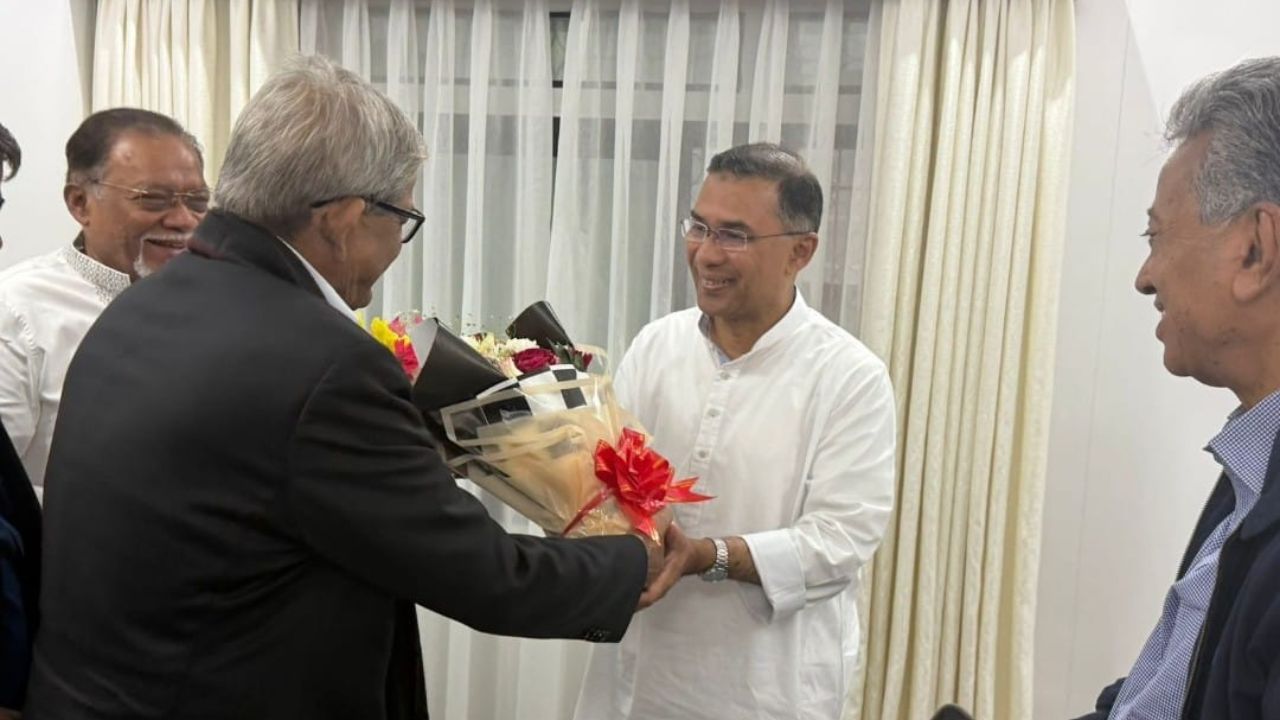



BNP Secretary General Mirza Fakhrul Islam Alamgir greeted party Chairman Tarique Rahman with a floral bouquet following the party’s decisive victory in the 13th parliamentary election. BNP secured a two-thirds majority, winning 209 out of 299 seats.
The greeting took place at the party’s Gulshan office upon Mirza Fakhrul’s return to Dhaka from his constituency in Thakurgaon on Friday afternoon. He travelled directly from the airport to the office to congratulate the Chairman.
Present at the occasion were BNP Standing Committee members Amir Khosru Mahmud Chowdhury and Salahuddin Ahmed, as well as Ismail Zabiullah, a member of the Chairperson’s Advisory Council.
Challenges for the next government
Speaking to journalists outside the internal terminal of Hazrat Shahjalal International Airport, the Secretary General outlined the critical hurdles facing the incoming administration.

He stated that revitalising the economy, curbing corruption, and maintaining law and order would be the primary challenges.
“The biggest challenges for the next government are to make the economy functional, keep the law and order situation under control, curb corruption, and establish justice – these are the challenges,” he remarked.



He further confirmed that the BNP would form the next government under the leadership of Tarique Rahman.
A ‘joyous yet sorrowful’ victory
Reflecting on the election results, Mirza Fakhrul described his emotions as a mix of “joy and sorrow”. He expressed deep regret that the party’s late Chairperson, Begum Khaleda Zia, could not witness this unprecedented victory.
He credited the “transparent and festive” election to the mass uprising of students and the public, which involved significant sacrifice.
“I am personally definitely overwhelmed… impressed,” he said, adding that maintaining this momentum is essential to preserving the continuity of democracy.
When questioned about the future of the Awami League, which did not participate in the election, the secretary general noted that the Election Commission had already decided to ban the party’s activities.
He indicated that subsequent decisions regarding the party would emerge from the evolving political context.