In the lead-up to Bangladesh’s February 12, national elections, accompanied by a constitutional referendum and following the 2024 uprising that ousted a long-standing government, debate has intensified regarding the potential for a hung parliament. The interim government led by Yunus has scheduled the polls, yet concerns about the electoral process persist. Critics argue that restrictions on party participation and questions about electoral neutrality undermine inclusivity and legitimacy. Warnings from domestic media and political circles indicate that these tensions, along with suspicions of international involvement, may fragment the vote, complicating governance. These discussions highlight broader anxieties about electoral fairness, political polarisation, and the dynamics shaping post-uprising politics in Bangladesh.
Alongside concerns about electoral fairness, analysts, politicians, businessmen, journalists, and some academics have discussed the possibility that the political dynamics engineered by the interim government, with support from stakeholders, could result in a hung parliament after the February 12 elections. They argue that this endeavour is intended to influence Bangladesh’s governance trajectory in ways that may align more closely with international partners’ expectations than with a fully competitive domestic mandate. This narrative, which once circulated mainly as rumour on social and political forums, has gained traction because it reflects educated assessments of unfolding political behaviour rather than concrete evidence of a deliberate plan, and senior political figures themselves dispute both the premise and motivations behind it.
Political analysts and media observers note that in Bangladesh rumours and unverified narratives frequently gain traction and, in some instances, later align with real developments, which fuels a tendency among the public and commentators to take speculative claims seriously rather than dismiss them outright. Such rumours often have sociopolitical motivations, emotional appeal, or vested interests behind them; thus, serious analysis should explore and assess them, not accept them uncritically, nor ignore their potential impact on political discourse and decision-making.
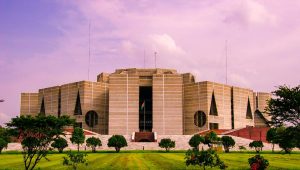
Bangladesh’s parliamentary system has struggled to serve as an effective venue for democratic governance, as major political parties have often boycotted Parliament since the 1990s and have resorted to street confrontations to challenge the government over its participation in legislative debate. This has weakened the legislature’s functions and contributed to dysfunction in the political system. The issue worsens when one party secures an absolute majority, allowing it to control legislative outcomes. Such overwhelming majorities undermine institutional checks and lead to constitutional changes with minimal consensus, weakening parliament and increasing political polarisation. Historical patterns indicate that both external pressures and a single party’s dominance have made the Jatiya Sangsad less effective for inclusive democratic governance.

A hung parliament can destabilise governance in a developing country, as no single party holds a majority, often leading to fragile coalitions and extended negotiations. This lack of clarity can lead to frequent leadership changes, diminishing citizens’ trust in democratic institutions, and creating policy uncertainty. Such instability can disrupt economic decision-making, as markets react negatively to unpredictability and investors hesitate due to perceived risks. Additionally, hung parliaments often face legislative gridlock, further eroding public confidence and weakening the state’s ability to tackle social and economic challenges.
In assessing Bangladesh’s political trajectory, it is important to recognise that neither an overwhelming absolute majority nor a hung parliament is inherently conducive to democratic consolidation, especially in an environment where political engagement has once again been shaped more by agitation and confrontation than by sustained dialogue. Bangladesh’s political culture, marked by episodes of mass unrest once, to censorship and authoritarianism in the near past, has now evolved to public grievances expressed in ways that have sometimes escalated into deplorable mob violence rather than deliberative political exchange.


In such a context, a hung parliament, if it genuinely reflects the electorate’s will through enfranchised voting, should be approached with a spirit of resilience and a commitment to dialogue, compromise, and coalition speaking and decision-making rather than polarisation. Effective governance in a hung parliament will demand that political actors learn to negotiate, build consensus, and use Parliament itself as the principal arena for resolving differences if democratic institutions are to be strengthened rather than further weakened. However, the inherent concern among all is whether our politicians have really achieved that level of resilience, tolerance, and maturity.
Political analysts sometimes draw comparative lessons from South Asia, where fragmented parliaments and elite-managed electoral outcomes have, in some cases, been seen as mechanisms for constraining political sovereignty. The 2018 general election in Pakistan produced an assembly in which no party could immediately command a stable majority without coalition partners.
That 2018 parliament later became the starting point for a no-confidence motion that removed the most popular leader and PM, Imran Khan, in 2022, an event that sparked deep political debate in Pakistan about the role of security institutions, coalition politics, and external diplomatic pressures in shaping governance outcomes. Analysts and commentators argue that the instability of a fragmented assembly made the government more vulnerable to elite negotiations and shifting alliances, contributing to Khan’s removal through parliamentary maneuvering and subsequent political volatility. There are credible allegations of direct foreign involvement, primarily diplomatic pressure from the United States. Such claims illustrate how contested electoral outcomes and engineered parliamentary fragmentation can become focal points for broader questions about sovereignty and national decision-making. For instance, Sri Lanka’s 2018 constitutional crisis similarly showed how rapid shifts in parliamentary majorities and executive interventions under stress weakened democratic norms and disrupted governance.
The growing interest in fragmented parliaments and engineered coalitions reflects how both domestic and external interests shape political decisions. Political stakeholders and citizens in Bangladesh must engage actively in democratic processes that emphasise transparency and integrity. This collective effort can help shift the political landscape toward constructive governance that honours the people’s will and enhances democratic resilience.
When a parliament lacks a clear mandate and is perceived as being shaped by forces beyond the electorate’s control, a country’s political agency can be seriously compromised. In such environments, dominant interests are better positioned to exploit instability to steer policy choices, restrain independent leadership, or align political outcomes with external strategic preferences rather than popular priorities. Some observers argue that this is precisely the direction in which Bangladesh’s politics is being manufactured, often framed as a test case. Yet if this assessment holds, it is less an experiment than a beta testing of an approach whose core outcomes were already witnessed in Pakistan, where parliamentary fragility became a critical vulnerability rather than a democratic safeguard.
Bangladesh faces a troubling paradox in its parliamentary outcomes, where both a landslide majority and a hung parliament threaten to undermine a democratic culture. A substantial majority can reduce Parliament to a mere rubber stamp, sidelining opposition voices and pushing political conflict to the streets. Conversely, a hung parliament, perceived as engineered rather than organically elected, risks instability and undue foreign influence. In a context of agitation, institutional fragility, and mistrust, either scenario weakens Parliament’s role in democratic negotiation. Analysts worry that fragmented or overly dominant parliamentary settings may compromise Bangladesh’s political sovereignty, enabling external actors to shape domestic decisions. If parliamentary dynamics cater to interests beyond the electorate, the consequences will be ineffective governance and the erosion of Bangladesh’s ability to determine its political future.
The writer is a political and international affairs analyst