Ayatollah Ali Khamenei, Iran’s supreme leader from 1989 until his death on February 28, 2026, was killed in strikes that Iranian state media and international news organisations attributed to the United States and Israel. Born April 19, 1939; He was 86.
For nearly four decades, Khamenei sat at the apex of the Islamic Republic’s hybrid system — a republic with elections and institutions, overseen by an unelected clerical office with final authority over the armed forces, the judiciary, state broadcasting and the broad direction of foreign policy.
Supporters saw him as the custodian of a revolution born in defiance, the leader who resisted American and Israeli power and pushed Iran’s security outward through allied forces.
Critics saw something harsher: a more securitised state on his watch, tighter political competition, repeated crackdowns on dissent, and a foreign posture that deepened isolation while ordinary Iranians carried the economic weight.
The struggle with Washington — and, increasingly, with Israel — was not a side plot of his rule. It was the backdrop of how he governed. In his telling, the United States never abandoned regime change, and Israel stood as the forward edge of that threat. Iran could push back, he argued, or be pushed over.
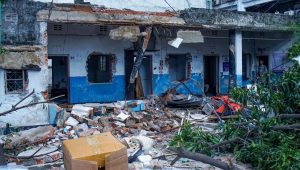
By the time Iranian state media confirmed his death, the story had already been written in the air: blasts over Tehran, a widening target list, and a sense that the old shadow war had snapped into something more direct.
Reuters and other outlets reported that the U.S.-Israeli strikes hit multiple sites tied to Iran’s military-security leadership and nuclear infrastructure, including the compound associated with the supreme leader.
Within hours, Iran launched retaliatory attacks at Israeli targets and U.S. bases across the Middle East — and the region slipped into the kind of escalation Khamenei had long claimed to be preparing for
To understand how long he lasted, it helps to look at the office he inherited — and the way the system adjusted around him. Iran’s first supreme leader, Ayatollah Ruhollah Khomeini, led the revolutionary state from 1979 until his death in 1989, steering it through the consolidation of clerical rule, fierce factional conflict, the rupture with the United States and, above all, the eight-year Iran-Iraq war. The war militarised the young republic and elevated the Revolutionary Guard from revolutionary force to pillar of the state.

The late 1980s brought a succession fight that shaped Iran for a generation. Grand Ayatollah Hossein Ali Montazeri, once designated as Khomeini’s heir, broke with the leadership after condemning repression, including the 1988 mass executions of political prisoners — killings rights groups have described as crimes against humanity. He was removed as successor in March 1989, clearing the path for a leader outside the traditional top clerical ranks.
After Khomeini’s death, Khamenei was elevated — and, crucially, the constitution was revised that summer. The 1989 amendments abolished the post of prime minister and removed the requirement that the supreme leader be a marja (a top-ranking clerical authority). In effect, it lowered the clerical threshold while entrenching the office at the system’s summit.
From Mashhad cleric to national figure
Born on April 19, 1939, in Mashhad, Iran’s holy north-eastern city, Ali Khamenei was the second of eight children in a clerical household led by Khadijeh Mirdamadi and her husband, Javad Khamenei, an Islamic scholar. He later described a childhood lived tightly — sometimes dependent on others’ help, with meals as spare as bread and a few raisins.
He trained as a Shia cleric and became active against the shah, enduring imprisonment before the 1979 revolution. He rose quickly in the new order and survived a 1981 assassination attempt that left him with lasting injuries — an episode that entered the republic’s political memory and reinforced his belief that the revolution lived under permanent threat.
After the assassination of President Mohammad Ali Rajai, Khamenei became president, serving from October 1981 until August 1989 — years dominated by the Iran-Iraq war and the consolidation of revolutionary institutions. As the Revolutionary Guard expanded in influence and capability, he learned the system’s practical lesson: balance factions at home, show resolve abroad, and never appear uncertain.



The architecture of control
Selected as supreme leader on June 4, 1989, Khamenei was initially seen by some observers as an unlikely choice, lacking the senior clerical stature of older grand ayatollahs. He did not govern like an interim. Over time he expanded the reach of his office, placed loyalists across security and judicial institutions, and relied on the Revolutionary Guard as both shield and instrument — domestically and across the region.
This became less about charisma than about method. Elections continued, but the field of competition tightened. The Guardian Council’s vetting became the gate through which candidates passed — or were turned away. The judiciary and intelligence services enforced the edges. State broadcasting set the tone nightly; the pulpit echoed the message weekly. Presidents came and went. The centre stayed put.
Khamenei did not rely on coercion alone. He fused religious authority with a security-first state, using sermons, state media and the language of resistance to present discipline at home as the price of sovereignty abroad.
Those tensions sharpened during the presidency of Mohammad Khatami, a mid-ranking cleric and former culture minister who served from 1997 to 2005 after a landslide election that channelled popular demands for political and social opening. Khatami spoke the language of the “rule of law,” civil society and measured détente with the West, and for a time Iran’s public sphere felt more alive — in universities, newspapers, and the sense that the country might be permitted to breathe.
But much of his agenda ran into unelected power centres aligned with the supreme leader. The period was marked by the crushing of the 1999 student protests and, by the early 2000s, a conservative pushback — including closures of reformist newspapers and tighter candidate vetting — that narrowed the space Khatami had helped open. The reform project was contained; the supreme leader’s office endured as the state’s decisive seat of authority.
Mahmoud Ahmadinejad’s presidency (2005–2013) marked a sharp turn from reformist language to abrasive populism at home and confrontation abroad. A former Revolutionary Guard member and Tehran mayor who styled himself as an outsider, Ahmadinejad championed redistributive promises and religious-nationalist rhetoric while projecting defiance on the international stage. Under his watch, Iran’s nuclear dispute intensified, diplomatic isolation deepened, and sanctions pressure tightened.
The relationship between Ahmadinejad and Khamenei was first read as complementary — and then it grew volatile. The disputed 2009 election and the mass protests that followed became a defining rupture of Khamenei’s middle years: the state moved to crush the Green movement, and Khamenei publicly backed the outcome, treating dissent as a threat not merely to a government but to the system itself.
During Hassan Rouhani’s presidency (2013–2021), a centrist cleric and former security official who campaigned on sanctions relief and engagement, Khamenei permitted a cautious diplomatic opening that culminated in the 2015 nuclear agreement. He allowed negotiations, but kept warning against Western influence. When the United States withdrew from the deal in 2018, the promised economic gains evaporated, hardliners were strengthened, and Rouhani’s room at home shrank.
If the nuclear file was one pillar of Khamenei’s foreign policy, the other was a security doctrine built beyond Iran’s borders — often personified by Gen. Qasem Soleimani, the long-time commander of the Revolutionary Guard’s Quds Force. Soleimani became a symbol of Iran’s regional reach, coordinating relationships with allied groups and sustaining partners from Lebanon to Iraq and Syria — deterrence, supporters said; destabilisation, critics argued. His killing by the United States in Baghdad in January 2020 shocked the system and underscored how tightly Iran’s posture had become tied to escalation and retaliation.
By the time Ebrahim Raisi, a hardline cleric closely associated with Iran’s judiciary, became president in 2021, the political arena had tightened further, with reformists marginalised and the system increasingly dominated by security-aligned conservatives. Raisi was widely seen as close to Khamenei’s preferred power centres — and, for some, as a possible successor — until he was killed in a helicopter crash in May 2024. In the election that followed, Masoud Pezeshkian, a relative moderate, won the presidency — a reminder that even within narrowed space, Iranian society kept testing the edges of what was permitted.
Cycles of dissent
Khamenei’s long tenure was punctuated by moments when the street posed the most serious challenge: the 1999 student protests, the 2009 Green movement, and the 2022–23 “Woman, Life, Freedom” uprising after Mahsa Jina Amini died in custody. Each exposed widening fractures between the state and large parts of society — particularly younger Iranians and women demanding change.
Economic anger repeatedly spilled into revolt as well. In November 2019, nationwide protests erupted after fuel price rises — another reminder that daily hardship and political constraint had become tangled together. Over time, the cost of endurance became harder to hide: sanctions, corruption and policy shocks hollowed out savings, weakened paycheques, and turned daily life into a chain of calculations — rent, medicine, food — until politics arrived first as a price tag.
Khamenei read the modern world through a single, stubborn lens: that the West was always, in one form or another, trying to unmake the Islamic Republic — through economic pressure, domestic unrest and, if needed, force. That belief shaped his reflexes. Compromise looked risky. Dissent looked suspicious. Openness looked like a door left ajar.
His health, in later years, became a secondary national drama. In 2014, Iranian state media reported that he underwent a prostate operation. Rumours of serious illness — even death — would flare whenever his public schedule thinned, then fade when he reappeared. But the deeper threat to the system was not the biology of one man; it was the growing distance between the state’s claims to moral authority and the lived reality of millions.
That distance cracked open after Amini’s death in September 2022. Protests spread across the country, and the crackdown drew international condemnation. A U.N.-mandated fact-finding mission later reported serious violations during the repression, including conduct it said may amount to crimes against humanity.
Foreign policy and domestic strain
Internationally, Khamenei’s organising principle was resistance: Iran’s security, he argued, depended on deterring the United States and Israel and keeping threats away from Iran’s borders. Under his leadership, Iran strengthened ties with regional allies and partners, deepening its leverage while binding itself into proxy wars and retaliatory spirals that repeatedly threatened wider conflict.
With Israel, the conflict moved from covert blows and shadow wars toward more direct escalation, each side testing red lines and absorbing retaliation. The risk, in Khamenei’s final years, was that deterrence stopped being a doctrine and became a fuse.
The nuclear dispute became the defining confrontation of his era: negotiation and brinkmanship, partial relief and renewed pressure. Khamenei permitted — and at points cautiously backed — diplomacy that produced the 2015 deal, then watched the bargain collapse after the U.S. withdrawal in 2018, feeding a new cycle of sanctions pressure and nuclear escalation.
In his final years, he also worked to widen Iran’s diplomatic options: restoring ties with Saudi Arabia in a China-brokered agreement, and pushing deeper into non-Western groupings as a hedge against isolation — including joining the Shanghai Cooperation Organisation and the expanded BRICS bloc.
The succession he tried to control
Khamenei’s death did not only remove a leader; it removed the hinge through which the system’s factions were balanced. Under Iran’s constitution, the next supreme leader is chosen by the Assembly of Experts, a clerical body that meets behind closed doors when succession is at hand. In practice, the outcome is shaped by the same forces Khamenei spent decades cultivating and coordinating: security networks, clerical alliances, and the gatekeepers who police the boundaries of politics.
The question, then, is not merely who comes next, but whether the state he centralised can manage a transfer of authority without the man who made himself synonymous with continuity — and whether any successor can command the same mix of coercion, religious legitimacy and institutional loyalty that kept the system intact through wars, sanctions and repeated waves of unrest.
In 1981, Khamenei survived an assassination attempt that paralysed his right hand. He later remarked that he did not need the hand — only that his mind and voice continue to work. In the end, it was the voice, more than any formal office, that defined his era: a steady insistence on resistance, a deep suspicion of opening, and a belief that survival required control. What Iran does with the space he leaves behind — whether it tightens further or finally exhales — will be the measure of what his long rule ultimately built, and what it foreclosed.
The writer is a journalist.