After delivering nearly 18 per cent return in turbulent 2025, significantly contributed by bond investment and stock trading, Investit Asset Management Managing Director and CEO Mohammad Emran Hasan is positioning for a far more aggressive 2026.
He is planning to allocate 80 to 90 per cent of fresh funds to equities as political certainty improves and interest rates trend downward.
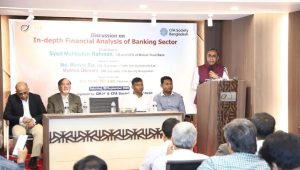
Speaking at TIMES of Bangladesh’s weekly market show FINPULSE, the asset manager said the nearly 18 per cent gain came in a year when most average investors suffered significant losses amid political uncertainty, elevated interest rates, foreign investor net selling and a prolonged market downtrend.
Launched in late February 2025, Investit Growth Fund adopted a defensive framework from the outset.
At the time, treasury bond yields were above 12 per cent, and Mohammad Emran Hasan allocated close to the regulatory ceiling in government securities, creating a high-yield stability cushion while maintaining the mandatory exposure to listed equities.
That allocation not only generated income but also helped produce capital gains as rates began to soften, preventing a sharp decline in net asset value during equity market corrections.

On equities, he initially focused on defensive names such as Berger and Marico — companies with relatively stable earnings, dividend consistency and lower retail-driven volatility — to limit downside risk.
Capital protection, he said, was the foundation of the strategy.
He pointed out that a 50 per cent loss requires a 100 per cent gain to recover, making loss minimisation mathematically more important than pursuing aggressive return spikes.




Alongside core positions, the fund deployed around 20 per cent tactically into mid-tier, liquid stocks during interim rallies. These were neither junk nor speculative counters, but companies with acceptable fundamentals and liquidity. Positions were exited when correction risks emerged.
He also raised exposure to banking stocks ahead of the earnings season, anticipating improved profitability following provisioning clean-ups and stronger balance sheets.
Looking ahead to 2026, Emran Hasan said political certainty following the national election has removed a major overhang that had constrained market confidence for nearly two years.
Interest rates, which peaked above 12 per cent in 2025 and in some tenors approached 13 per cent, are now on a downward trajectory, though he does not expect a dramatic or abrupt fall.
If managing a fresh Tk100 crore fund today, he said 80 to 90 per cent would go into equities, compared with last year’s significantly higher allocation to fixed income when yields were elevated and market trends were weak. The remaining 10 to 15 per cent would be kept as liquidity or tactical buffer.
He described market corrections as healthy within an upward-trending environment, arguing that equities move in zigzag patterns rather than straight lines, and volatility itself creates return opportunities.
Sectorally, he remains constructive on banking in the near term, especially around dividend and earnings announcements, while cautioning that not all banks offer equal upside after recent rallies.
He expects profit rotation from banks into pharmaceuticals, information technology and infrastructure-linked sectors such as cement and steel if economic activity strengthens.
He also sees opportunity in select mid-cap stocks trading at relatively low price-to-earnings multiples, offering reasonable dividend yields and limited downside relative to valuation, provided entry prices remain disciplined.
Beyond sector calls, Emran Hasan pointed to liquidity dynamics as a potential driver. If interest rates decline and retail participation expands, surplus liquidity could fuel a stronger rally. However, he warned that liquidity-driven surges can distort valuations.
He acknowledged geopolitical risks, particularly through oil prices and shipping costs, but said their impact would become significant only if conflicts escalate and disrupt trade flows materially.
While not ruling out a strong rally, he cautioned that buying quality companies at inflated prices can trap investors for years, citing past market cycles where peak valuations took long periods to recover.
“Return is important, but risk control determines survival,” Emran Hasan said, emphasising that disciplined allocation, tactical flexibility, valuation awareness and strict downside management will define performance in 2026.