The appointment of returning officers—arguably the most influential officials in election field administration—has once again emerged as a politically charged issue ahead of the 13th parliamentary polls.
Returning officers oversee every critical phase of the electoral process, from scrutiny of nomination papers to symbol allocation and supervision of polling and counting. For decades, deputy commissioners (DCs) have traditionally held these posts, a practice that has repeatedly drawn allegations of partisanship from opposition parties.
This year, the debate has returned with renewed intensity. BNP, Bangladesh Jamaat-e-Islami, National Citizen Party (NCP) and several other political groups have demanded that officials from the Election Commission (EC) itself be appointed as returning officers, arguing that reliance on DCs—who are part of the executive branch—compromises neutrality.
Representatives of civil society echoed similar concerns during recent consultations with EC, while the Election Reform Commission also recommended giving priority to EC officials.
Yet, despite these calls, EC appears inclined to retain the traditional model centred on DCs. However, in a notable departure from earlier rigidity, the commission now says it is considering appointing its own officials in a limited number of constituencies.
Election Commissioner Abdur Rahmanel Masud told TIMES of Bangladesh that EC officials may be assigned to “five to six” constituencies, describing the move as an initial step toward broader reform.

If implemented, this will mark the first time that EC officials are appointed as returning officers in a national election. Previously, they have served as returning officers only in by-elections. In local government polls, however, EC officials routinely perform the role of returning officer.
The pressure within the commission has also become increasingly visible. On 6 December, the Upazila Election Officers Association publicly demanded that EC officials be appointed both as returning officers and assistant returning officers in all 300 constituencies, emphasising that two assistant returning officers should be placed in each metropolitan seat to ensure accountability and professional oversight.
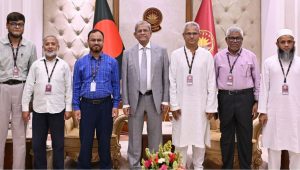
Just two days later, the Bangladesh Administrative Service Association (BASA)—which represents civil servants of the country—met Chief Election Commissioner (CEC) AMM Nasir Uddin.
A five-member delegation led by Kaniz Moula, treasurer of BASA and secretary of the Bangladesh Parliament Secretariat, conveyed what they described as the readiness of field administration officials to conduct the upcoming election.



Moula told TIMES that they did not discuss returning officer appointments, adding that such decisions lie solely with EC. The delegation, however, made no public statement after the meeting, prompting speculation about tensions between administrative and EC cadres.
Responding to questions about the BASA delegation’s visit, EC Senior Secretary Akhtar Ahmed told reporters that there was “no legal impediment” to such meetings, adding that offering cooperation was within the association’s rights.
When asked whether administrative officials needed to reassure EC of their willingness to perform duties that are already obligatory under law, he replied that “there is no harm if someone expresses eagerness to contribute positively.”
Shortly afterward, leaders of Bangladesh Election Commission Officers’ Association also met the CEC to push for the appointment of EC cadre officials as returning officers.
The association’s convener and EC Deputy Secretary Mohammad Monir Hossain said they highlighted the commission’s internal capacity, pointing out that “95 percent of election-related work is carried out by EC officials.”
According to him, the CEC assured the delegation that the matter would be discussed in the full Commission meeting before final decisions are taken.
Inside EC, the debate has reportedly become sharper. Several senior officials insist that the commission has more than enough experienced officers capable of running national polls.
They argue that EC staff routinely manage local government elections—often more complex due to the sheer number of candidates and polling centres. They also note that even when DCs serve as returning officers, the operational workload largely falls on EC personnel.
Officials also say that 19 districts have more than five parliamentary constituencies. Among them, Dhaka has 20, Chattogram 16, Mymensingh and Cumilla 11 each, Tangail 8, and Bogura 7 constituencies. In addition, Khulna, Kishoreganj, Sylhet, Gazipur, Noakhali, Brahmanbaria, Dinajpur, Rangpur, Naogaon, Rajshahi, Jashore, Barishal and Sirajganj each have 6 constituencies.
Those who have been appointed as DCs this time do not have experience working in the field. In that case, it may be difficult for them to manage districts with a large number of constituencies. If EC’s own officials were made returning officers in these constituencies, implementing the election would have been easier.
These officials allege that two election commissioners—Anwarul Islam Sarkar and Abdur Rahmanel Masud—have opposed broader deployment of EC cadre officers, claiming they lack sufficient “situational readiness” for such a politically sensitive role.
Some believe that pressure from the administrative cadre is shaping the conversation, as representatives from Bangladesh Administrative Service Association also visited the CEC earlier, possibly raising concerns over preserving the traditional role of DCs.
Despite the internal disagreements, the commission appears to be inching toward a compromise. Commissioner Masud confirmed that no final decision has been taken but indicated that deploying EC officers in a handful of constituencies is under active consideration, calling it “the beginning of a process.”
Commissioner Sarker, in earlier comments to TIMES, defended the preference for DCs, citing their inherent administrative authority, district-level coordination power and established command over local stakeholders.
He also highlighted their training background, contrasting it with what he described as the limited preparatory exposure of EC officials. Once the newly formed Election Commission Service is fully structured as a formal cadre, he suggested, election officials would be better positioned to assume returning officer duties nationwide.
For now, EC seems to be balancing long-standing political demands, institutional pressures and practical administrative considerations. Whether the tentative inclusion of a few EC officers will satisfy critics—or merely intensify calls for deeper electoral reform—remains to be seen as the country approaches another national vote.