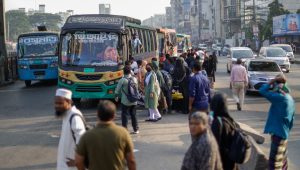




The pavements of Dhaka have never truly become pedestrian-friendly, a failure attributed to the persistent negligence of city authorities and a pervasive lack of public awareness.
Far from improving, the situation is deteriorating daily to the point where pedestrians – the very people for whom these paths were constructed – find themselves in the most precarious position.
Dhaka’s footpaths are currently a chaotic tapestry of obstacles: hawkers, shop extensions, car repair activities, and unauthorised parking. The intrusion of motorbikes remains a primary source of distress, while many cyclists appear oblivious to the fact that they are not supposed to use these walkways.
In a controversial move, city authorities have even sought to formalise this occupation by introducing a system to lease out sidewalk space, a decision that has drawn the scrutiny of the High Court, which has demanded an explanation from the relevant bodies.
Moreover, a decade-old police mandate to prevent motorbikes from using sidewalks has seemingly been forgotten.
Growing crisis of pedestrians
According to data from the Dhaka Transport Coordination Authority (DTCA), walking accounted for approximately 19 to 20 per cent of daily trips in the capital in 2009. This figure has since surged to 38.8 per cent, indicating that nearly double the number of people who are now walking compared to previous years.
Despite this increase, the infrastructure remains woefully inadequate. The DTCA’s draft ‘STP 2025’ report reveals that Dhaka possesses roughly 1,840 kilometres of sidewalks. However, only 33 per cent of these are at least two metres wide.
Out of 163 major sidewalks, at least 108 kilometres are under illegal occupation.

The consequences are lethal; approximately 73 per cent of those killed or injured in road accidents in the capital are pedestrians, a statistic largely driven by the fact that they are forced off the occupied footpaths and onto the dangerous main roads.
Vested interests and the ‘syndicate’
Urban planner Adil Muhammad Khan told TIMES of Bangladesh that the occupation is sustained by a powerful syndicate. “There is a cycle involving political party leaders, a section of the law enforcement agencies, and the administration,” he noted.
“This cycle controls a significant portion of the money generated from sidewalk businesses.” Khan argued that a permanent solution is impossible if the authorities merely evict hawkers without taking decisive action against these organised interest groups.
The frustration amongst the public is palpable. Redwanul Karim Rikkon, after dropping at the Shahbagh Metro Station, was forced to step onto the main road near BARDEM Hospital because the path was completely blocked by fruit sellers and various vendors.
Promi Akter, a student at the University of Dhaka, expressed her irritation at the persistent chaos, while Kamal Hossain, visiting a hospital, remarked that there is simply no space for the sick to walk safely.



This grim reality is replicated across nearly every vital area of the capital, including Mirpur, Gulistan, Farmgate, New Market, Karwan Bazar, Mohakhali, Malibagh, and Motijheel. In some areas, the paths are further obstructed by piles of construction materials or the long-term presence of vagrants and beggars.
Shafin Ahmed, a resident of Lakshmibazar, noted that pedestrians are forced to take risks on the road, which simultaneously exacerbates the city’s chronic traffic congestion. Abu Tayemur of Mohakhali added that the situation is so dire that even the roads are occupied, making it impossible to walk or take a vehicle.
Open markets and sidewalk workshops
In areas like the stretch from the opposite side of Dhaka College through Nurjahan Market to the Hawkers Market, the sidewalks have been transformed into a massive open-air bazaar selling plastic goods, kitchenware, clothes, toys, and food.
The situation is equally hazardous between Banglamotor and Moghbazar, where long stretches of the sidewalk and roadside are used for vehicle repairs. Pedestrians must navigate through scattered engine parts, bodies being painted, and rows of cars awaiting service.
The ground is often slick with oil and grease, making walking not only difficult but dangerous.
Failure to curb motorbikes
The safety of pedestrians is further endangered by motorcyclists who take to the footpaths to bypass traffic signals. Saeda Begum, walking in Banglamotor, recounted how she frequently has to move aside for hooting bikers.
“They drive onto the sidewalk to get ahead whenever there is a jam,” she told TIMES.
Despite a 2012 High Court order directing police to take immediate punitive action against those driving motorbikes on sidewalks, enforcement has been non-existent.
While a traffic police officer at Farmgate claimed they regularly take action, he admitted it has not been effective. Saeda Begum noted that when pedestrians do protest, motorcyclists often respond aggressively.
Economics of occupation
The occupation is not merely a matter of convenience for hawkers; it is a livelihood and a source of illegal revenue. In commercial hubs like Gulshan, Badda, and Motijheel, sidewalks are used as temporary parking for sedan cars, vans, and bikes.
Hawkers like Nasir Hossain in Lakshmibazar and Sabuj Ali in New Market argue they have no alternative. “We run our families through these small shops,” Nasir said, calling for the government to provide designated business zones.
A fruit seller at Shahbagh echoed this, stating that while the public may be annoyed, they must occupy the space to “survive with their families.”
However, this trade comes at a cost; traders must pay daily fees ranging from Tk 100 to Tk 1,200, depending on the location. These sums are collected under various guises, such as “electricity bills” or “association fees,” by local influentials and political activists.
Hawker organisations estimate there are currently 250,000 such traders across the capital.
Fruitless eviction drives
Though the city sees periodic eviction drives – such as the coordinated police effort from 1 to 5 April – the relief is always temporary. Within two to three days, the hawkers typically return to areas like Gulistan, Dholaikhal, Kalabagan, Paltan, Motijheel, and New Market.
Dhaka North City Corporation (DNCC) claims to have conducted 351 operations in the past year, clearing 166 kilometres of sidewalk.
Meanwhile, Dhaka South City Corporation (DSCC)’s attempt to rent out sidewalks to hawkers was met with a High Court rule on 19 May, following a writ petition by Advocate Md Shoebuzzaman.
The petition argued that using sidewalks for business is unconstitutional as it conflicts with the public’s constitutionally recognised right to free movement.
DNCC Public Relations Officer Md Jobayer Hossain told TIMES that they intend to discuss the matter with political leaders and stakeholders to prioritise the selection of specific sites for rehabilitation and relocation.
Similarly, DSCC Public Relations Officer Md Russel Rahman admitted that old methods have failed and the corporation is now considering new approaches that must include rehabilitation.