


The government will arrange special court facilities to address all types of problems faced by expatriate Bangladeshi workers, including harassment and suffering, Law Minister Md Asaduzzaman announced on Tuesday.
He said the government will also provide necessary guidance and assistance to workers abroad facing documentation issues to help them regularise their status through coordinated efforts.
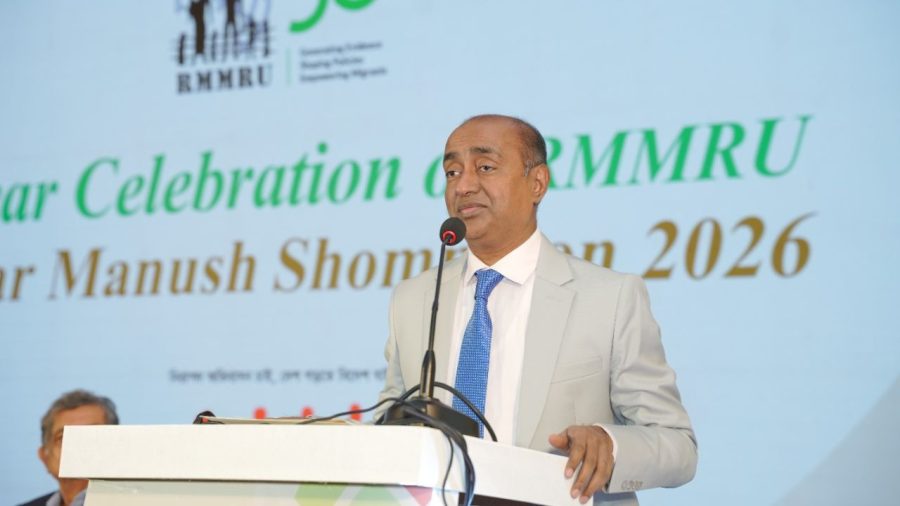
Asaduzzaman made these remarks at the opening session of a two-day conference titled “Shonar Manush Shommilon 2026″ at a hotel in the capital.
The conference was organised by the Refugee and Migratory Movements Research Unit (RMMRU) to mark its 30th anniversary of working on forced and voluntary migration as well as climate change-induced displacement.
Plight and rights of migrant workers
Highlighting the harsh reality of migrant workers, Asaduzzaman stressed that ensuring the rights, safety, and future of migrant workers is essential, as many are forced to endure inhumane physical labour abroad.

Recounting his experience from a recent visit to Dubai, he described the living conditions of workers there as extremely painful, citing a worker who shared that they must stand in long queues even to use the bathroom in the morning, wait for a long time before starting work, and manage cooking and family interactions after a full day of arduous work.
Asaduzzaman noted that despite their hard physical labour, migrant workers often receive limited living facilities and amenities.
He emphasized that the government’s responsibility does not end with merely securing overseas employment; ensuring a dignified life, proper living standards, working environment, safety, legal assistance, and proper guidance is equally critical.




Pillar of national economy
Underscoring the economic contribution of expatriates, Asaduzzaman described migrant workers as one of the key pillars of Bangladesh’s economic progress.
He noted that while foreign currency earnings through ready-made garments, agriculture, and goods exports are widely discussed, the vital role of expatriate workers as a primary driving force of the national economy must be properly recognized.
He added that remittances sent by migrants play a crucial role in advancing the economy, noting that opportunities for skilled and talented Bangladeshi manpower abroad are expanding over time.
Asaduzzaman called upon the government, relevant authorities, institutions, and society to take responsible, coordinated, and realistic steps to support migrant workers facing legal complexities or documentation challenges abroad.
While acknowledging that all problems may not be resolved simultaneously, he expressed the government’s sincere commitment to protecting migrants’ rights and taking effective initiatives so that Bangladeshi workers can work safely, with dignity, and receive fair remuneration for their labour.
Commemorating RMMRU’s 30-year journey
Reflecting on RMMRU’s three-decade journey, the minister remarked that the organisation has consistently played a vital role in protecting the rights, safety, and future of Bangladeshi migrants since its inception.
Over the past three decades, RMMRU has conducted over 100 research studies, contributed to formulating 13 national policies and strategies, and delivered rights-based services to migrants in 21 districts across Bangladesh.
The conference aims to share experiences from these efforts, exchange new knowledge on migration, and set future policy priorities.
President Mirza Fakhrul Islam Alamgir is scheduled to attend the closing day of the conference as a guest.
Earlier, the conference opened with welcome remarks delivered by the event moderators, RMMRU Associate Executive Director Motasim Billah and Director (Programme) Marina Sultana.
The event was attended by civil society representatives, academics, researchers, cultural activists, national and international development organisations, media development organisation Somosti, and media representatives.