
Election Commission (EC) Secretary Akhtar Ahmed has insisted that a level playing field exists in the run-up to the 13th parliamentary elections, despite incidents and counter-claims emerging across the country during the first five days of campaigning.
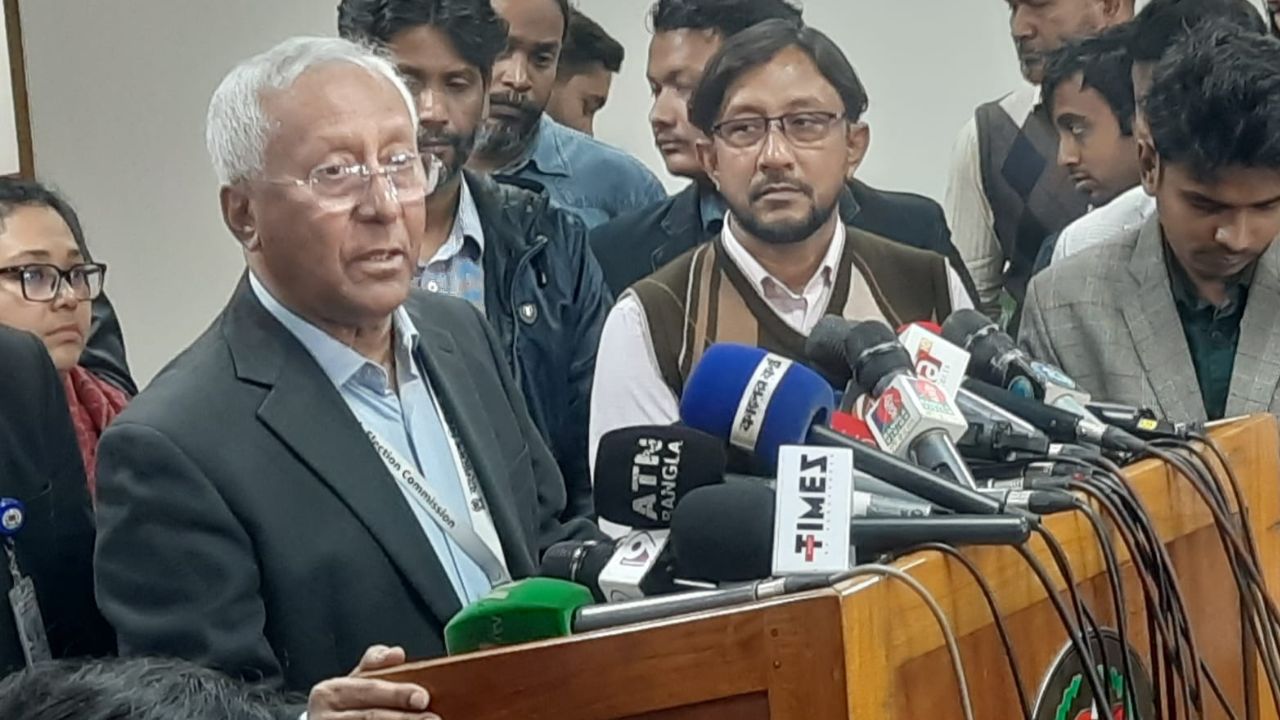
Speaking to reporters at a press briefing at the election commission on Monday, Akhtar Ahmed said, “A level playing field definitely exists. The very fact that complaints are being made proves it. If it did not exist, would anyone even complain?” He advised stakeholders not to approach the commission directly but to submit any complaints to the Electoral Inquiry and Adjudication Committee for proper follow-up.
“Inform the Electoral Inquiry and Adjudication Committee and provide us a copy. I will follow it. But if you go around inspecting on your own, that would be a miscarriage of justice towards me,” he added.
Akhtar Ahmed also briefed diplomats on Sunday regarding the parliamentary elections and the upcoming referendum. A total of 41 diplomats, including ambassadors and mission chiefs, attended the session, alongside government officials and representatives from the Chief Adviser’s office.

“They mainly wanted to understand how our election system works. Their curiosity focused on security arrangements, command structure, and how long it will take to announce results,” he said.
The EC secretary provided specific details on security deployment, including police, army, air force, navy, RAB, and Ansar personnel. He added that 25,000–30,000 body-worn cameras will be deployed at polling centres to ensure transparency.


He explained that seat-wise results will generally be declared within three to four hours. However, counting of postal ballots will take longer. “The question was mainly how long the results will take. According to our calculation, centre results will be declared in three to three and a half, or four hours, depending on the number of votes cast. Postal ballots for expatriates will take more time,” he said.
Akhtar Ahmed highlighted that two different ballot papers are in use—one for expatriates and one for domestic voters—which requires scanning both sides of each paper at counting centres. For example, in Feni-3, over 16,000 postal ballots will be processed at a single centre, requiring additional time.
He also noted that all 300 constituencies have Electoral Inquiry and Adjudication Committees. “Report to the committees and the returning officers and provide us a copy. We will follow up,” he said.
Citing past instances in Dhaka-11 and Dhaka-13 where election posters were observed, the EC secretary said returning officers took prompt action to remove them. “You may feel that nothing is being done. It is not always visible. But if you see violations, report them to your electoral inquiry committee, returning officer, or executive magistrate, and provide us a copy. We will follow up,” he added.
He acknowledged the practical challenges of monitoring Dhaka city personally. “Journalists are our eyes. I cannot oversee every street. Inform the committees and send us copies. I will act, but asking me to check everything physically would be a miscarriage of justice,” he said.
With over two thousand candidates contesting the 12 February elections, campaigning began on 22 January. Akhtar Ahmed’s remarks reinforce the EC’s stance that transparency and fairness are being maintained despite challenges during the initial days of the campaign.