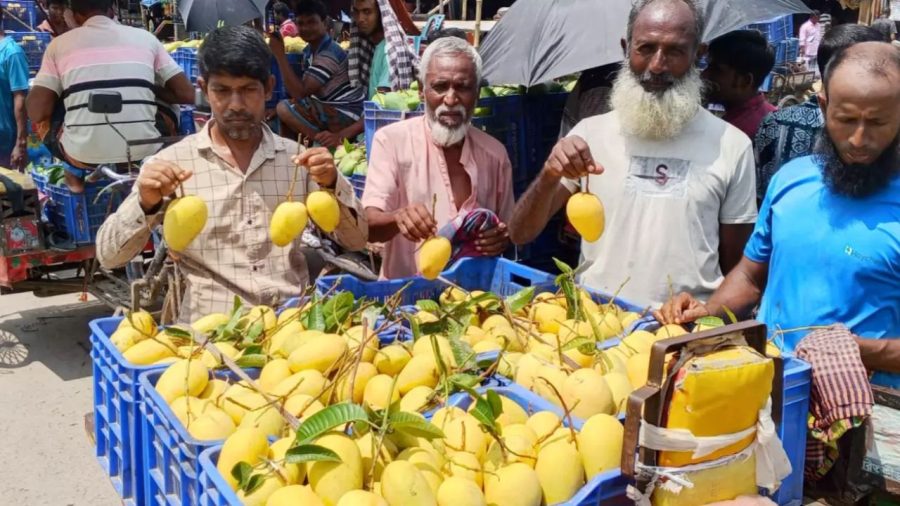

Although the season for popular mango varieties such as Amrapali, Fazli, Gopalbhog and Himsagar has ended, Katimon mangoes are keeping Naogaon’s markets active during the off‑season.
At Sapahar, the district’s largest mango market, farmers are bringing fresh Katimon from their orchards and buyers are continuing to purchase the fruit even after the traditional mango season.
A visit to the Sapahar market on 10 and 11 September found the market bustling with Katimon mangoes. Farmers arrived with their produce in vans, while buyers gathered to purchase the fruit.
Local residents said the busy market looked much like the peak mango season, although other popular varieties are no longer available.
Mangoes are traditionally associated with a particular season in Bangladesh. Amrapali usually arrives early, followed by varieties, including Nak Fazli, Himsagar, Haribhanga, Gobindabhog, Langra and Gopalbhog. By the end of the regular season, mango supplies normally decline sharply.
Katimon, however, has changed that pattern. Commercial cultivation of the variety has expanded in Naogaon in recent years because it can produce fruit several times a year.
Mansur Ali, a farmer from Haripur, said he cultivated Katimon on 5 bighas of land and is happy with the yield.
“I asked for Tk 8,000 per maund, while traders offered Tk 6,500. I will sell if I get Tk 7,000,” he said, adding that prices vary depending on the quality of the fruit.

Farmers Rezaul and Siddiqur Rahman of Balukadanga said demand for Katimon remains strong because other varieties are unavailable at this time.
The weather was favourable and the yield was good this year, they said, hoping of expanding their cultivation in the future.
Consumers are also happy to find fresh mangoes in the market at a time when the regular season has ended.
Pradip, a local buyer, said he has never seen such a busy Katimon market before.
“Mangoes are not usually available at this time. Seeing such beautiful fruit makes me want to buy some for home,” he said.
Hafizur Rahman of Sarogdanga said he cultivated Katimon on 16 bighas of land and was selling the fruit for around Tk 6,000 per maund.




“The trees still have blossoms, so the supply is likely to continue until November or December. In that sense, the variety is available almost throughout the year,” he said.
Hafizur said he began cultivating Katimon in 2019 after watching an inspirational video online, and his trees started bearing fruit in 2021.
The orchard also provides employment for 10 to 12 people, he said.
Nasir Uddin of Nishchintapur said he also planted Katimon saplings in 2019 after watching videos on YouTube.
He expanded his cultivation from 15 bighas last year to 37 bighas this year, providing work for nine people. “It is a profitable venture, although it requires hard work and significant production costs,” he said, adding that prices range from Tk 6,300 to Tk 7,000 per maund depending on quality.
Jamal Uddin of Tengra Kuri village has established a Katimon orchard on 60 bighas.
He said the yield generally ranges from 20 to 25 maunds per bigha and can reach 30 to 35 maunds in some cases.
“Since other mango varieties are unavailable now, Katimon dominates the market,” he said, estimating that his orchard could generate Tk 60-70 lakh in sales this season.
Local traders Mostafizur and Samar Saha said they have never seen such brisk trading of Katimon mangoes during the off-season.
They said the fruit is fetching relatively good prices because there is little competition from other varieties at this time. Farmers from Porsha, Dhamairhat and Patnitala are also bringing Katimon mangoes to the Sapahar market, they said.
Agriculture officials said commercial cultivation of Katimon has expanded beyond Sapahar to Porsha, Niamatpur, Patnitala, Raninagar and other parts of the district.
Sapahar Upazila Agriculture Officer Shapla Khatun said Katimon is currently cultivated on around 150 hectares of land in the upazila, up from 97 hectares previously.
“As farmers are getting good prices, their interest in Katimon cultivation is increasing. Since the variety can produce fruit throughout the year, consumers can also enjoy mangoes outside the traditional season,” she said, adding that the Department of Agriculture Extension is providing farmers with advice and technical support.
Rezaul Karim, additional deputy director of the Naogaon DAE, said Katimon cultivation has expanded to around 255 hectares across the district, compared with 190 hectares last year.
He said farmers can harvest Katimon two or three times a year, depending on cultivation practices. “This is the main feature that makes Katimon different from other varieties, which generally have a fixed harvesting season,” he said.
Rezaul added that the taste of Katimon is somewhat different from traditional varieties, but its availability outside the regular season has increased its market potential. “The mango is also being exported from Naogaon along with other agricultural products,” he said.
According to the DAE, Katimon yields around 12 to 15 tonnes per hectare this season. A total production target of 3,060 to 3,825 tonnes has been set on 255 hectares of land.
The fruit is currently selling at Tk 150-200 per kilogram, with an average price of around Tk 180.
Based on the current prices and projected production, the estimated market value of Katimon mangoes is around Tk 59.67 crore, officials said.
The district currently has around 30,310 hectares of mango orchards, according to the DAE.
Although the traditional mango season generally ends by June, late varieties such as Ashwina, BARI-4, Gaurmati and Katimon continue to reach the market afterwards.
With Katimon now available well beyond the traditional mango season, farmers in Naogaon are increasingly looking to the variety as a source of higher returns and year-round employment.