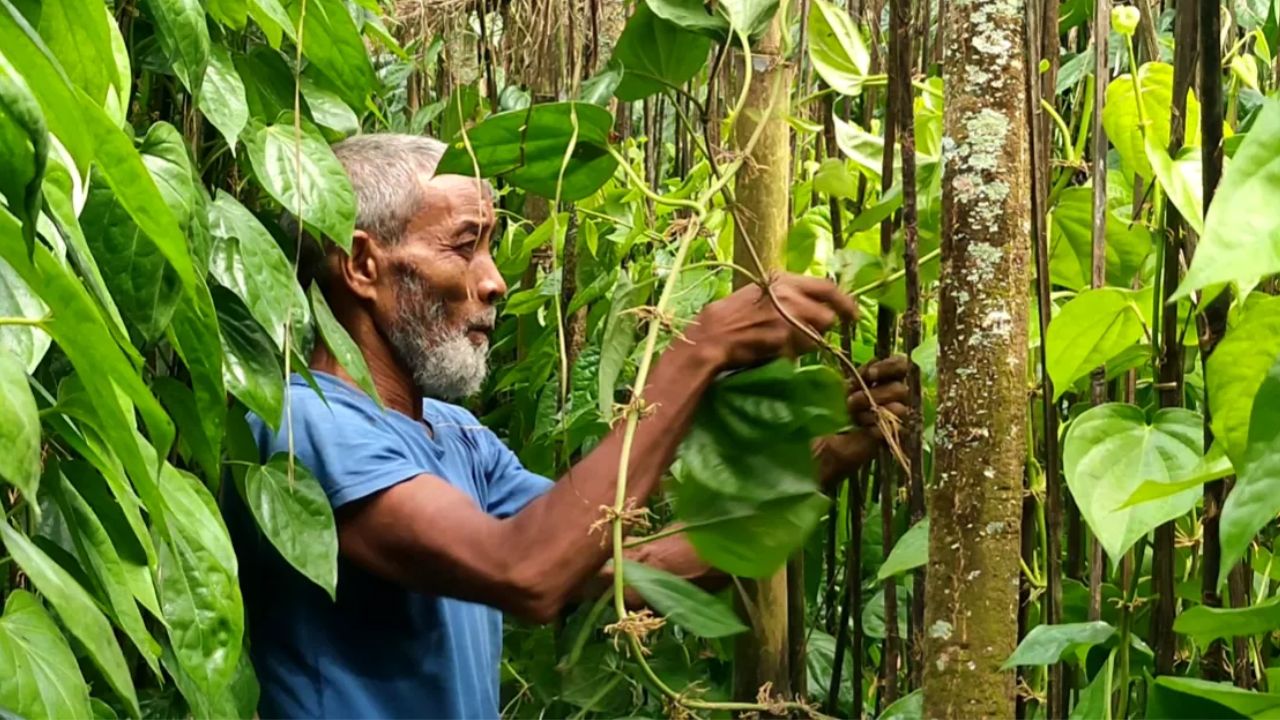



In Chapainawabganj, where betel leaves have been cultivated since the British Raj, a plentiful harvest has failed to bring joy to farmers. Despite an abundant yield this season, the crop is fetching poor prices, leaving many struggling to recover even their production costs.
Betel leaf cultivation thrives in Sadar and Shibganj upazilas, where generations of farmers have tended to their gardens. This year’s favorable weather promised a fruitful season, with leaves sprouting in abundance. However, market prices have fallen sharply, causing financial strain for growers, reports UNB.
Farmers sell betel leaves in units known as ‘pa’n’, each containing 80 leaves, with prices varying by size small, medium, and large. Last year, large pa’ns could sell for Tk 130–140, medium ones for Tk 70–90, and small ones for Tk 25–30. This year, large pa’ns are only fetching Tk 30–40, medium ones Tk 12–15, and small ones barely Tk 2–5.
Abdul Bari, a grower from Jadupur in Sadar upazila, lamented, “Although production costs have risen, prices have dropped to one-third of last year’s. We are facing losses despite higher costs for labor, pesticides, and materials.”

Abdus Salam from Durgapur shared a similar struggle: “Last year, large pa’ns sold for Tk 130–140, but this year, they’re barely worth Tk 30–40. The small ones are practically worthless, and we can’t even cover our costs.”
The financial strain is even more severe for those who took loans, hoping for a profit. Moyez Ali of Jadupur said, “Last year, I bought a betel garden for Tk 2 lakh and earned Tk 4 lakh.




This year, despite high production, I’m worried about repaying the loan due to the lack of market prices.”
Jayedul Hossain, another grower, borrowed Tk 50,000 for cultivation. “Prices have fallen so much that I doubt I’ll even make half of that back. I’m stressed about repaying the loan and supporting my household,” he said.
Yasin Ali, Deputy Director of the Department of Agricultural Extension (DAE) in Chapainawabganj, confirmed that betel leaf cultivation covered approximately 15 hectares this season, slightly less than last year. “The favorable weather ensured a good yield.
However, the surplus supply in the local market caused prices to drop. Farmers are being advised to explore alternative markets for better prices,” he added.
As the sun sets over Chapainawabganj’s lush fields, the shimmering leaves serve as a reminder of nature’s bounty and the fragile fortunes of the farmers who labor to harvest them.