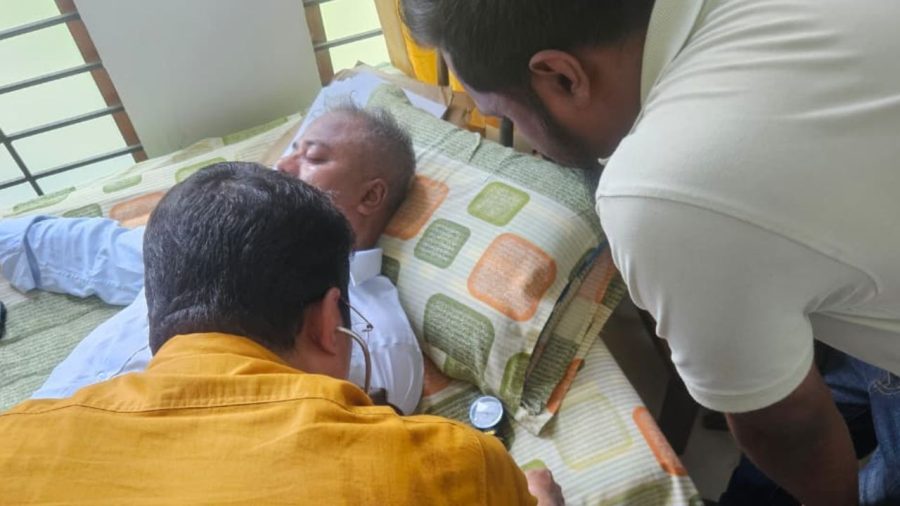



Doctors have examined the health of Dr Sheikh Shariful Alam, vice chancellor of Chittagong University of Engineering and Technology (Cuet), in two phases while he remains confined to the VC’s building.
He has been confined to the building since 12pm Monday. During his health examination on Tuesday afternoon, doctors observed variations in his blood pressure readings, prompting a re-examination to verify the matter.
Medical team granted access
At around 11:30am on Tuesday, doctors from the Cuet medical centre were allowed to enter the locked vice chancellor’s building.
Representatives from several media outlets also entered the premises at the time. Inside the building, several individuals were present, with Shariful staying in a separate room accompanied by a few people, while several others were seen in an adjacent room.
When media personnel initially requested to speak directly with the vice chancellor, he declined.

Later, speaking from in front of his room door, he said, “We are in a very inhumane situation here. In this situation, we have sought cooperation from the administration. How they will assist is up to them.”
During the first phase of the health check, the duty doctor initially returned after waiting for a long time without being able to perform the examination.
Later, at around 1:30pm, when the vice chancellor expressed interest in seeing a doctor again, Dr Md Sahabuddin, a doctor at the Cuet medical centre, was brought to the vice chancellor’s building.


Following the examination, Dr Md Sahabuddin said, “I measured his pulse and blood pressure. Currently, they are normal. He did not tell me about feeling any chest pain. He also did not express any desire to go to the hospital.”
Conflicting medical reports
At around 2:00 pm, Dr Tiblu Kanti Dey, acting resident medical officer at Raozan Upazila Health Complex, went to the vice chancellor’s building to examine his health, measuring his pulse rate and blood pressure.
When asked whether he was experiencing chest pain, the vice chancellor informed him that he had been feeling chest pain since 10:00 am, though the pain had gradually diminished.
He added that he does not regularly take medication to control blood pressure and could not recall the name of the drug when asked which medicine he takes.
Dr Dey initially measured the vice chancellor’s blood pressure at 140/100 millimetres of mercury (mmHg). However, upon coming outside, he said the reading was 150/100 mmHg, while also noting that the vice chancellor had experienced chest pain.
Re-examination reveals further variations
Following the discrepancies in the two doctors’ accounts regarding the physical condition and blood pressure measurements of the vice chancellor, students arranged for another health check.
Subsequently, Dr Md Sahabuddin, a doctor at the Cuet medical centre, and Dr Dey, acting resident medical officer at Raozan Upazila Health Complex, examined his health once again.
Discrepancies persisted between the two doctors during the second round of examinations. In the vice chancellor’s right arm,
Dr Dey measured a blood pressure reading of 145/100 mmHg, whereas Dr Md Sahabuddin recorded 139/100 mmHg in the same arm. In the left arm, he recorded 135/100 mmHg, while Dr Md Sahabuddin measured 120/80 mmHg.
Despite the variations recorded across both rounds of examinations, full assessments of the physical condition of the vice chancellor by the two doctors or further details regarding subsequent medical treatment were not immediately available.