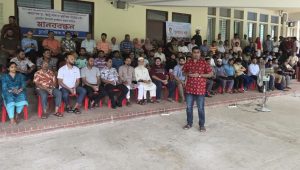
The Dhaka University unit of Islami Chhatri Sangstha has demanded a speedy trial and exemplary punishment for those involved in the murder of second-grade student Ramisa Akter in the capital’s Pallabi area.
The demand was raised at a human chain programme formed in front of the Raju Memorial Sculpture on the Dhaka University campus on Wednesday afternoon.
The protesters expressed their outrage over the brutal killing of the child, as well as the ongoing violence against women, incidents of rape, and the general deterioration of law and order in the country.

Speaking at the event, DU unit president Sabikunnahar Tamanna condemned the killing of the child and expressed concern over rising violence against women along with what she described as a deterioration in law and order across the country.
She alleged that the government has failed to provide security for the public. She noted that while murders are occurring consecutively, the authorities remain preoccupied with constitutional interpretations and the distribution of various cards.




She added that women and girls are living in insecurity and that the country has failed to provide a safe environment for children.
Tamanna further alleged worsening conditions of women’s safety, claiming that even members of the ruling party were treating women as ‘commodities’, while visible action from authorities was lacking.
Addressing Prime Minister Tarique Rahman, the student leader suggested that as the government distributes various welfare cards for development, it should also introduce a special “security card” for women and children to help protect them from harassment and violence.
Sumaiya Fahmida, another student from the DU unit, asserted that the state must take responsibility for the prevailing “culture of impunity”. She argued that when the state and the judicial system become weak, injustice and irregularities become the fate of the people.
“Due to this culture of impunity, criminals are becoming increasingly bold,” Fahmida said. “They are not afraid to murder or rape in broad daylight… while fathers like Ramisa’s are helplessly stating they do not seek justice because the state has failed to provide it”.
Another student, Asma Khatun, described the killing as a reflection of deep societal failure, expressing concern that a woman allegedly being involved in the crime highlights a broader psychological and social breakdown.