


Every initiative taken by the BNP government seems to invite a wave of trolls and memes on social media. Yet beneath the jokes and political reactions lies a more serious question: why do measures intended to address women’s everyday struggles so quickly become subjects of ridicule?
The idea of the ideological state apparatus, introduced by Marxist theorist Louis Althusser, helps explain how institutions such as family, education, media and religion shape the way people think and behave.
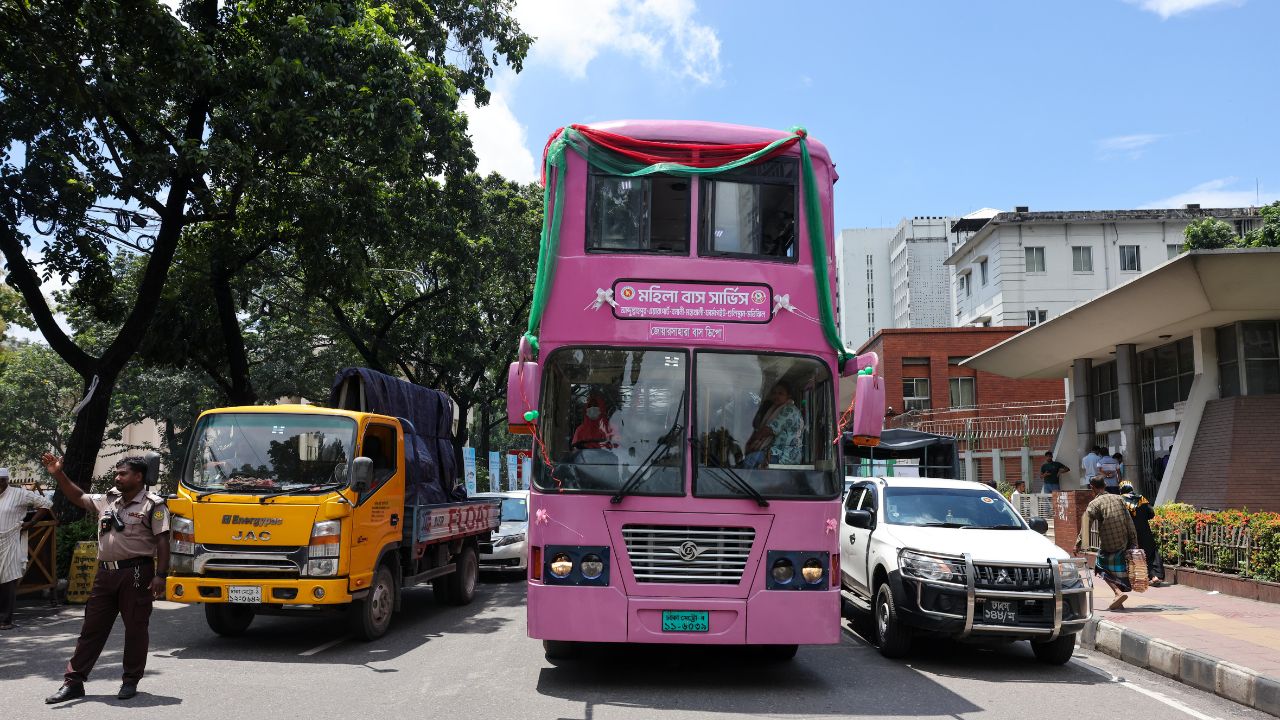
In Bangladesh, ideas about gender and women’s place in society are deeply embedded in everyday life. The launch of women-only “Pink Bus” services in Dhaka on Tuesday has exposed those attitudes once again. Social media users remain divided, with some supporting the initiative and others dismissing it through jokes and criticism.
For women, however, safe transportation is not a luxury. It is a basic necessity. From childhood to old age, women often have to struggle to secure even the most ordinary needs. Access to public transport without fear of harassment should not be an exception.

For years, women travelling on public buses have faced sexual harassment, bullying and catcalling. Such experiences do more than create momentary discomfort; they can undermine women’s confidence and restrict their freedom to move around independently.
The Pink Bus initiative therefore raises an important question: could segregated transport finally offer some relief to women who have spent years navigating unsafe journeys? The service has female drivers and conductors, which could reduce women’s fear of harassment inside buses.




But segregation alone cannot eliminate the wider problem. Predatory behaviour and gender discrimination exist beyond the bus. Female drivers themselves may face intimidation from male drivers on the road, particularly in a society where patriarchal ideas can still shape perceptions of power and authority.
The assumption that women are somehow inferior to men remains deeply rooted among some sections of society. Until now, female passengers have largely borne the brunt of harassment on public transport. With women entering roles as drivers and conductors, they too could become targets of such behaviour.
There is also the question of access. Only 10 buses have been introduced on 10 key routes and adjoining areas. What about women who travel on routes outside this network? Their choices may remain limited. They could still encounter the dismissive response: “You have a designated bus; we can’t take you.”
That would expose a contradiction at the heart of segregated transport. A service created to make women’s mobility easier should not become another barrier to their movement.
The Pink Bus can be seen as a long-awaited response to a problem women have faced for years. But its success should not be measured simply by the number of buses on the road. The real measure will be whether women can travel with greater safety, dignity and freedom and whether society is willing to recognise those rights as basic rather than exceptional.
The views expressed in this article are solely those of the author
The writer is a Sub-Editor at TIMES of Bangladesh