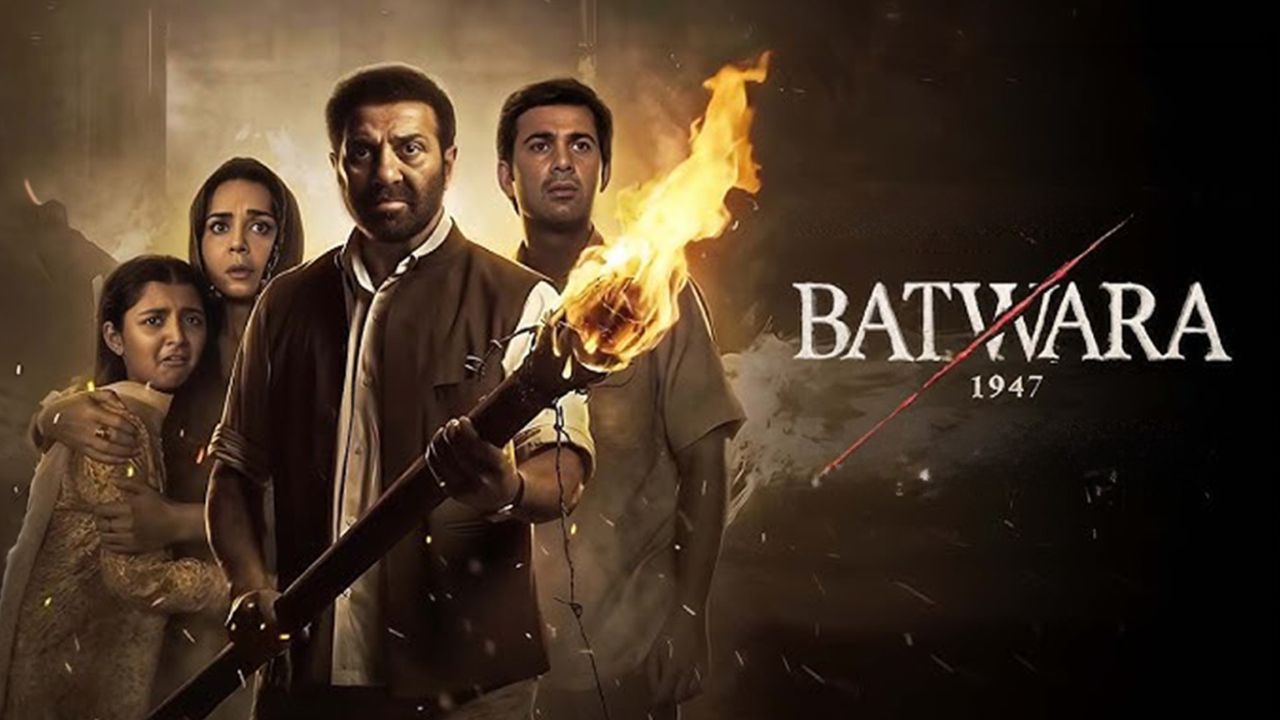



For decades, Bollywood has struggled to turn stories about the trauma of Partition into box-office successes. Batwara 1947, however, arrives with a rare combination of star power and a story that could challenge that pattern.
The film brings together Sunny Deol and filmmaker Rajkumar Santoshi, the duo behind Ghayal, Ghatak and Damini. Aamir Khan produces the project, while AR Rahman composes the music and Javed Akhtar writes the lyrics. Yet, despite the names attached to it, the film has generated less buzz than expected. NDTV has highlighted the film’s strong connection to Sunny Deol’s Gadar legacy while noting its distinct Partition setting.
Hindi cinema has produced several acclaimed films about Partition, but many struggled commercially. MS Sathyu’s Garm Hava explored the quiet pain of displacement, while Deepa Mehta’s 1947: Earth examined friendship and communal violence in Lahore. Chandra Prakash Dwivedi’s Pinjar dealt with the abduction and suffering of women during the Partition riots. Pamela Rooks’ Train to Pakistan, adapted from Khushwant Singh’s novel, portrayed communities torn apart by the new border.
Other films tried to give the subject a more commercial treatment. Kamal Haasan’s Hey Ram (2000), featuring Shah Rukh Khan, placed the politics of 1947 inside a revenge thriller. Vidya Balan’s Begum Jaan (2017) took a more overtly dramatic route. Yet neither managed to turn the Partition setting into a major box-office success.
That history makes Sunny Deol’s Gadar an important exception. The 2001 blockbuster transformed Partition from a story of helplessness into a larger-than-life tale of courage, revenge and family. Its 2023 sequel, Gadar 2, repeated much of that formula, combining nostalgia, nationalism, family emotion and Sunny Deol’s larger-than-life screen persona. NDTV has also drawn a direct visual link between Batwara 1947 and the iconic hand-pump imagery from Gadar.

The difference may lie in how audiences experience Partition on screen. Films such as Garm Hava, Pinjar and Earth ask viewers to confront displacement, loss, communal violence and sexual brutality. Their characters largely remain victims of history. They offer little escape from the pain of 1947.
Gadar took the opposite route. Tara Singh crosses the border, confronts impossible odds and fights to bring his family home. The film turns tragedy into victory. It simplifies a deeply complicated historical conflict into familiar Bollywood language: hero versus villain, good versus evil and India versus Pakistan.
That formula also made the famous hand-pump sequence work as pure cinematic spectacle. The audience does not leave mourning Partition. It leaves cheering for Tara Singh.




Batwara 1947 appears to be testing whether there is another way.
Santoshi and Deol have positioned the film as a grounded human story rather than another Gadar. Yet the trailer carries flashes of the familiar Deol aggression. One exchange has Deol’s son declaring, “Tu mere baap ko nahi jaanta… woh na ghar dekhenge, na sarhad… seedha ghuske maarenge.” Another has a challenge of “Panga lena hai?” followed by Deol’s reply, “Iraada toh nahi hai, par aitraaz bhi nahi hai.”
The swagger is unmistakable. But the story underneath it is more complicated.
Batwara 1947 draws from Asghar Wajahat’s acclaimed 1989 play Jis Lahore Nai Vekhya, O Jamya E Nai. It follows a Muslim family that moves into a haveli in Lahore after its Hindu owners abandon it during Partition. The family then discovers that an elderly Hindu woman, played by Shabana Azmi, refuses to leave her home.
That changes the central conflict. This is not simply a story about Hindus against Muslims or India against Pakistan. It is about ordinary people trying to preserve their humanity while communal hatred tears their world apart.
The film therefore has the chance to reverse Bollywood’s familiar Partition formula. Its Muslim protagonist ultimately stands up for an elderly Hindu woman. The real enemy becomes the hatred unleashed by Partition rather than the person on the other side of a border.
That is a difficult balance for a mainstream Hindi film. It must deliver the emotional release audiences expect from a Sunny Deol-Santoshi collaboration without reducing the history to another black-and-white battle.
The film’s success could depend on whether it finds that balance. Sunny Deol brings enduring star power, while his reunion with Santoshi carries the weight of their earlier successes. NDTV has described the reunion as coming nearly three decades after their previous collaborations.
The bigger challenge comes after the opening weekend. A strong start may come from Deol’s name and the nostalgia surrounding his earlier films. Sustaining that interest will depend on whether audiences connect with the film’s message of compassion and humanity.
Batwara 1947 does not necessarily have to choose between the audience that embraced Gadar and viewers who prefer serious Partition cinema. If Santoshi can combine the emotional force of a mainstream Hindi film with the humanity at the heart of Wajahat’s story, the film could occupy a rare middle ground.
The question is whether audiences want to revisit Partition through compassion or through another hand-pump moment.
The box office will decide. And Bollywood’s history suggests that, when Partition meets the ticket counter, victory has always been easier to sell than grief.