
As the midday sun scorched the vast wetland of Shangkai Haor, Mashuk Mia stood barefoot on the slippery edge of his wooden boat, hands tightly gripping the oar.
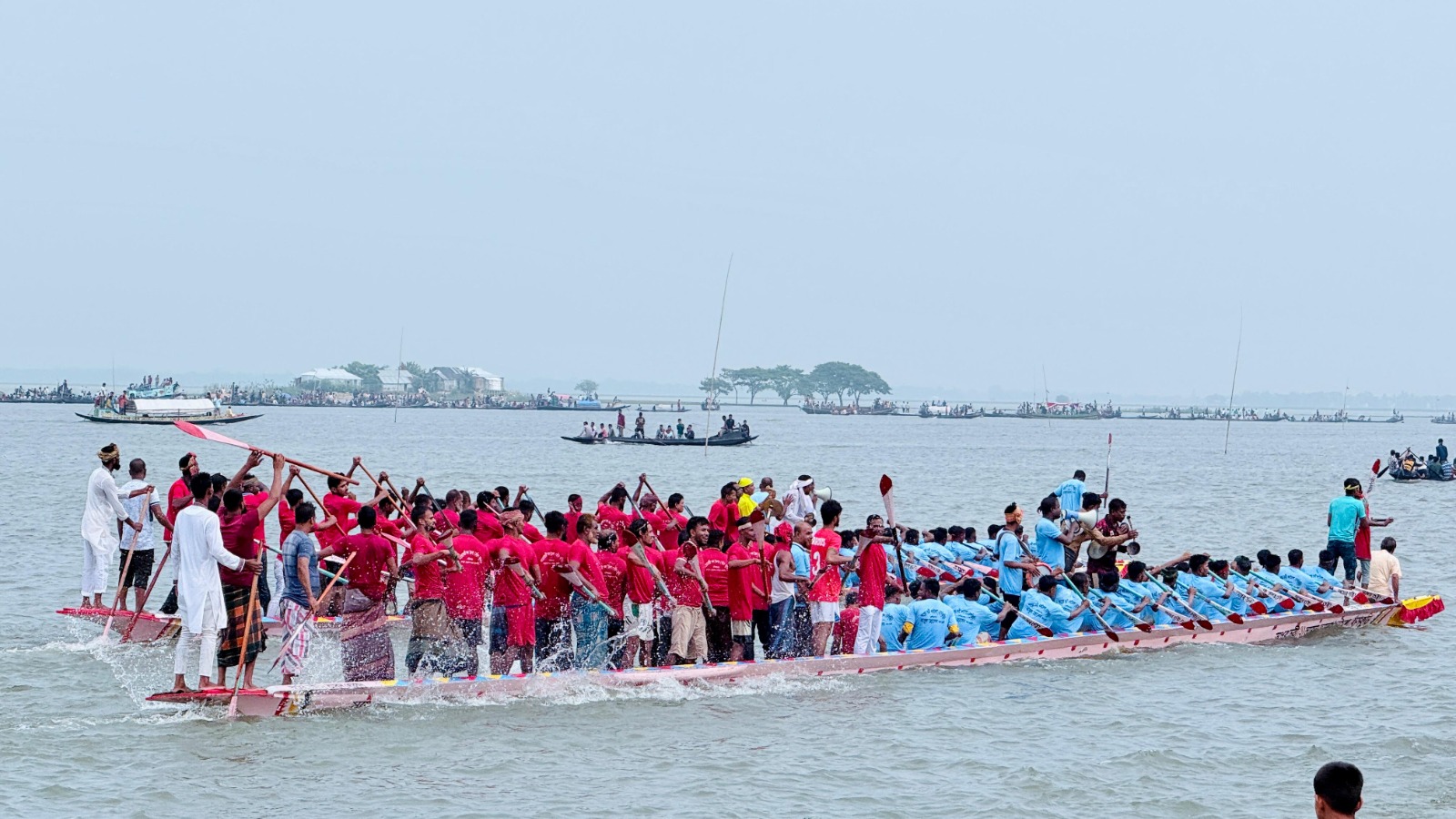
“Row like the wind is chasing us!” shouted Mashuk, with his voice rising above drumbeats and cheers echoing across the water. Moments later, the longboat lunged forward, slicing through the water like a serpent on fire.
For the 40-year-old farmer-turned-seasonal boatman, this nouka baich [traditional boat race] was more than a competition—it was a prayer whispered in rhythm with the oars.
“Our lives are changing,” Mashuk said later, wiping sweat from his forehead. “But when I row, I feel like the old days are still here.”
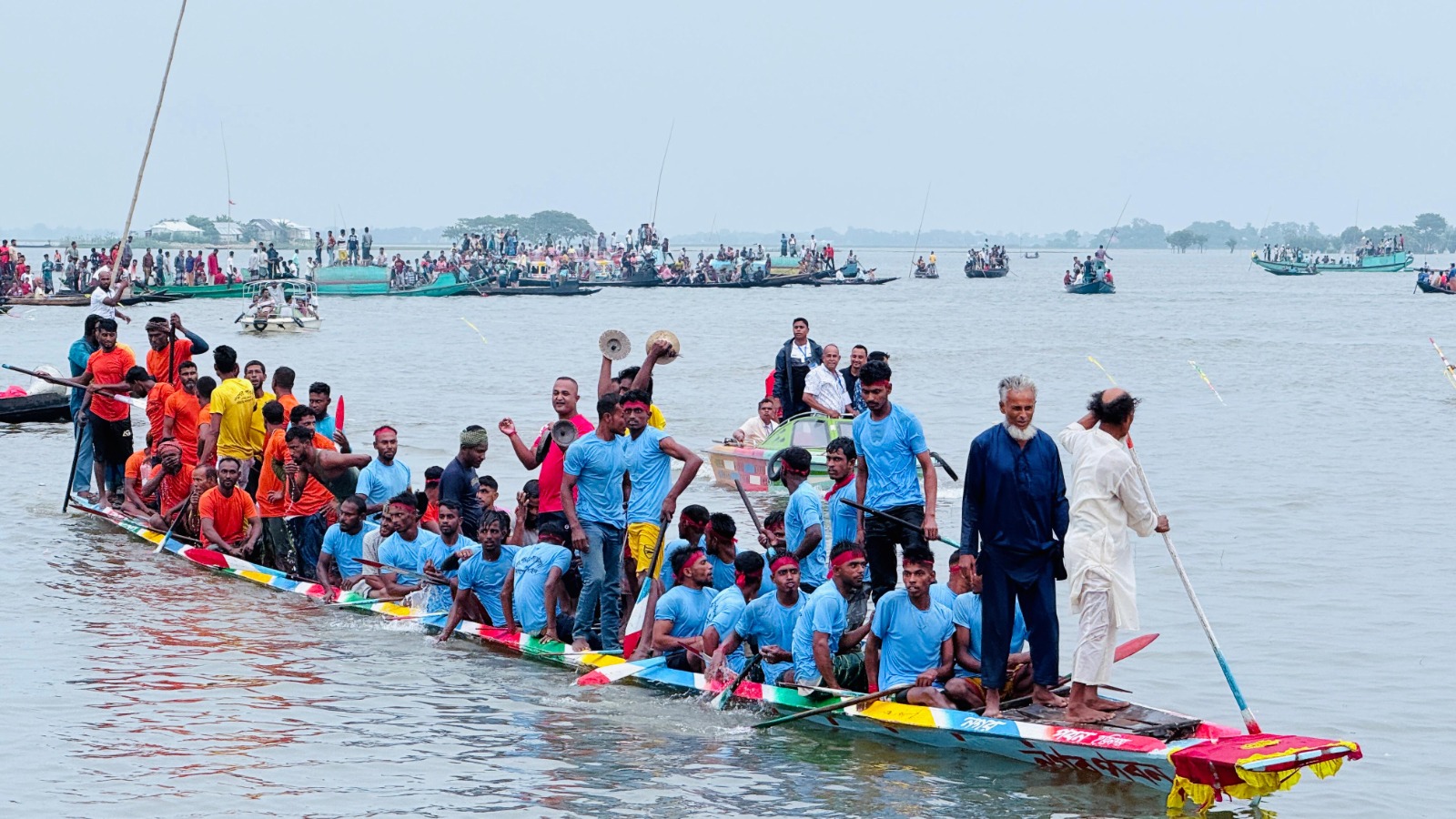
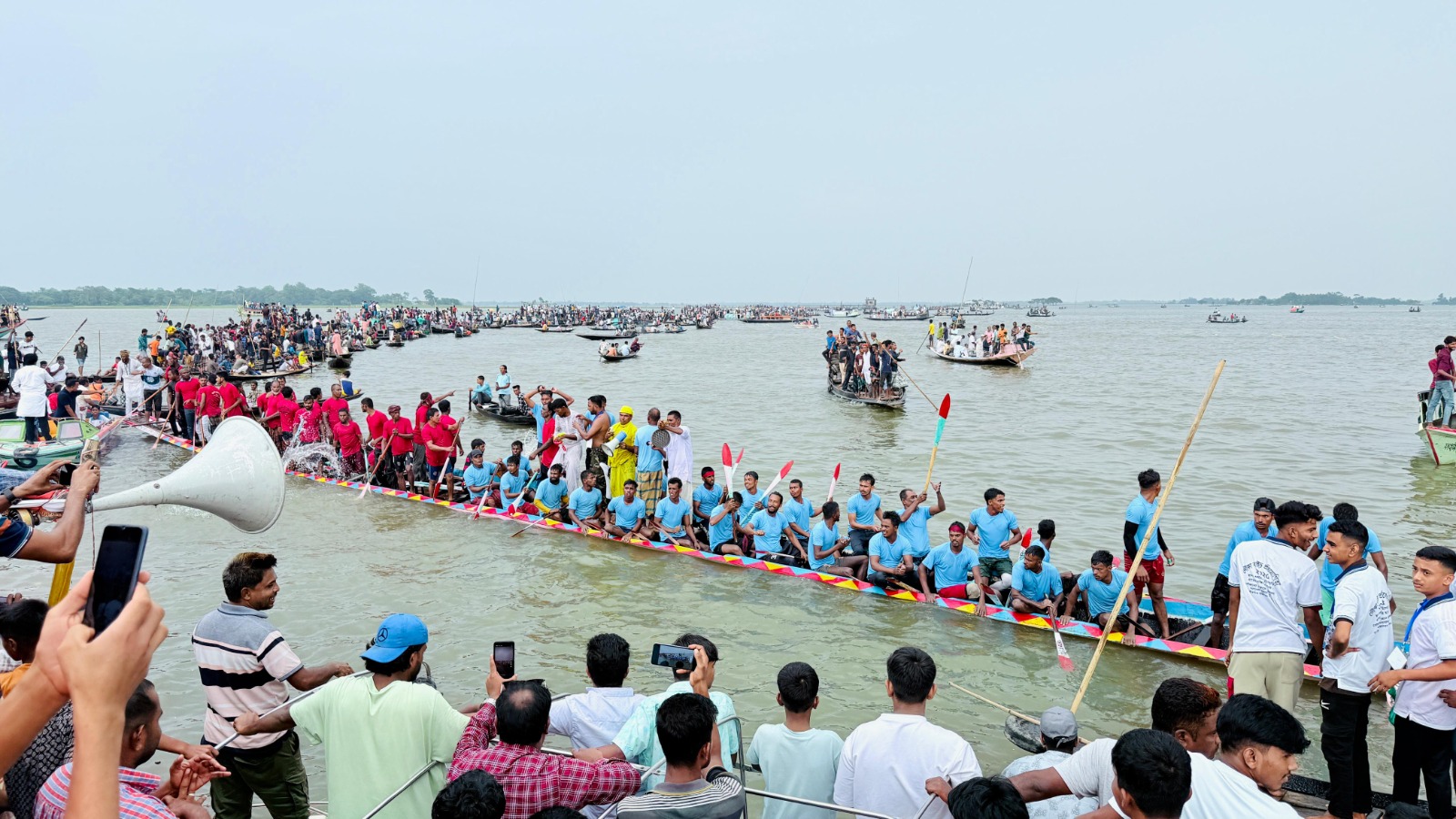
This year’s regatta, held on the shimmering waters of Shangkai Haor in Sunamganj’s Shantiganj upazila, drew more than 50,000 spectators.
Families came in with various type of boat from surrounding villages, some carrying water and food. At least 10 colourfully decorated longboats took part, each crewed by 30 to 40 men rowing in perfect sync.

Yet, it wasn’t just sport that brought people here—it was memory.
Shangkai Haor is part of Bangladesh’s north-eastern haor basin, a floodplain that transforms into a vast inland sea during the monsoon.
For generations, boat race was the heartbeat of this region—held after crop harvest, it marked a rare moment of celebration in a land shaped by hardship, migration and water.



“People here live with floods, but they also dance with the water,” said Abdus Subhan, a local schoolteacher who watched the race with his family. “This boat race is our way of saying—we’re still here.”
The haor is also the birthplace of Shah Abdul Karim, the country’s legendary Baul singer who gave voice to rural mysticism and protest. For many, his spirit lingers in folk songs sung from boats, drifting across wetlands like prayers.
But modernity has crept in. Many youths now leave for Dhaka or Sylhet. Small wooden boats are giving way to engines. Climate change has disrupted the wetland’s rhythm.
“For years, there’s too much water, sometimes not enough,” said Sajol Ahmed, a race organiser. “But we still hold the race—because it holds us together.”
This year’s top prize—a motorcycle—was sponsored by Abul Hossain, a UK-based expatriate who grew up in Hashkuri village near the haor. “We may live abroad, but our hearts row back here every year,” he told TIMES of Bangladesh.
Hossain also funded the second and third prizes—a refrigerator and a television—and arranged for loudspeakers, decorations and food for participants. He’s part of a growing diaspora movement seeking to keep rural traditions alive through direct community support.
The winners—‘Swopner Tori 1’, ‘Swopner Tori 2’ and ‘Nagar Paban’—celebrated their victory with chants, music and shoulder-high boat rides through cheering crowds.
Yet, the mood wasn’t jubilant. It was defiant, indeed.
“People think the haor is only for floods and poverty,” said Mehdi Ahmed, a college student volunteering at the event. “But this is culture. This is dignity. We want the world to see that.”
Events like these aren’t unique to Bangladesh. From dragon boat races in China to regattas in Venice, water festivals often serve as both celebration and resistance—a way for communities to assert continuity in a rapidly changing world.
At Shangkai, organisers say they plan to expand next year’s race to include cultural fairs, Baul music nights and youth forums.
“It’s not just about boats anymore,” said organiser Mahin Ahmed, adding: “It’s about telling our story on our own terms.”
As the sun dipped behind the horizon and the boats were hauled ashore, Mashuk Mia sat quietly dipping his feet in the water.
“When I die,” he said softly, “I want my sons to row in this race, not for prize but for pride.”