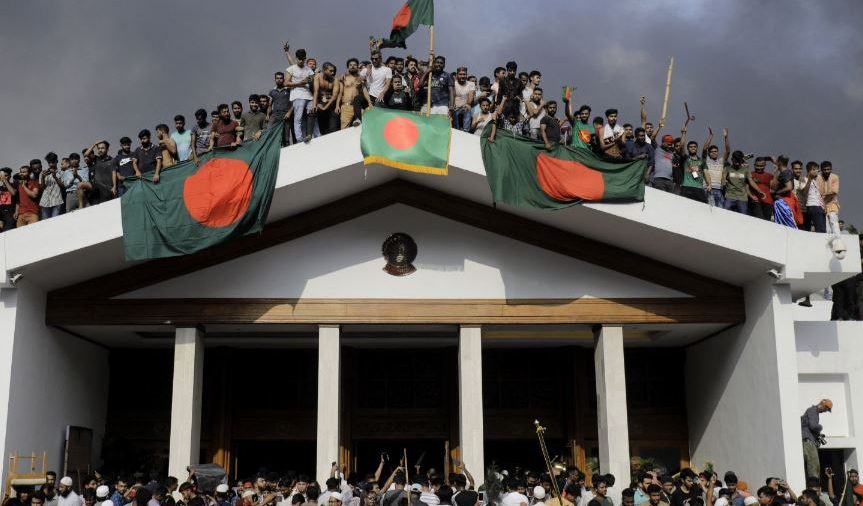



Two years after the July 2024 mass uprising swept the Awami League from power, Bangladesh’s political landscape finds itself caught between the promise of a newly established political order and the lingering turbulence of its previous regime. An objective look at recent events suggests that while the Awami League’s domestic machinery remains heavily limited, its supporters abroad and digital apparatus are actively contesting the post-uprising status quo through aggressive agitation, confrontations, and counter-narratives of victimhood.
While Awami League’s operations within Bangladesh remain heavily restricted under emergency measures and judicial bans enacted after Sheikh Hasina’s departure, the party’s diaspora branches have emerged as the primary arena of visible resistance.
This overseas defiance was on full display in New York during the 81st United Nations General Assembly in late September. In Jackson Heights, Queens, a historic epicentre of the Bangladeshi-American community, violent clashes erupted at Diversity Plaza between BNP activists and Awami League loyalists. Dozens of riot police were required to separate the factions after slogans devolved into physical brawls and the tearing down of welcome banners for visiting Prime Minister Tarique Rahman. Days later, outside the United Nations headquarters in Manhattan, the tension spilled into diplomatic spaces: Bobby Hajjaj, the state minister for Primary and Mass Education, was accosted in broad daylight, surrounded, and repeatedly harangued as a ‘terrorist’; in view of local law enforcement.

These diaspora confrontations are not confined to North America. European chapters have exhibited an even sharper edge. In Italy, an Awami League leader sparked sharp backlash after circulating remarks warning supporters of the July 2024 uprising of physical harm if they visited the country, accompanied by explicit verbal intimidation targeting female activists.
Journalists covering the transition have found themselves caught in the crossfire. In mid-August, after Farid Alam, North America bureau chief for NTV, aired an in-depth interview with former U.S. Deputy Chief of Mission Jon Danilowicz examining the former Hasina government’s continuing shadow over Dhaka’s political stability, Awami League loyalists launched coordinated harassment campaigns against Alam, issuing direct threats of assault and attempting to undermine both journalistic and diplomatic records.



To critics and members of the current ruling coalition, these incidents confirm that the party’s culture of coercive intimidation has merely crossed international borders. Conversely, Awami League loyalists frame these disruptions as necessary acts of political resistance against a government they regard as having seized authority through unlawful means. Beyond street-level and diplomatic confrontations, the political battle is increasingly fought in the digital sphere, led directly by the remnants of the party hierarchy. Sajeeb Wazed, son of the ousted Prime Minister, has spearheaded an aggressive international campaign on social media, accusing the current Dhaka administration of institutionalised authoritarianism.
Wazed has highlighted recent detentions, including arrests in Muktagacha, Gazipur, Sylhet, and Meherpur under the Cyber Security Ordinance and the Anti-Terrorism Act to claim that the new government is systematically weaponising the judiciary to silence political speech. In public statements, Wazed argued that ‘an arrest is never proof of guilt’; and cited constitutional protections under Articles 31, 32, and 39, maintaining that the Awami League remains a legitimate political body whose participation in civic life cannot be permanently extinguished.
The current administration offers a fundamentally different perspective, pointing out that many detentions involve investigations into crimes committed during the crackdowns of July 2024 or direct incitement of civil unrest. However, observers note the political irony: the legal mechanisms now being criticised by Awami League leaders, most notably broad anti-terrorism provisions and cyber laws are the exact statutes expanded under Sheikh Hasina’s tenure to dismantle her own political opposition.
Thus, the question arises: will the banned Awami League ever return to the side of the people, or will it continue to carry out terrorist activities both at home and abroad?
The views expressed in this article are solely those of the author
The writer is the City Manager, New York Life insurance, New York . Email: [email protected]