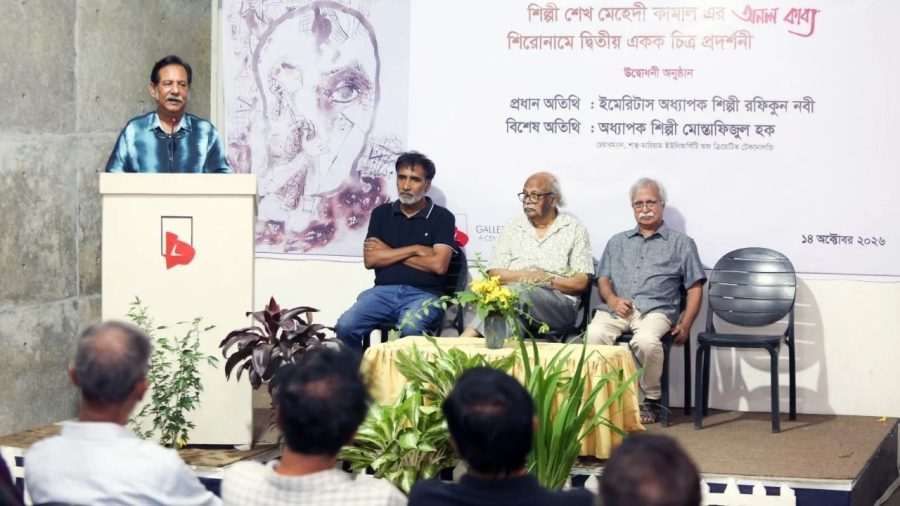



Artist Sheikh Mehedi Kamal is exploring the relationship between fire, artistic expression and human suffering in his second solo exhibition, Onol Kabyo (Poetry of Fire), at Gallery Chitrak in Dhaka.
The exhibition, running from 14 to 22 October 2026, features contemporary works created through experimental techniques involving heat and fire, offering visitors an opportunity to experience unconventional forms of visual art. It remains open daily from 11am to 8pm.
The inaugural ceremony was curated by Professor Nisar Hossain, with Emeritus Professor and artist Rafiqun Nabi attending as chief guest.
Professor Mostafizul Haque, chairman of the Board of Trustees of Shanto-Mariam University of Creative Technology, attended as special guest, while Gallery Chitrak Executive Director Md Moniruzzaman conducted the programme, according to a press release.
Born in 1973, Mehedi emerged as an artist in the 1990s and completed his postgraduate studies at the Faculty of Fine Arts, University of Dhaka, towards the end of the last century.
He subsequently worked in graphic design, advertising and the media, including more than a decade as an art director at Desh TV, while continuing his practice as a painter.

Known for his proficiency in watercolour, Mehedi developed his landscape painting skills by working outdoors alongside accomplished watercolour artist Alokesh Ghosh.
His experience with the medium has been reflected in works displayed at group exhibitions and shared on social media.
In his latest exhibition, however, Mehedi has moved beyond conventional watercolour techniques to experiment with two relatively unfamiliar artistic processes in Bangladesh.




One involves pyrography, a technique in which specially treated, thick paper is worked with a heated iron plate or needle-like instrument to create lines and images.
The technique has traditionally been used for centuries to produce decorative designs on soft wood and leather.
The other process resembles watercolour painting, using washes to create variations in tonal values. Unlike conventional painting, however, the images emerge on paper through the application of heat.
Both techniques leave little opportunity for retouching or revision, requiring the artist to work with the effects of heat and the movement of lines as the images take shape.
The scorched surfaces create tonal qualities reminiscent of monochromatic etching and aquatint prints, while producing distinctive textures and forms.
Most works in the exhibition are presented under the title Onol Kabyo, reflecting the artist’s perception that the gradual emergence of images through fire resembles the experience of poetry.
Another work, Agunpakhi (Firebird), evokes the legendary Shuk-Sari birds of Bengali folklore.
Through these works, Mehedi attempts to portray the physical and psychological suffering of people who have endured hardship, depicting both scorched bodies and wounded souls.
The exhibition’s underlying theme also draws a connection between fire, purification and human emotion, recalling Rabindranath Tagore’s poetic expression of spiritual renewal through burning.
Artist Rezaul Haque Liton has also developed expertise in producing images through heat and fire, although Mehedi maintains that their materials and application techniques differ considerably.
The exhibition reflects a broader tradition of experimentation among Bangladeshi visual artists, particularly those who emerged towards the end of the last century.
The Asian Art Biennale in Dhaka has played a significant role in encouraging such experimentation, providing opportunities for artists to explore new materials, techniques and forms of expression.
Through Onol Kabyo, Mehedi seeks to extend that experimental tradition by using fire not merely as a tool but as an integral element of artistic creation.