
Danish Maersk Group subsidiary APM Terminals has received the Letter of Award to invest $550 million in the Laldia Container Terminal at Chattogram Port, marking the largest single European equity investment in Bangladesh and one of the country’s biggest public–private partnership projects.
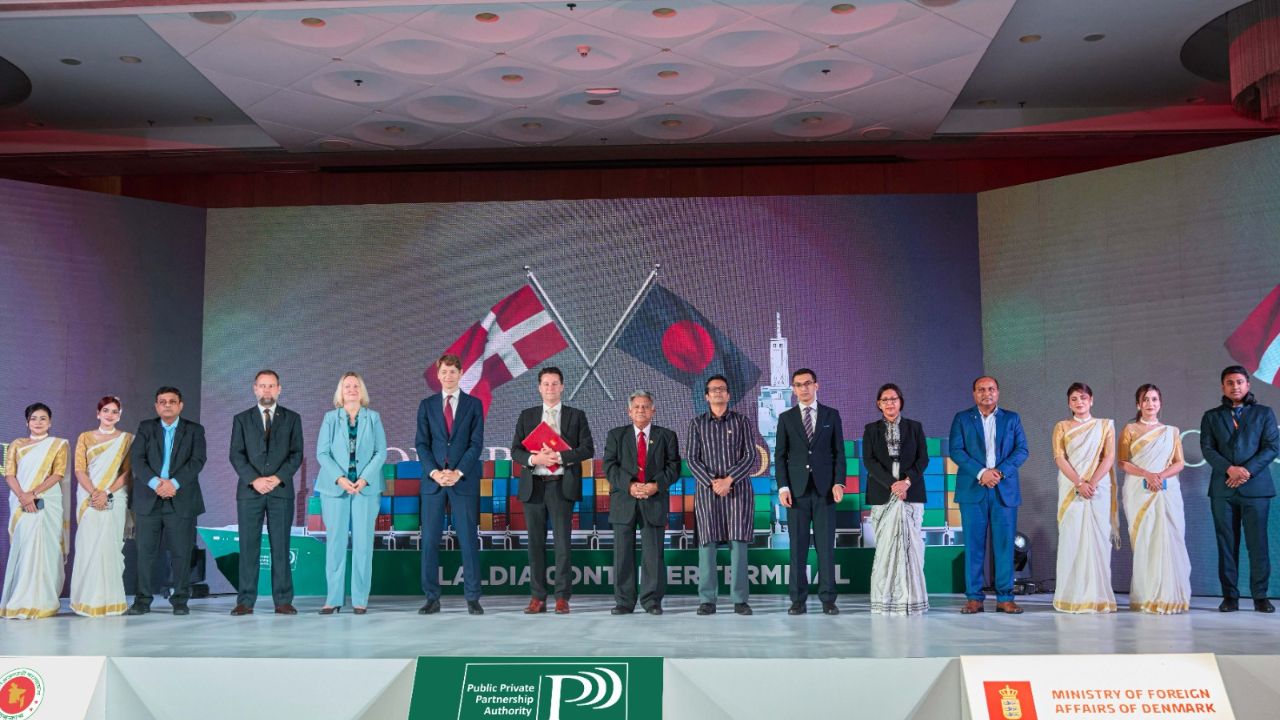
The Letter of Award was handed over on Monday at an event organised by the Public Private Partnership Authority, APM Terminals and the Chittagong Port Authority in the capital.
Maersk Group Chairman Robert Maersk Uggla and Danish State Secretary for Trade and Investment Lina Gandløse Hansen were present.
APM Terminals and its local partner QNS Container Services will implement the 30-year concession. The companies will fully finance, build and operate the greenfield terminal without creating government debt.
In a virtual message, Danish Foreign Minister Lars Løkke Rasmussen said the investment showed Maersk’s long-standing confidence in Bangladesh’s economic future.
APM Terminals CEO Keith Svendsen said the terminal would support exporters, importers and manufacturers by improving efficiency and creating skilled employment.

Chittagong Port Authority Chairman Rear Admiral SM Moniruzzaman said the port urgently needed additional capacity and improved efficiency to keep pace with rising cargo volumes.
He said river-port constraints had increased logistics costs and limited competitiveness.
Shipping Adviser M Sakhawat Hossain said the project would ease congestion, allow larger vessels to berth and offer better predictability for exporters.




He said A.P. Moller–Maersk’s global operational experience would help resolve daily port challenges.
PPP Authority CEO Ashik Chowdhury said the project highlighted Bangladesh’s ability to execute complex PPPs. The terminal would increase the port’s capacity by 44% and strengthen investor confidence in the wider PPP pipeline, he added.
Chief Adviser Professor Muhammad Yunus on the same day met a delegation from the Maersk Group and the Danish government on Monday at the State Guest House Jamuna.
He said the investment marked a new beginning for the country and opened the door for larger and more diversified European investment.
Uggla said the project would be the biggest European investment in Bangladesh and would transform maritime infrastructure when the terminal becomes operational in 2030.
The terminal would be sustainable, create jobs and encourage more European companies to invest, he said, adding that the Maersk Group planned to explore broader opportunities in logistics and supply chain.
Special Envoy to the Chief Adviser Lutfey Siddiqi, PPP Authority CEO and BIDA Executive Chairman Chowdhury Ashik Mahmud Bin Harun, SDG Coordinator Lamiya Morshed and Danish Ambassador Christian Brix Møller attended the meeting.
According to the Bangladesh Investment Development Authority, APM Terminals—wholly owned by A.P. Møller–Maersk—will design, finance, construct and operate the Laldia terminal under a 30-year concession, while the port will remain under the Chittagong Port Authority.
The project will incorporate global technology, safety and operational standards applied across APM Terminals’ network of more than 60 terminals in 33 countries.
The terminal will handle vessels twice the size of current capacity, reduce freight costs and allow 24/7 operations including night navigation where permitted.
The facility will add more than 800,000 TEUs of annual capacity, with commissioning expected in 2030. Increased throughput is expected to boost CPA revenue through dollar-denominated fees, taxes and marine-service earnings.
The project will create 500–700 direct jobs and several thousand indirect jobs. Technology transfer, training and upgraded safety standards will strengthen local port capability. Faster turnaround times and reduced dwell periods will benefit exporters, especially time-sensitive sectors.
APM Terminals is one of the world’s leading terminal operators, running more than 60 terminals in 33 countries, including China, Singapore, Sri Lanka, Vietnam, and Malaysia.
According to the World Bank, 10 of the world’s top performing 20 container ports are being operated by the company.