


Prime Minister’s political assistant Rashed Khan has called on political parties, the media and people from all walks of life to work together to rebuild the state in the national interest, urging all concerned not to exploit the country’s crisis for political gain.
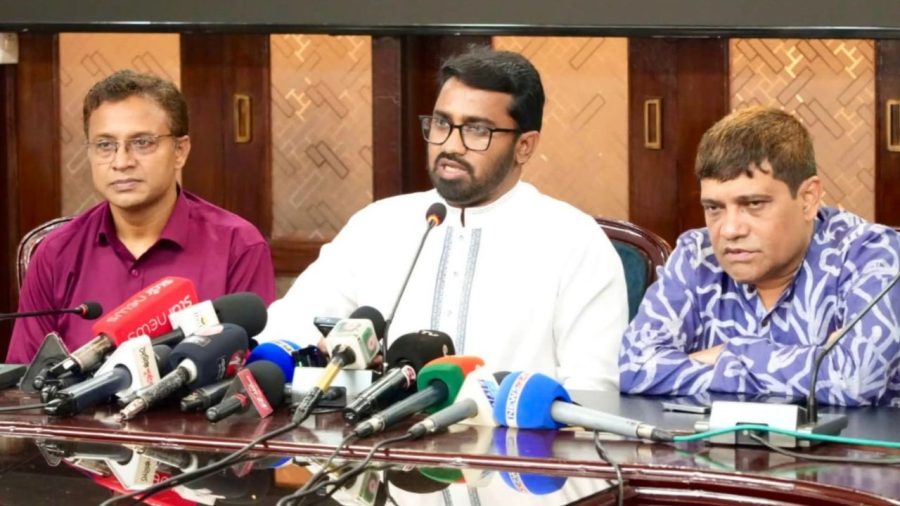
He made the remarks while exchanging views with journalists at the conference room of Chattogram Circuit House on Friday afternoon.
Rashed said Bangladesh should be built as a prosperous, democratic and people-oriented state by upholding the spirit of the mass uprising and ensuring collective participation in the country’s reconstruction.
Highlighting Chattogram’s historical significance, he said the port city played a pivotal role at the beginning of the Liberation War. He also paid tribute to the memory of former president Ziaur Rahman, referring to the historic declaration of independence and Chattogram’s role in the country’s struggle for independence.

Rashed also briefed journalists on his activities during his visit to Chattogram. He held discussions with Islamic scholars at Al-Jamiatul Islamia Azizul Uloom Babunagar Madrasa in Babunagar, Fatikchhari, and Al-Jamiatul Ahlia Darul Uloom Moinul Islam Madrasa in Hathazari.
During the visit, he paid respects at the graves of Allama Shah Ahmad Shafi and Allama Junaid Babunagari and met Allama Muhibbullah Babunagari, Amir of Hefazat-e-Islam Bangladesh. Later, at the invitation of the district superintendent of police, he attended a meeting with relevant officials.
Regarding the country’s energy situation, Rashed said Bangladesh’s energy challenges were part of a broader global crisis, with conflicts in the Middle East affecting international energy supply chains.



He said the government had taken various measures to address the situation and was working to reduce the country’s dependence on imported energy by expanding renewable and alternative energy sources.
Rashed said long-term plans were being considered to increase the use of hydroelectric, wind and solar power and to develop a more diversified energy system.
He also called on the media to play a responsible role in reporting on the energy crisis. Journalists, he said, have an important responsibility to provide people with accurate and precise information, particularly during a national crisis.
Speaking about the current political situation, he said political parties should cooperate in state reconstruction and public welfare instead of creating anxiety or confusion among the people through political programmes.
Political differences would inevitably remain, he said, but an environment of tolerance and cooperation was essential for the national interest. Political parties should therefore work together on issues of national importance while maintaining their respective political positions.
He said national unity was essential to strengthening democracy, the rule of law, social justice and economic development. The ultimate objective, he added, should be to build an inclusive Bangladesh where the rights of all citizens are protected irrespective of race, religion or creed.
Rashed also praised the media’s role during periods of political and democratic uncertainty. He expressed hope that journalists would continue to provide objective news, inform the public accurately and help counter rumours and misinformation.
During the ongoing process of state reconstruction, he said, all sections of society should contribute to fostering unity rather than division.
“Political differences will remain, but working together in the national interest is imperative,” he said.