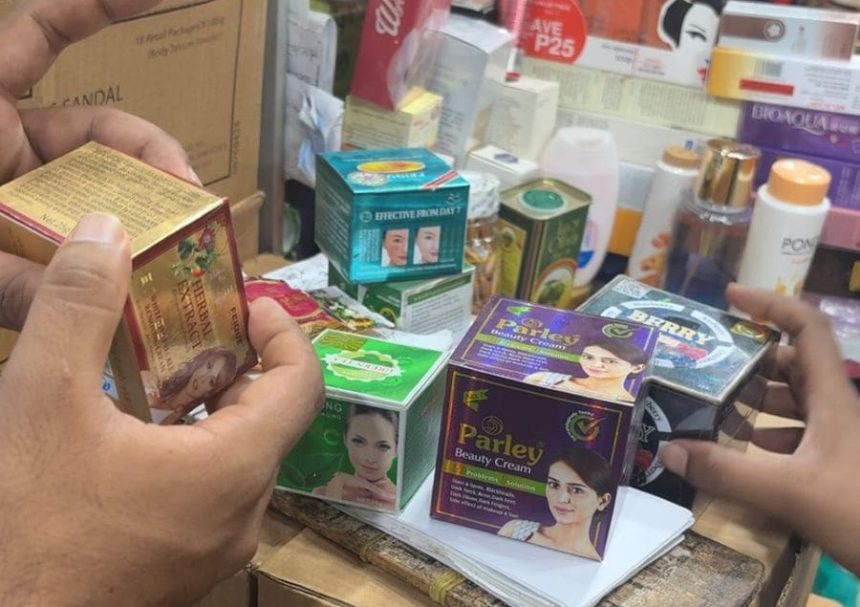

A recent study has revealed high levels of mercury availability in most of the skin-whitening creams of Bangladeshi markets — raising serious health concerns among consumers.
Tested out of 26 skin-whitening creams from retail shops and online marketplaces of Chawkbazar, New Market, and Dhanmondi, mercury levels were found to be far more than the internationally accepted safety limit (1ppm).
The collaborative investigation of the Environment and Social Development Organization (ESDO), the European Environmental Bureau (EEB) and Philippines-based group BAN Toxics, confirmed the presence of toxic mercury. They followed X-ray fluorescence (XRF) testing.
Dew Beauty Cream and Golden Pearl Beauty Cream, containing 24,800ppm and 20,700ppm of mercury, topped the list of most toxic products. Gouri Beauty Cream and these two — are officially banned by the Bangladesh Standards and Testing Institution (BSTI) yet remain widely available in physical and online stores.

Experts are consistently calling out for strong law enforcement and public awareness campaigns regarding the matter.
“It’s extremely worrying that despite some local and international progress, these products are still easily accessible,” said Prof Dr Md Abul Hashem, former chairman of the Department of Chemistry at Jahangirnagar University and senior technical advisor at ESDO.




As per the World Health Organization (WHO), mercury exposure can damage the nervous system severely.
The Zero Mercury Working Group (ZMWG) notes that long use of mercury-laced creams can harm the eyes, lungs, kidneys, digestive and immune systems — affecting both users and nearby ones, especially children, infants, and unborn babies.
Thony Dizon, Advocacy and Campaign Officer at BAN Toxics, voiced for “strong border controls, regional cooperation, and strict adherence to international treaties like the Minamata Convention on Mercury” to curb the production and sale of such toxic products.
Deputy Director at BSTI SM Abu Sayeed responded: “We are actively conducting mobile court drives and monitoring both physical and online marketplaces. Mystery shoppers are also being used to detect banned creams.”
However, he stressed that BSTI cannot face this issue alone. We need a collective response involving the public, civil society, media, and both government and non-government actors, he added.
Dr Shahriar Hossain, another senior technical advisor at ESDO, said mercury-related health effects can be slow and silent, emphasising again on the combined effort.
Since a desire for skin fairness continues to popularise more products, experts warn that consumers may unknowingly be applying poison to their faces — which requires urgent action.