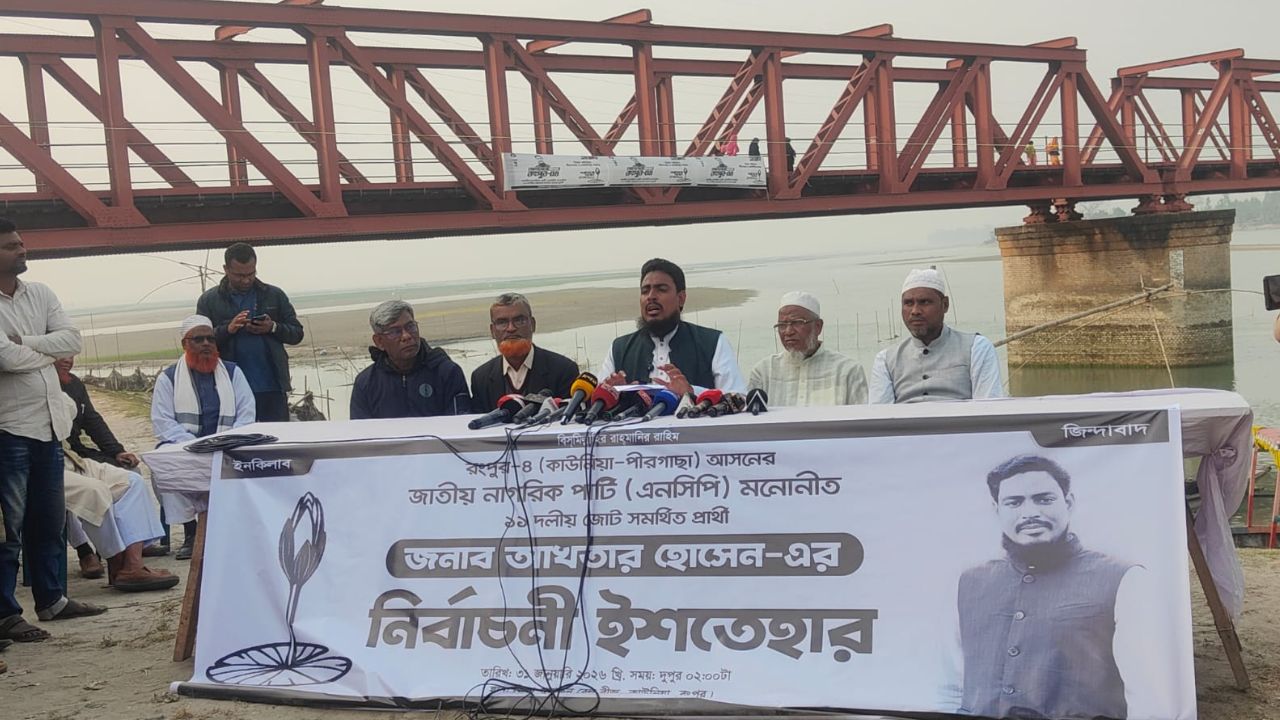

NCP Member Secretary Akhtar Hossain and the 11-party alliance candidate for Rangpur-4, on Saturday unveiled a 49-point election manifesto, urging voters to transform the river’s challenges into opportunities for regional development.
Addressing supporters at around 3:30pm beside the Teesta Railway Bridge, Akhtar said rivers have been central to the history of global civilisation, but over time they have also become sources of crisis.
“We want to create potential around the river, which is why we are announcing the manifesto here at Teesta,” he said, adding that the this river is the lifeline of the northern region and its potential must be used to open the door to development.
He said the implementation of the Teesta mega plan would be the starting point for development in the area.
The NCP leader stressed the need for transparency and accountability in public spending, calling for budget allocations to be displayed openly at every union parishad.

He also said quick-response teams would be formed to resolve land disputes, while normal delivery centres would be set up to ensure efficient service delivery.
The manifesto also outlines plans to support women and youth entrepreneurs, and to establish special economic zones to create jobs.


On infrastructure, Akhtar pledged to upgrade the existing rail line to broad-gauge tracks and increase intercity train services.
He said road connectivity would be improved through solar-powered lighting, paving of all earthen roads, widening of major highways, and construction of drainage systems, bridges and culverts.
The manifesto also promises improvements in education and healthcare, including annual scholarships and recognition for outstanding students at the upazila level.
Akhtar said government hospitals in Pirgacha, Kaunia and Haragach would be brought under digital service systems. He further pledged to establish administrative, legal, education and health service centres to improve public service delivery.
Addressing social issues, Akhtar said special initiatives would be taken for the Dalit, Haridas, Rabi Das and Santal communities, as well as other minority groups.
He also called for coordinated efforts to revive traditional jute cultivation, improve potato storage facilities and ensure fair pricing, including export arrangements.
Akhtar said he would push for India to notify Bangladesh before releasing water into the Teesta River and proposed the formation of a separate ministry to oversee development in the char (river island) areas.
He also vowed to ensure fair government allocation based on justice and to provide equal funding for all places of worship, including mosques and temples.
The manifesto announcement drew attention as the dilapidated Teesta Railway Bridge stood in the background – a reminder of the region’s historic importance and the bridge’s former capacity to carry two trains simultaneously during the British period.
NCP leaders and alliance supporters attended the event, including Rangpur city convener Abu Hasan Chanchal, senior joint convener Shanti Qaderi, senior joint member secretary Alamgir Noyon, district joint convener Abu Reza, Kaunia upazila Ameer Maulana Abdus Salam, secretary Advocate Omar Faruk, and Kaunia upazila chief coordinator Shahidul Islam.