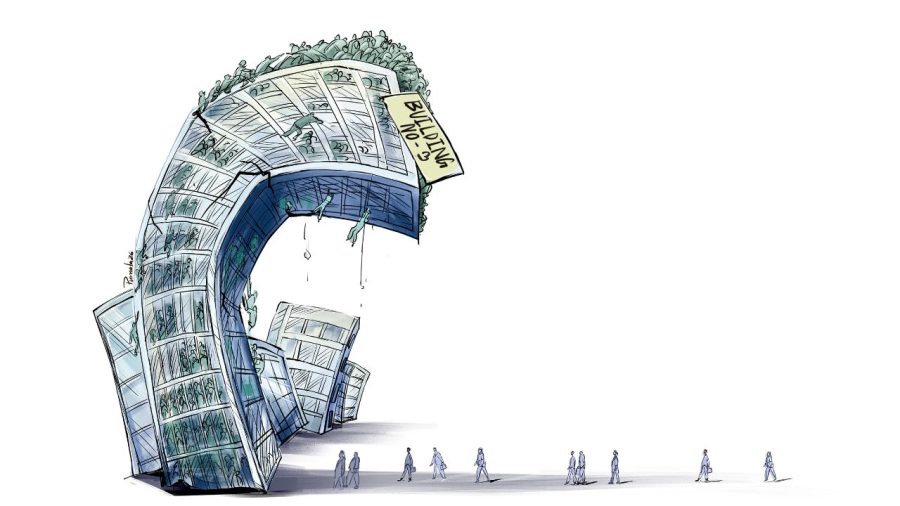

A surge of people seeking personal favours, transfers, postings and other interventions has overwhelmed ministers and senior officials at the Bangladesh Secretariat, disrupting routine government work at the country’s administrative centre.
The pressure has become so intense that Muhammad Hasnat Morshed Bhuiyan, private secretary to Home Minister Salahuddin Ahmed, has moved his workplace from his own office to a chamber beside the minister’s room to avoid the constant flow of visitors seeking recommendations.
“We are exhausted. Many people come with requests, including police transfers and various other matters. This is disrupting our normal routine work,” Hasnat told TIMES.
His experience reflects a wider struggle inside the Secretariat, where ministers, secretaries and senior officials say a growing crowd of political leaders, activists, intermediaries and individuals seeking personal intervention is making it increasingly difficult to focus on administrative duties.
The rise in visitors has also raised questions over how access to government offices is being obtained, with officials alleging that political connections, personal recommendations and, in some cases, financial transactions are being used to secure entry.
Officials at the home ministry told TIMES that the number of visitor passes issued by senior officials has increased sharply since BNP came to power in February.
Ministers are now issuing 25 to 30 visitor passes a day, compared with 10 to 12 under the previous Awami League government. Secretaries are issuing around 10 passes daily, while additional secretaries and joint secretaries are issuing about five and three respectively.
During the interim government, advisers holding ministerial status could issue five passes a day. Secretaries could issue three, while additional secretaries and joint secretaries could issue two and one respectively.
The Secretariat houses more than 40 ministries. At the current rate, if each ministry issues around 40 passes a day, more than 1,600 authorised visitors could enter the premises daily.
The actual number is likely higher because some people enter without official passes.
Several home ministry officials estimated that around 150 people enter the Secretariat through unauthorised channels every day, although no official record exists.

To assess the scale of the crowd, this correspondent observed the Secretariat entrance on Wednesday and saw around 250 visitors enter within 20 minutes, between noon and 12:20pm.
Monday and Thursday were previously designated as visitor-free days, when no passes could be issued. However, officials said the arrangement has failed to stop outsiders from entering through other channels.
“Even if we do not issue passes to many people, they still manage to enter through various ways,” Hasnat Morshed said.
Senior Home Secretary Manzur Morshed Chowdhury said complaints over unauthorised entry were increasing.
“We are receiving complaints about the gates. Mobile courts are also conducted,” he said.
Additional Secretary Munira Hafiz said her ministry did not allow unauthorised visitors to enter.
“No one is allowed to enter illegally from our ministry. What happens is that they enter through other ministries,” she said.
Several officials, speaking on condition of anonymity, said the problem could not be blamed only on security arrangements.


They alleged that some visitors enter using vehicles belonging to additional secretaries, joint secretaries, ministers’ private secretaries or assistant private secretaries, making security personnel hesitant to challenge them.
Officials also alleged that a section of police personnel at the visitor gate helps outsiders enter in exchange for money.
Police officer Delwar Hossain, posted at the Secretariat entrance, acknowledged the increase in visitors but denied involvement in illegal entry.
“The number of visitors has increased compared with before. If anyone helps others enter illegally, I am not involved in that,” he told TIMES.
Inside the Secretariat, visitors move from one office to another throughout the day seeking intervention in transfers, postings and other administrative matters.
Bishwajit Chowdhury of Sreepur in Magura said he waited outside for three hours before entering the Secretariat after paying Tk600 to police. He later went to the health ministry.
At the gate, Rabeya Khatun was waiting to pursue a transfer request for a relative at the Ministry of Fisheries and Livestock.
“I sent my identity card to a senior official. But he did not provide a pass. So I do not know whether my work will be done,” she told TIMES.
The pressure is particularly visible at ministries handling high-demand services, including local government, finance, health, land, law, shipping, road transport and bridges, commerce, and housing and public works.
Abdul Gani, a lift operator at Building 8, said the number of outsiders had increased significantly.
“Ministries such as local government, roads and financial institutions are located here, so the crowd is much higher. There were not so many people before. We are exhausted while doing our duties,” he said.
Physician Farida Akter, posted in Manikganj, waited nearly four hours at the health ministry to meet Health Minister Sardar Md Sakhawat Hossain over a posting issue but could not meet him.
She said she came to the Secretariat after failing to resolve the matter through her departmental head.
“What else can I do?” she said.
The pressure has also drawn frustration from ministers and senior officials.
Disaster Management and Relief Minister Asadul Habib Dulu said excessive lobbying was affecting government work.
“I am exhausted because of lobbying pressure. It has become difficult to carry out routine government work because of this. There needs to be stricter action,” he told TIMES.
Additional Secretary Ziauddin Ahmed said the volume of requests had become difficult to manage.
“It is lobbying after lobbying. If we cannot control excessive visitors, it will become difficult to work,” he said.
Religious Affairs Secretary Munshi Alauddin Al Azad said access to the Secretariat needed tighter control.
“We listen to everyone calmly. If a request cannot be fulfilled, we do not accept it,” he said.
Officials said lobbying often involves intermediaries who seek money by promising to influence government decisions.
Many such individuals are linked to ruling party leaders and affiliated organisations, while professionals and other intermediaries are also involved, they said.
The pressure has even affected daily life inside the Secretariat.
Workers at several canteens said food now runs out earlier because of the growing number of outsiders.
At the Tourism Restaurant on the ground floor of Building 6, food that was previously available until afternoon often runs out by 2pm.
Md Anis, assistant manager at the home ministry canteen, said:
“Many types of food are prepared here. But after 2pm, everything is finished because there are too many outsiders.”
Senior Assistant Secretary of the Labour Ministry Ramkrishna Barman said employees often have to leave the Secretariat to eat.
“We are usually free after 3pm. By then, food is no longer available. So we have to go outside to eat,” he said.
For ministers and officials, the growing flow of favour-seekers is no longer only an issue of crowded offices. It has become a challenge to routine governance, as time meant for administration is increasingly consumed by requests for personal intervention.