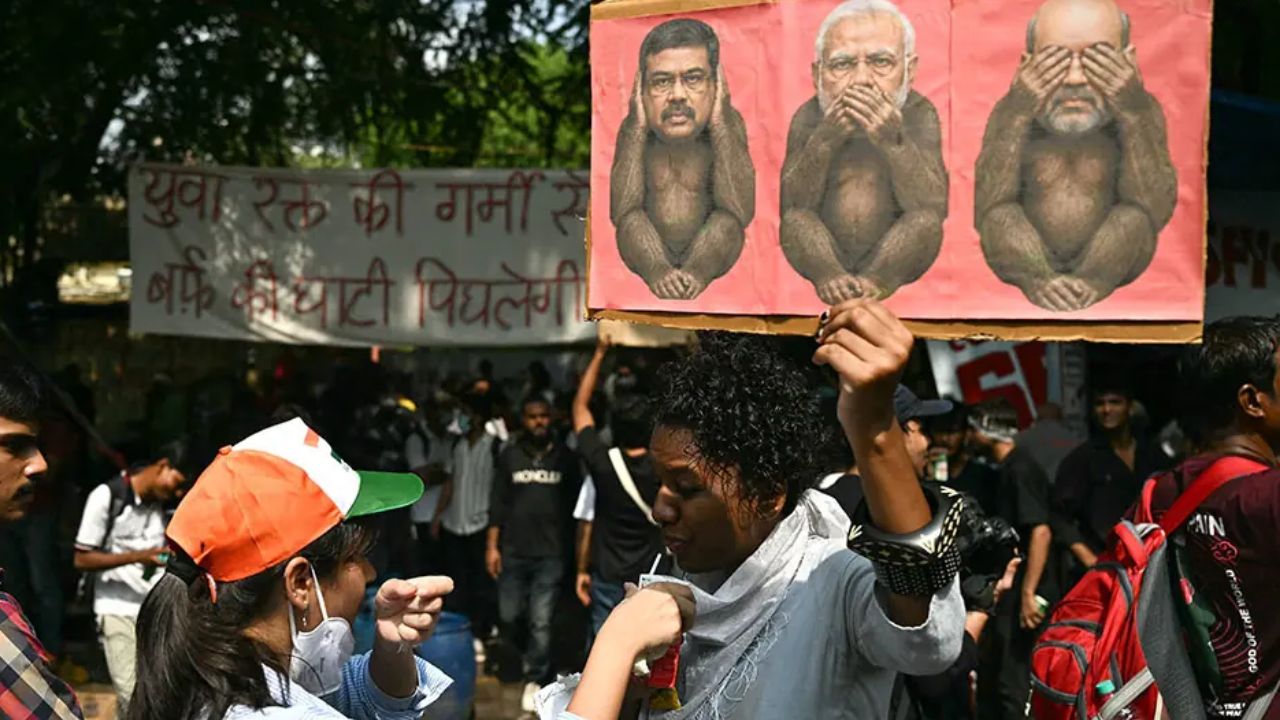



Activists in India are pursuing legal action against Prime Minister Narendra Modi’s administration regarding the use of AI-driven surveillance during a massive youth-led demonstration.
The case, currently before Delhi High Court, is expected to serve as a landmark test of federal authority over digital monitoring.
The dispute intensified during recent student protests over leaked examination papers, after images of a mobile police surveillance unit were circulated online. This vehicle was equipped with a 360-degree camera mounted on a telescopic mast to monitor the assembly, reports Reuters.
Student leader Aishe Ghosh has petitioned the court to declare mass surveillance of this nature unconstitutional. Her legal challenge calls for the destruction of all personal data gathered during the event and the establishment of strict protocols for the deployment of such technology.

Although education minister Dharmendra Pradhan resigned following the unrest and a panel was formed to reform the examination process, Ghosh is continuing her legal pursuit.
Advocates argue that the surveillance conducted at the primary protest site in New Delhi was unlawful, citing a lack of specific legislation in India governing the use of facial recognition by law enforcement. In contrast, the government maintains that these measures were legal and necessary to preserve public order.
During a court hearing on Friday, Solicitor General Tushar Mehta defended the actions of the police, suggesting that expectations of privacy at a public assembly were contradictory. He asserted that monitoring was “absolutely necessary” for “legitimate state interest”.




On Monday, Ghosh’s representatives argued that such intrusive mass monitoring was disproportionate. The court has set to resume the hearing on Tuesday.
The Internet Freedom Foundation, a digital rights group, has formally requested that the Delhi police commissioner delete the biometric information collected.
While the Delhi police did not respond to requests for comments, the force stated on social media that facial recognition technology had not been used to restrict anyone’s freedom.
Akash Karmakar, a partner at the law firm Panag & Babu, emphasised the need for mutual accountability. He suggested that if facial recognition is employed to track demonstrators, it should also be used to identify police officers who allegedly fail to wear name badges during operations.
Witnesses observed police recording the Instagram handles of protesters to check for criminal backgrounds. The surveillance van, marked with the Delhi Police crest and the name “Ikshana” (meaning “vision” in Hindi), contained displays showing faces with “face accuracy” metrics.
CP Plus, an Indian CCTV company and development partner for “Ikshana”, confirmed it supplied the AI-powered hardware.
However, the company clarified that the Delhi Police were responsible for the operational deployment and database management.
Police officer Raj Kumar Dahiya noted that the AI systems assist in identifying individuals with criminal records and provide an automated count of protesters.