
Abu Dhabi-based project finance and investment firm Equiline Finance, part of the Resource Investment Group, plans to invest $2-3 billion in Bangladesh, targeting government-backed infrastructure, energy, healthcare and digital projects as it seeks to establish a long-term presence in one of South Asia’s fastest-growing economies.
Bangladesh has emerged as one of the company’s priority investment destinations, reflecting its rapid industrialisation, young workforce, expanding manufacturing base and track record of implementing large-scale infrastructure projects with support from international development partners, according to a visiting team of the company.
They said in a statement on Tuesday the proposed investment will primarily target strategically important projects undertaken by government ministries, departments and state-owned agencies, although Equiline Finance is also exploring opportunities in the private sector.
Projects would first be identified jointly with the government before undergoing internationally recognised technical, commercial and financial feasibility studies to determine suitable financing structures and commercial terms, according to the company.

Financing would be arranged through government guarantee, public-private partnership (PPP) and offtake agreement models, depending on the nature of each project.
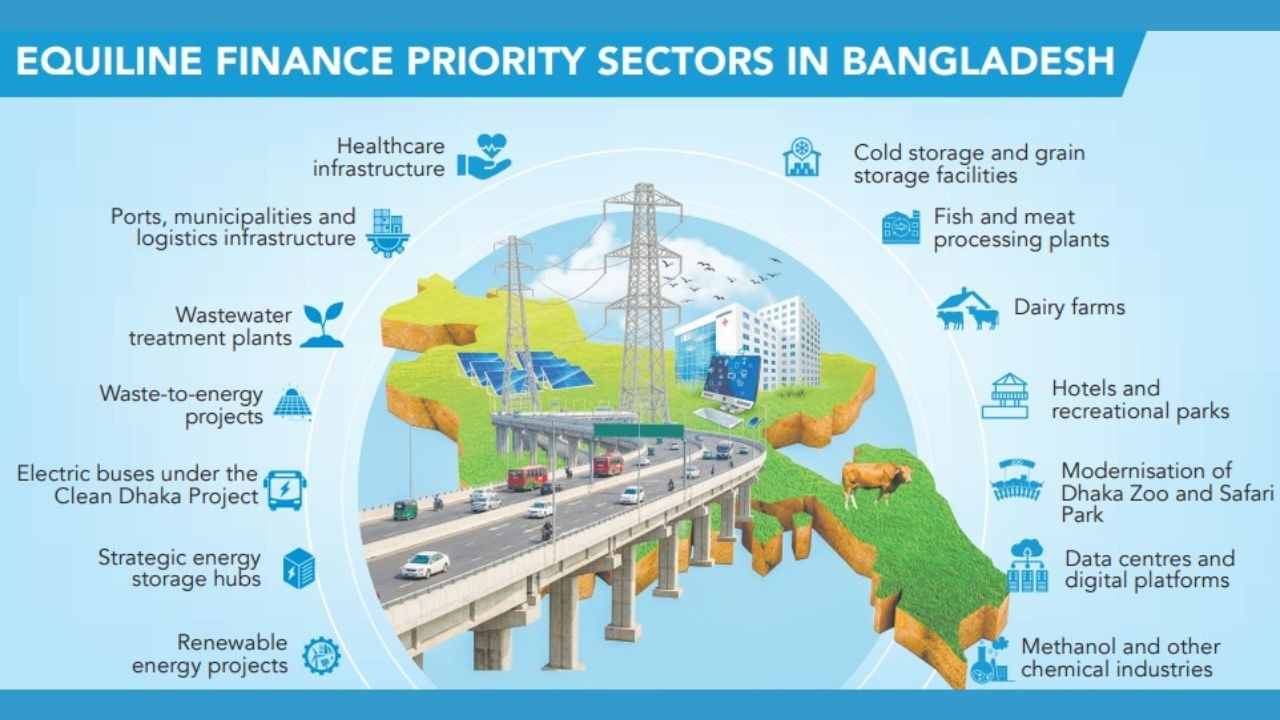
The proposed investment pipeline spans renewable energy projects, strategic energy storage hubs, electric buses under the proposed Clean Dhaka Project, waste-to-energy facilities, wastewater treatment plants, logistics infrastructure, healthcare, agriculture, tourism, digital infrastructure and chemical manufacturing.
Plans also include modernising ports, municipalities and other public institutions through equipment and logistics infrastructure, alongside expanding healthcare services by establishing diagnostic centres, intensive care and dialysis units, neonatal facilities and other medical infrastructure at district-level government hospitals.




The company is also proposing investments in multi-purpose cold storage facilities, grain storage infrastructure, fish and meat processing plants and dairy farms to strengthen food security, reduce post-harvest losses and support export growth.
Other proposals include hotels and recreational parks, the modernisation of Dhaka Zoo and Safari Park, data centres, digital platforms, and methanol and other chemical production projects.
“Bangladesh has tremendous opportunities in renewable energy, digital infrastructure, fintech, agricultural processing, healthcare, logistics and recycling industries,” Salah Ibrahim Al Nasser, CEO of Equiline Finance and chairman of Faminas Investment Group, said.
He described Bangladesh as a market with strong long-term potential, supported by rapid industrialisation and a young population, adding that the company’s objective is to become a long-term development partner.
Although Bangladesh offers liberal foreign direct investment policies, including full foreign ownership, tax incentives and unrestricted profit repatriation, greater political stability, lower bureaucratic complexity, reduced corruption and improved infrastructure would help accelerate foreign investment, Al Nasser said.
The planned investments could reduce import dependence, create employment, modernise infrastructure, strengthen supply chains and improve public services, he added.
The visiting team met senior government officials to discuss potential projects and was optimistic that investments could begin once mutually beneficial projects are identified.
Ranadil Mizan, partner of Faminas Investment Group, also participated in meetings with several government ministries earlier this week.