
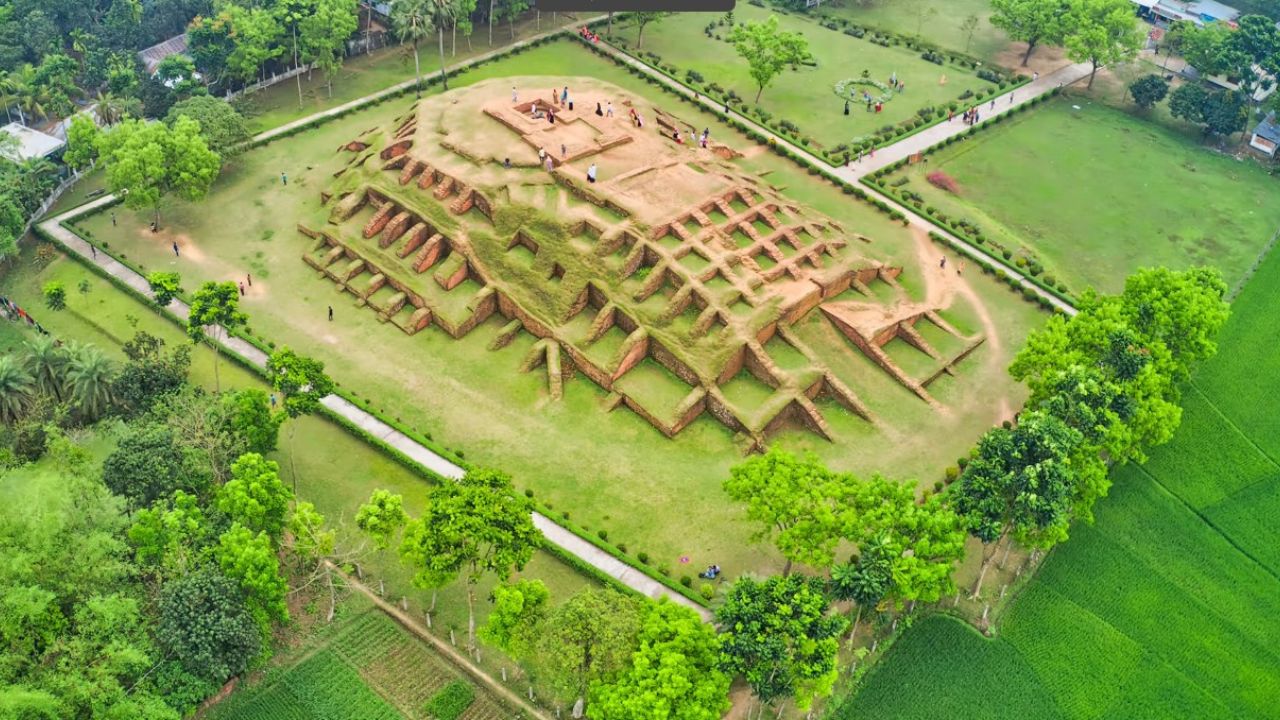

A baffling legal mystery has gripped the Supreme Court as the Ministry of Cultural Affairs denies filing a leave-to-appeal against a longstanding court order protecting the ancient archaeological site of Mahasthangarh in Bogura.
The plot thickened after contradictory claims surfaced over who actually filed the petition. A lawyer representing the Attorney General’s Office insists the appeal originated from the Solicitor’s Office, the law ministry wing tasked with conducting state litigation, yet the Advocate-on-Record maintains it came straight from the Attorney General’s Office itself.
A four-member Appellate Division bench, chaired by Chief Justice Zubayer Rahman Chowdhury, briefly heard the matter on Sunday.
Though expected to continue on Tuesday, the case conspicuously vanished from the day’s cause list.
The drama follows a formal letter sent by the Cultural Affairs Ministry to the Solicitor’s Office referencing a landmark January 2012 injunction, which strictly barred construction, excavation, demolition, and expansion in and around the protected ancient ruins.
The letter noted that Civil Petition 2234/2026 sought to stay that protective order, listing the culture secretary as the primary petitioner. Crucially, the ministry disavowed the filing entirely, clarifying that the secretary had no connection to the case and never authorised the appeal.

The ghost petition listed six high-profile petitioners: the cultural affairs secretary, home secretary, Bogura deputy commissioner, Bogura superintendent of police, Shibganj police officer-in-charge, and the Mahasthangarh Museum Custodian.
Intriguingly, it surfaced shortly after State Minister for Local Government Mir Shahe Alam inaugurated new excavation and construction work at the site, openly defying the court’s restrictions.
When contacted by TIMES of Bangladesh, every single official named in the petition flatly denied having filed the appeal.
Unravelling the paper trail has proved elusive as official sources pass the buck.




Advocate-on-Record Haridas Pal pointed the finger firmly at the Attorney General’s Office, claiming that is where the filing originated.
Solicitor Sana Md Mahroof Hossain declined to comment, while Attorney General Ruhul Quddus Kazal could not be reached as he is currently abroad.
Meanwhile, Additional Attorney General Aneek R Haque, who appeared during Sunday’s hearing, shifted responsibility back to the Solicitor’s Office, explaining that they only proceeded because the paperwork came from that department.
Confronted with these conflicting statements, Haque later clammed up, adding only that Tuesday’s session was stalled due to a judge’s ill health and promising further clarity at the next hearing.
Shahe Alam pushes for dev works
Amid the legal chaos, LGRD State Minister Mir Shahe Alam has emerged as the driving force behind the push for ‘development activities’ at Mahasthangarh.
Upon joining the government, he wrote to the Ministry of Cultural Affairs seeking approval for construction at the site. Although the ministry rejected his initial proposal, a grant of Tk74 lakh was later approved, paving the way for construction to begin on a rest facility for female worshippers.
The project hit a wall when the Bogura regional office of the Department of Archaeology intervened on 17 June, writing to the Deputy Commissioner to demand an immediate halt to the work and prompt legal action, a request that ultimately brought the construction to a standstill, only for the mysterious appeal to surface shortly after.
The unprecedented nature of the ghost petition has drawn sharp criticism from senior legal figures.
Lawyer Manzill Murshid, who opposed the appeal during Sunday’s Appellate Division hearing, described the situation as outright trickery. “In my 38 years of legal practice, I have never seen an appeal where all the named petitioners deny filing it,” he noted, adding bluntly, “This is playing games with the court.” Murshid explained that under standard procedure, the Solicitor’s Office acts on a ministry’s instructions before briefing the Attorney General’s Office to lodge an appeal.
Given the paper trail, he firmly believes the state minister is pulling the strings. “Filing an appeal costs money, so who paid for it? It is obvious that the state minister allocated the funds and that this was carried out at his direction.”
For his part, the state minister has flatly rejected these allegations, insisting to TIMES that the officials named in the petition did file it, and claiming he has no idea why they are now distancing themselves.
He fiercely defended the construction efforts, framing them as vital development for a local mosque and shrine that directly answers the demands of his constituents.
As a local representative, he maintained, backing the project was simply his duty.
Unesco listing at risk
Murshid also questioned the suspicious timing of the move, asking why anyone would challenge a ruling that had stood unchallenged for so long.
“The original court verdict was in the government’s favour, and the government’s official policy is to preserve the area,” he pointed out. “Why suddenly file an appeal after 14 years?”
He warned that unauthorised excavation and construction at Mahasthangarh could severely jeopardise its chances of securing Unesco World Heritage status. “Mahasthangarh is currently on Unesco’s tentative list,” Murshid explained. “Before upgrading a location to the final list, Unesco rigorously assesses whether the site has been properly preserved and whether any alterations or structural changes have taken place.”