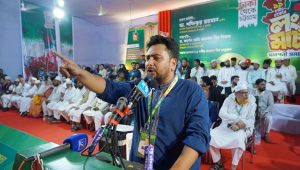
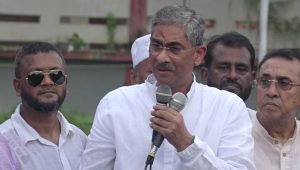
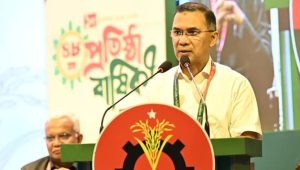
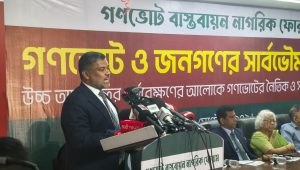
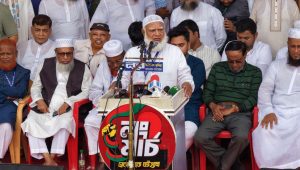
Bangladesh Jamaat-e-Islami Ameer Shafiqur Rahman, once a relatively unfamiliar political figure, has emerged as a nationally recognised leader, particularly following the fall of the Awami League government last year.
Now, he is widely known across the country and has established himself as a prominent and influential figure in Bangladesh’s political landscape.
Yet, despite his growing prominence, one question continues to shadow his political journey, will he finally succeed in entering the Jatiya Sangsad (National Parliament)?
Shafiqur Rahman has contested four parliamentary elections to date but has never won a seat. Even during elections conducted under the BNP-led four-party alliance, he was unable to secure victory.

With the next general election approaching, he is preparing to contest once again, and political analysts are watching closely to see if his long-standing electoral misfortune will end.
The history of Jamaat-e-Islami in Bangladesh has been fraught with challenges. Following the Awami League’s return to power in 2009 and the launch of war crimes trials related to the 1971 Liberation War, the party faced a severe crisis. Many of its senior leaders were either executed or sentenced to life imprisonment.
The history of Jamaat-e-Islami in Bangladesh has been fraught with challenges. Following the Awami League’s return to power in 2009 and the launch of trails over crimes against humanity committed during the 1971 Liberation War, the party faced a severe crisis. Many of its senior leaders were either executed or sentenced to life imprisonment.
In this difficult period, Shafiqur Rahman rose to the position of party Ameer, having previously served as Jamaat’s Sylhet district Ameer.




Although Shafiqur Rahman’s ancestral home is in Moulvibazar, he grew up, studied, and built his professional career in Sylhet city. This connection led him to contest his first parliamentary election in 1991 from Sylhet-1.
While he did not win, he performed respectably, securing 15 per cent of the vote. The BNP won the seat with 31.7 per cent, while the Awami League secured second place with 30.3 per cent.
In the 12 June 1996 election, Shafiqur Rahman again contested Sylhet-1 but finished fourth, receiving just 9.8 per cent of the vote.
The election saw Awami League candidate Humayun Rashid Chowdhury narrowly defeat BNP heavyweight and former finance minister Saifur Rahman by only 720 votes, while Jatiya Party candidate Babrul Hossain Babul came in third with nearly 22 per cent.
Ahead of the 2001 election, Jamaat joined the BNP-led four-party alliance, and Shafiqur Rahman was nominated as a coalition candidate. This time, he contested from his ancestral constituency, Moulvibazar-2, rather than Sylhet-1.
Despite the alliance’s nationwide sweep, he lost again. Independent candidate MM Shaheen, who did not receive BNP’s nomination, won the seat, while Awami League’s Sultan Mohammad Mansur finished second. Shafiqur Rahman came third with only 7.2 per cent of the vote.
He did not contest the 2008 election under the military-backed caretaker government, despite the BNP-Jamaat alliance remaining intact.
In the controversial 2018 election, widely criticised as a “night-time vote,” the alliance nominated Shafiqur Rahman from Dhaka-15. The constituency, which includes parts of Mirpur and Kafrul, was previously part of Dhaka-11 before being re-demarcated.
Historically, Jamaat’s vote share in the area has been extremely low. In the 1996 election, for instance, the party secured only 3.31 per cent of the vote there when contesting alone.
However, in the 2018 election, Shafiqur Rahman managed to build a relatively strong personal profile in the Dhaka-15 constituency as a joint BNP–Jamaat candidate, particularly in areas such as Kafrul, where Jamaat has a noticeable support base.
Looking ahead to the 13th National Parliamentary Election, the key contest in Dhaka-15 is expected to be between Shafiqur Rahman and the BNP’s Shafiqul Islam Khan Milton, a former acting general secretary of the central Jubo Dal.
Observers note that he is comparatively weaker than many other BNP candidates in Dhaka, a factor that could work in Shafiqur Rahman’s favour.
Despite his growing recognition, historical voting patterns are not particularly encouraging. Before the formation of the four-party alliance, Jamaat’s highest vote share in a Dhaka constituency was 9.3 per cent in 1991, achieved by then Jamaat acting Ameer Abbas Ali Khan.
In 1996, when contesting alone, the party failed to reach even four per cent of the vote in any constituency in the capital.
Past electoral trends, therefore, offer little cause for optimism for Shafiqur Rahman. Nonetheless, his increased national visibility, a relatively weak rival candidate, and widespread allegations of extortion against the BNP in Dhaka could potentially improve his prospects in the next election.
Whether these factors will finally allow him to break his parliamentary deadlock remains to be seen, but for a party leader who has weathered political storms and personal setbacks, the upcoming election represents perhaps his best chance yet.