



A college student abused the prime minister with derogatory remarks, and the state made a historic discovery: national security apparently has a new enemy — vocabulary.
Missiles may need radar. Bombs may need intelligence reports. Armed groups may require surveillance. But a badly chosen sentence on Facebook? That requires immediate mobilisation.
The security machine wakes up, stretches its muscles and declares: finally, a threat we can understand.
The student, Sifat Abdullah of Adamjee Cantonment College, posted a video showing electricity bills of around Tk4,000 and Tk5,000 and complained about rising costs and public suffering.
Then came the truly explosive material – he used abusive language against the prime minister and government officials.
The result was swift. His words travelled faster than electricity through a national grid struggling to keep the lights on. Within no time, a social media rant entered the grand theatre of national security.
A country unable to guarantee uninterrupted power supply has discovered an alternative energy source: outrage.
The message is revolutionary. Darkness caused by electricity shortages may last for hours, but a bad word can light up the entire administrative system within minutes.
What an achievement. While other nations invest in artificial intelligence to detect threats, we have developed a cheaper technology: emotional intelligence.
The state simply asks, “Who was insulted?” and the alarm system decides whether it is a joke, criticism or a national emergency.
A person who insults the prime minister is no longer merely angry, frustrated or politically immature. Congratulations — they have entered a fascinating new category: somewhere between a keyboard criminal and a security threat.
Meanwhile, another miracle has taken place.

A different group has discovered that abuse is not actually abuse if it travels in the correct political direction.
For them, the student is not an offender. He is a digital warrior. A freedom fighter with a smartphone. A revolutionary armed not with weapons, but with adjectives sharp enough to hurt feelings.
According to this new democratic theory, democracy is no longer about debate, accountability, evidence or ideas.
No.
Democracy begins when everyone receives a free licence to shout the loudest insult and then wait for their own side to applaud.
The political dictionary may soon require an urgent revision:
Criticism: Asking uncomfortable questions.
Debate: Producing arguments supported by facts.
Abuse: A dangerous crime when directed at us, a heroic sacrifice when directed at them.



Democracy: Saying the most offensive thing possible and checking whether your supporters are cheering.
The great ‘sontrasbadi gali’ mystery
And now we arrive at the greatest intellectual puzzle of our time:
When does abuse become terrorism?
Simple.
When the wrong person receives it.
When does abuse become freedom of expression?
Again, simple.
When the right person benefits from it.
It is a magnificent system. The same sentence can be a criminal offence before lunch and a revolutionary slogan after dinner — depending entirely on whose political camp owns the microphone.
One side announces:
“An insult threatens the nation.”
The other side declares:
“An insult saves democracy.”
Both sides stand on opposite rooftops, screaming at each other, while common sense quietly packs its bags and leaves the country.
Nobody wants to discuss the boring middle ground: that citizens have the right to criticise power, but criticism does not require turning public debate into a competition in verbal violence.
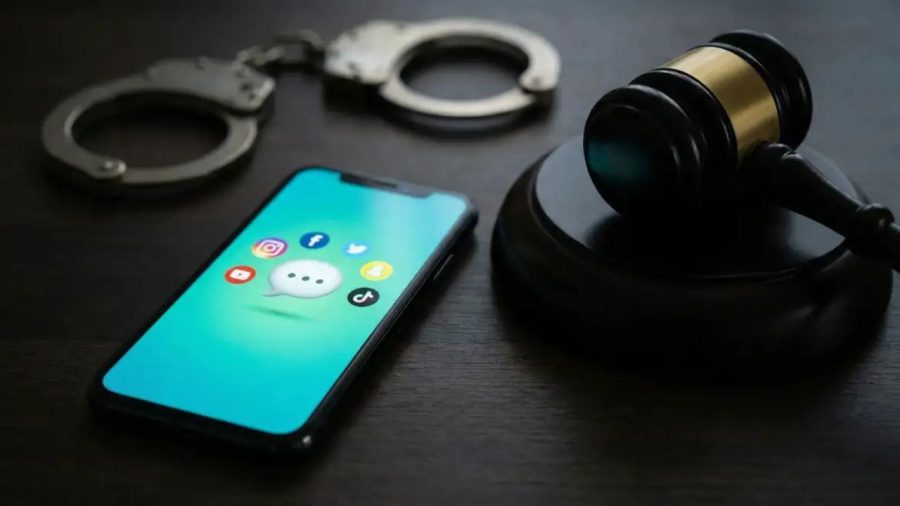
When terrorism laws meet Facebook comments
Lawyers and rights activists have questioned whether the Anti-Terrorism Act is the right instrument for dealing with offensive remarks.
Their argument is not that abusive language deserves applause. Their argument is far more inconvenient: terrorism laws are supposed to fight terrorism, not every angry sentence typed by a frustrated citizen.
They suggest that there is already a perfectly ordinary legal lane for such “unspeakable” remarks — if a person feels defamed, the aggrieved party himself can seek remedy under the Cyber Security Act.
They ask a dangerous question – dangerous because it involves logic:
If every offensive comment becomes a security threat, will the country soon need anti-terror units at political rallies, television talk shows and family gatherings?
Perhaps airports will introduce new security procedures:
“Please remove your shoes, your belt and that suspicious adjective.”
“Madam, your Facebook post appears heavily armed.”
“Sir, please declare whether your sarcasm has extremist intentions.”
But beneath this comedy lies a serious question
A democracy must protect the right to criticise governments. At the same time, public debate cannot survive if every disagreement turns into personal abuse.
The problem is not that people are angry. People have reasons to be angry.
The problem is that anger has become the cheapest political currency. It requires no facts, no solutions and no responsibility – only a microphone and an audience.
A healthy democracy cannot be built by declaring every insult a terrorist act or every insult a heroic act.
Because becoming a terrorist by using abuse and becoming a freedom fighter by using abuse are equally absurd.
The tragedy is that while everyone is fighting over whether a bad word is a bomb or a badge of honour, the electricity bill remains unpaid, public frustration remains unresolved, and common sense continues waiting outside the room where politics is happening.
Our democracy is walking confidently on two legs.
The only problem?
One leg is running towards freedom.
The other is marching towards control.
And both are convinced they are leading the way.