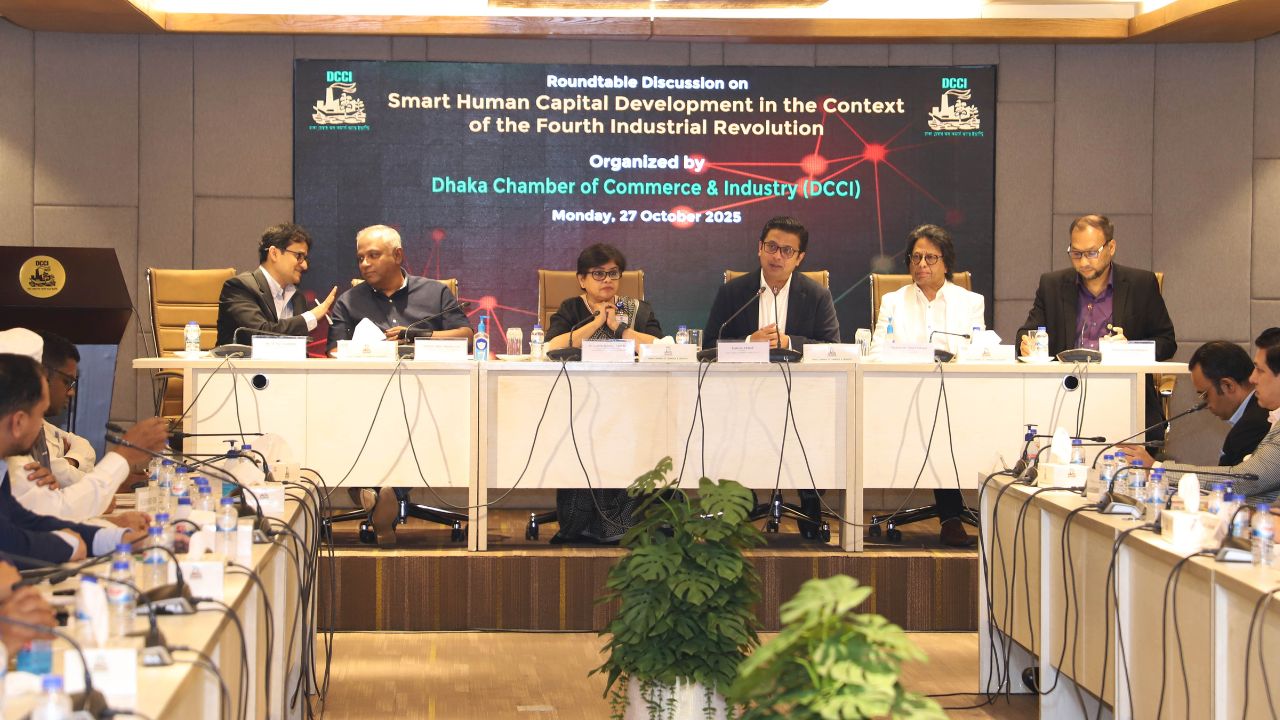

Bangladesh must strengthen skills training, modernise education and boost collaboration between industry and academia to cope with looming job disruptions as artificial intelligence (AI) and automation transform the global economy.
The urgency of developing smart human capital was underscored at a roundtable titled “Smart human capital development in the context of the Fourth Industrial Revolution,” held on Monday at the Dhaka Chamber of Commerce and Industry (DCCI) auditorium, according to a statement from the chamber.
“Bangladesh may lose 5.38 million jobs by 2030 in the apparel, food and agriculture, furniture, tourism and hospitality sectors due to automation and technology,” said Visiting Professor of Economics Dr M Niaz Asadullah, citing a 2019 Aspire to Innovate and UNDP study.
Workers must be equipped with technological skills through structured training and modern tools in technical education backed by adequate budget, he added.
The Fourth Industrial Revolution is reshaping production systems, business operations and labour markets around the world, said DCCI President Taskeen Ahmed.

“Nearly one-fourth of today’s jobs will be transformed within five years,” he said, citing the World Economic Forum.
He said smart human resources will be crucial for post-LDC competitiveness and Bangladesh must reform education and strengthen industry-academia linkage to prepare for AI-driven employment.
Weak coordination among government agencies and low awareness continue to slow progress in skill development, said National Skills Development Authority (NSDA) Executive Chairman (Secretary) Dr Nazneen Kawshar Chowdhury.
She said NSDA is now prioritising training and preparing workers for Japan with expanded Japanese language programmes while also focusing on women’s upskilling.




Promoting technical education and changing the societal mindset toward vocational training are needed because only 20% of graduates get jobs matching their qualifications while about 20 lakh remain unemployed, said The Institute of Cost and Management Accountants of Bangladesh (ICMAB) President Mahtab Uddin Ahmed.
Education is not yet aligned with industry needs and coordinated efforts are essential to develop a skilled workforce, said East West University Vice Chancellor Professor Dr Shams Rahman.
More local and foreign investment is needed in hi-tech parks to create skilled jobs, said Bangladesh Hi-Tech Park Authority Joint Secretary Mohammed Saiful Hassan.
Artificial intelligence can create employment opportunities if used efficiently but timely training is key to meeting future demand, said Brain Station 23 Chief Executive Officer Raisul Kabir.
Disparity in education quality between rural and urban areas remains a major obstacle to building a capable workforce, said BUET Professor Dr Muhammad Masroor Ali.
Skill development must be supported by curriculum modernisation and enhanced corporate training, said British American Tobacco Regional Senior Manager of Data and Analytics Khan Muhammad Saqiful Alam.
A national council could help improve coordination among training agencies and raise awareness of ICT and automation benefits, said Transcom Group Corporate Head of Human Resource M Shabbir Ali.
Sending more skilled manpower abroad would boost remittance earnings, said former DCCI Vice President M Abu Hurairah.
DCCI Director Zamsher Ali and Standing Committee Convenor Mir Sharukh Islam also spoke.
DCCI Senior Vice President Razeev H Chowdhury, Vice President Md Salem Sulaiman, board members and business stakeholders were present.