Sunday’s fatal incident at Farmgate, where a metro rail bearing pad fell and killed a commuter, has raised serious concerns over the efficiency of institution-dependent and bureaucrat-driven probe committees.
Whenever a tragedy occurs on the country’s soil, and there are plenty in each passing year, Bangladesh shows a rather troublesome tendency of relying on investigation committees led by ministry or agency officials.
Experts say bureaucrats investigating themselves works only on paper. Such committees often fail to identify root causes or find individuals responsible for whatever disaster or tragedy they are supposed to investigate. Sometimes, they even end up suppressing information.
Unless this cycle of bureaucratic dominance is broken, Bangladesh could very well face even greater disasters.
Out of depth probe committees?
This is not the first time a metro rail bearing pad came loose at Farmgate. The same incident occurred back in September 2024, but luckily there were no fatalities.
A ten-member probe committee was formed to investigate the malfunction, but neither the exact cause nor the individuals responsible were identified. The matter faded away from the public memory soon after.
That committee had four members from the Metro Rail-6 general consultant NKDM Association, four officials from Dhaka Mass Transit Company Ltd (DMTCL) and one representative each from Project-1 and Project-6, meaning everyone was connected to the metro construction.

Responding to a query, that committee’s chair DMTCL Director of Planning and Development Md Abdul Baki Mia declined to comment on the matter without the approval of Managing Director Faruque Ahmed.
A similar pattern emerged as a new six-member probe committee was formed after Sunday’s fatal accident. Three of the six members are from the ministry and metro rail authorities, while the remaining three engineers have no prior experience with metro rails.
Road Transport and Bridges Ministry Bridge Division secretary Mohammad Abdur Rouf has been appointed as the committee head.
Metro Rail Line-5 Project Director Brig Gen (retd) Mohammad Abdul Wahab serves on the committee, and ministry deputy secretary Asfiya Sultana has been made member-secretary.
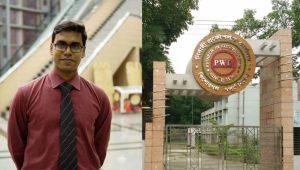
For technical review, Bangladesh University of Engineering and Technology (BUET) Mechanical Engineering Department Prof ABM Toufiq Hasan and Military Institute of Science and Technology Civil Engineering Department Associate Prof Lt Col Md Zahidul Islam have been included.

Toufiq Hasan too has no prior experience with metro rail projects.
Experts questioned why the accident, which is fundamentally a structural engineering issue, does not include representation from BUET’s civil or structural engineering faculty.
No alternative to independent, neutral probe
Aside from taking an innocent life, Sunday’s accident halted metro rail operations for nearly four hours. Service on the Uttara North-Agargaon section resumed at 3pm, and trains from Motijheel to Shahbagh restarted after 7pm.
Full operations from Uttara North to Motijheel resumed at 11am on Monday, although metro trains are currently travelling slowly between Bijoy Sarani and Farmgate.
Transport experts warn that metro rail is a mass transit system highly dependent on technology, and any incident must be investigated by professionals with deep technical knowledge.
Speaking to TIMES of Bangladesh, BUET Professor Hadiuzzaman said, “I think no one from the metro rail or the road transport ministry should be in this committee. The investigation committee must be completely independent and neutral.
“Bureaucrat-led and ministry-dependent probe committees are a major barrier to identifying the real cause of accidents.”
Hadiuzzaman added, “The committee should be formed with 100% technically adept professionals. If you try to hide the disease, it will not be cured. A bearing pad has fallen, tomorrow a train coach may collapse.”
Echoing the same, Transport expert Professor Shamsul Hoque said, “A full, independent, skilled and technically capable organisation must conduct the investigation to identify the real causes. The probe should never be any form of internal inquiry.”
A look at MRT-6
MRT-6, the country’s first metro rail project, covers approximately 20.1 kilometres from Uttara to Motijheel, and is one of the most expensive infrastructure development projects in Bangladesh. Its total cost stands at Tk 22,000 crore.
Japan International Cooperation Agency (JICA) is financing about 75% of the project or around Tk 16,650 crore, while the Bangladesh government is providing the remaining 25% or around Tk 5,550 crore for land acquisition, taxes and other local expenses.
JICA signed a 70.693 billion yen ODA (official development assistance) loan on 20 February 2013, followed by an additional 18.285 billion yen loan in 2022.
The loan carries a 10-year grace period and 40-year repayment term with a 0.70% interest rate for construction and 0.01% for consultancy services.
Dhaka Mass Transit Company Limited, operating under the Road Transport and Bridges Ministry, is the executing agency, currently led by Managing Director Faruque Ahmed and Project Director Brig Gen (retd) Md Abdul Wahab.
The general consultant NKDM Association, led by Japan’s Nippon Koei Company Limited, covers design, supervision, procurement support and project management under a Tk 928 crore contract signed on 19 November 2013.
The consortium includes Delhi Metro Rail Corporation Limited, Nippon Koei India Private Limited, Development Design Consultants, Mott MacDonald Limited and Katahira & Engineers International (KEI).
The consultancy cost is about 4% – 5% of the total project expenditure.
China’s Sinohydro Corporation, Ital-Thai Development Public Company, Japan’s Marubeni Corporation and India’s L&T Construction are among the contractors. Funds have also been spent on environmental protection measures, including noise and vibration control.