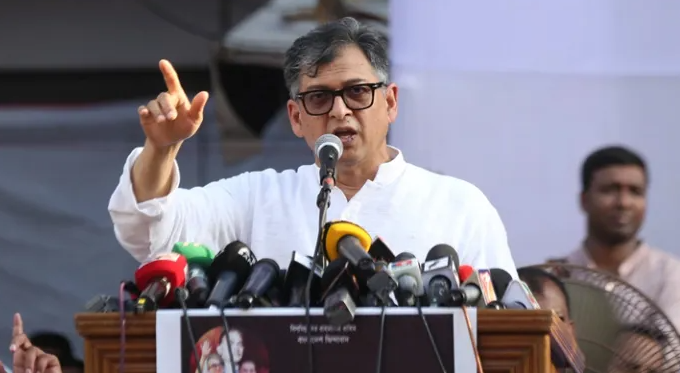

BNP Standing Committee member Salahuddin Ahmed has said the biggest challenge to organising a free, fair, and credible national election lies in the absence of political consensus on the process of democratic transition.
Speaking at a roundtable discussion titled “Expectations and Challenges for a Free and Fair Election: The Role of Government, Political Parties, and Civil Society” at the CIRDAP auditorium in the capital on Thursday, Salahuddin stated, “While we may have moved beyond fascism, we have yet to reach a common understanding among ourselves on how to transition democratically.”
The BNP leader underlined that a truly independent Election Commission, an impartial judiciary, caretaker government system, and a free press are essential safeguards for free and fair elections.

“If these are guaranteed, then holding fair elections will no longer be a challenge,” he added.
On the broader political reform agenda, Salahuddin argued that reform, justice, and elections should not be viewed as mutually dependent.
“Some reforms can be enacted immediately via executive decisions; others must begin now, even if they take time,” he said. “If this government can’t complete them, the next one must.”


Regarding proposals for constitutional amendments, he reaffirmed that parliament remains the sole legitimate forum for enacting such changes.
Shafiqul Alam, press secretary to the Chief Adviser, has said that the national election is set for the first half of February. Referring to the recently held DUCSU (Dhaka University Central Students’ Union) election, he said it was a successful trial run ahead of the national vote, noting “No untoward incidents occurred. The interim government remains committed to holding a free, fair, and peaceful election.”
Hasnat Abdullah, chief organiser (South) of the National Citizen Party (NCP), criticised the prevailing mindset in politics stating, “We still psychologically believe that controlling the administration guarantees election victory. Unless we move past this mentality, credible elections are not possible.”
Dr Shafiqul Islam Masud, secretary of Dhaka South City Jamaat-e-Islami, claimed “Jamaat is the only party fielding candidates in all 300 constituencies,”
while also questioning the legal foundation of the July Charter and the neutrality of the administration.
Rashed Khan, general secretary of Gono Odhikar Parishad, said, “We had hoped the fall of Sheikh Hasina’s regime would mean the end of fascism. But this interim government has retained all the previous repressive tactics. Their biggest failure is their inability to purge those who enabled fascism.”
Saiful Haque, general secretary of the Revolutionary Workers’ Party, commented on the DUCSU polls, “While the university election was fair and peaceful, whether the national election will be the same depends entirely on the sincerity of the current administration.”