By Ershad Hossain
Bangladesh’s banking sector has entered its most perilous phase since independence. With nearly half of all loans distressed, capital buffers collapsing, and governance failures deepening, the sector faces a systemic crisis. Political capture by oligarchs, weak supervision, and macroeconomic headwinds have converged into a perfect storm. analysis explores the roots, scale, and implications of the crisis, while offering a roadmap for reform. Charts and infographics illustrate the magnitude of the challenges ahead.
The Long Shadow of History
The roots of Bangladesh’s fragile banking culture stretch back to 1971. In the post-independence era, banks were nationalized to fund reconstruction. While this centralized control provided direction, it also embedded inefficiency and political favoritism. Through the 1980s and 1990s, liberalization brought private banks, yet licenses were distributed through political channels rather than merit. Unlike India, where institutional ownership dominates, in Bangladesh bank boards fell under the sway of powerful families and business groups. This DNA of weak governance remains visible today.
The Illusion of Growth

Between 2010 and 2020, bank credit tripled. Infrastructure projects, the garment industry, consumer credit, and real estate boomed. GDP growth of 6–7% appeared to validate this expansion. Yet the expansion was built on shallow capital buffers, weak provisioning, and the abuse of loan rescheduling. By 2020, fragility was visible but concealed by regulatory forbearance. The credit boom was a mirage, its cracks revealed when external shocks—from COVID-19 to global inflation—hit the economy.
NPLs: The Numbers Behind the Crisis
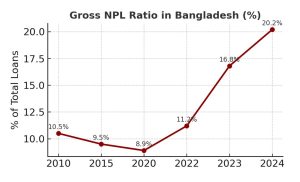
By December 2024, gross non-performing loans stood at Tk 345,764 crore, or 20.2% of all loans. By March 2025, this figure swelled to Tk 420,334 crore (24.1%). State-owned banks carry the worst burdens, with some reporting over 40% NPLs. Private banks face pressure as industrial borrowers falter. Specialized banks, tasked with priority lending, also show double-digit NPLs. Foreign banks, by contrast, maintain healthier portfolios under stricter oversight. The sheer scale of NPLs in Bangladesh is unmatched in South Asia, making it a regional outlier.
Distressed Loans: The Hidden Crisis



Beyond NPLs lies the broader category of distressed loans: defaults, rescheduled exposures, and written-off loans. In 2024, this figure reached Tk 756,526 crore, or 45% of total loans. Defaults stood at Tk 345,765 crore, rescheduled loans at Tk 348,461 crore, and written-off loans at Tk 62,300 crore. Worryingly, nearly 40% of rescheduled loans slid back into default. The cycle of evergreening has become a trap, allowing influential groups to roll over debts without consequence while small borrowers are penalized.
Islamic Banks: A Quiet Crisis
Islamic banks, once marketed as safer, now mirror conventional weaknesses. Islami Bank Bangladesh faced Tk 72.46 billion in irregular loans in 2022. First Security Islami Bank faced liquidity stress and regulatory intervention in 2024. Governance weaknesses—family dominance, insider lending, and political patronage—are rampant. Their large depositor base, often middle-class savers, makes instability in Islamic banks socially and politically explosive.
Ownership Matters: Bangladesh vs India
In Bangladesh, banks are dominated by businessmen and family groups. Boards are often filled with owners’ relatives, blurring lines between lender and borrower. In India, by contrast, ownership is institutional—public banks are state-owned, while private giants like HDFC and ICICI are held by diversified institutional investors. Regulatory oversight ensures fit-and-proper criteria. This difference in ownership explains why Indian banks maintain stronger capital and governance, while Bangladeshi banks remain vulnerable to insider capture.
Political Capture and Oligarchic Dominance
Conglomerates such as S Alam, Beximco, Bashundhara, Orion, Family of Saifuzzaman Chowdhury, and other influential groups dominated both industry and banking. Their capture of boards, backed by political elites, enabled them to direct loans toward themselves and escape accountability. Bangladesh Bank insiders admit that powerful borrowers have siphoned funds abroad with impunity. This nexus of politics, oligarchy, and finance entrenches moral hazard and weakens governance.
Regional Comparisons – A Bleak Picture
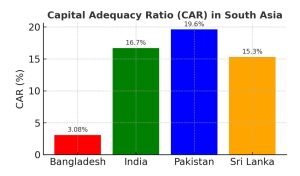
India: Gross NPLs at 2.5%, CAR at 16.7%. Pakistan: Gross NPLs at 7–8%, CAR near 20%. Sri Lanka: Gross NPLs at 10.9%, CAR 15.3%. Bangladesh: Gross NPLs above 20%, CAR at 3%. These figures make Bangladesh the weakest system in South Asia. Globally, only a handful of fragile economies share such poor banking metrics.
Reforms and the Road Ahead
Bangladesh Bank has launched reforms: Asset Quality Reviews by global firms, the Bank Resolution Ordinance 2025, the creation of a Bank Restructuring & Resolution Unit (BRRU), and Tk 50,000 crore in liquidity injections. Governance reforms aim to limit family dominance and reduce political interference. International partners—IMF, ADB, World Bank—are supporting with funding and expertise. Yet reforms face resistance from entrenched interests. Without political will, they risk remaining cosmetic.
Conclusion
Bangladesh’s banking sector is at a crossroads. With nearly half of loans distressed, capital depleted, and oligarchic capture entrenched, the sector faces systemic risk. Islamic banks add further vulnerability, while depositor trust is fragile. Reforms provide hope, but only if enforced with courage. The next decade must be about rebuilding resilience, restoring credibility, and renewing the social contract between banks and the Bangladeshi people. Credit without capital is not progress—it is fragility.
–Writer is a Director at Putnam Capital Advisory Pte Ltd
And, Senior Director at Lion City Advisory Limited