
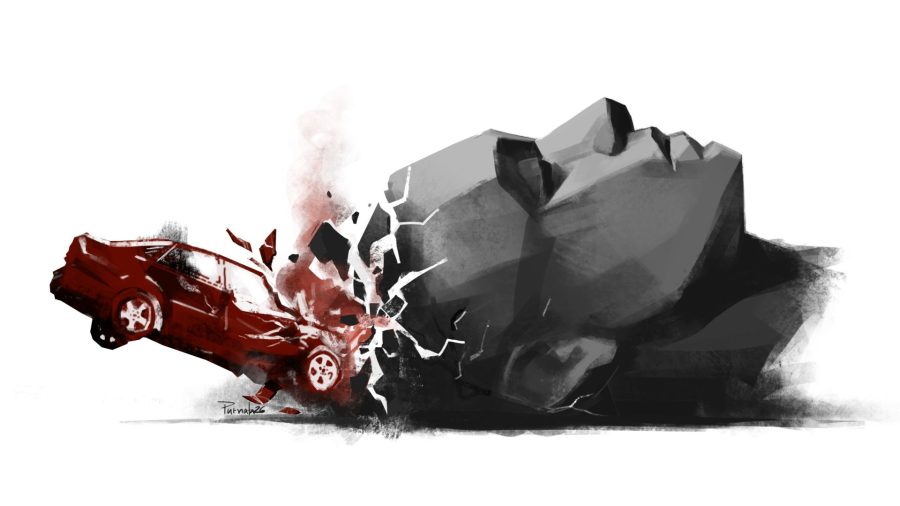



Whenever we hear the words “health crises,” we tend to think in terms of hospital beds, vaccines, and microscopic pathogens. However, one of Bangladesh’s most critical health crises is occurring in plain sight almost every single day. Every morning, thousands of commuters step onto roads across the country where many fall victim to accidents and mishaps. The staggering frequency of these daily occurrences has forced health experts and epidemiologists to officially classify the crisis as an epidemic.
Behind this surging crisis lies a chaotic trail of systemic failures, corruption, uncertified reckless drivers, and a lack of pedestrian safety infrastructure. But the people caught in the crossfire are often overlooked. For those who survive, that one moment is life-altering: the catalyst of a painful journey of physical and mental trauma. According to the Centre for Injury Prevention and Research, Bangladesh (CIPRB), on average, nearly 65,000 individuals are either killed or disabled every year across Bangladesh due to this crisis.
The epidemic claimed another devastating chapter this week. In the early hours of Tuesday, a head-on collision between a passenger bus and a sand-laden truck in Natore’s Bonpara left at least 14 people dead and dozens injured. The bus, operated by RP Paribahan, was travelling from Barguna to Chapainawabganj when it collided with the truck on the Natore-Pabna highway around 4am. Nine people died on the spot, including an eight-year-old girl; others succumbed to their injuries at hospitals.

Survivors alleged that the bus helper was driving recklessly while the driver slept at the back, an allegation police said they were investigating. The dead included an onion trader travelling with eleven others to buy seeds, a bank officer and his daughter, and a couple on their way to visit family for Durga Puja. For the families left behind, the grief is compounded by allegations of missing cash and belongings from the wreckage.
The physical trauma inflicted on victims is often severe and permanent. Injuries ranging from broken bones, shattered limbs, internal organ haemorrhaging, and brain damage are instantly followed by gruelling emergency surgeries, skin grafts, and amputations aimed at keeping them alive. Severe injuries such as a severed spinal cord can leave them paralysed. Once discharged, victims must adapt to a life of mobility issues, chronic pain and, for some, permanent paralysis.




The aftermath of physical trauma is an equally severe yet largely invisible mental health crisis. Many survivors suffer from Post-Traumatic Stress Disorder, trapped in a cycle of debilitating flashbacks, panic attacks, and an intense fear of vehicles or open roads. Many even suffer from survivors’ guilt if they lose loved ones in the accident they survive. The mental toll is compounded by clinical depression and anxiety as victims struggle to cope with their altered bodies and sudden loss of personal independence.
Entire households are often pulled into a storm of socio-economic crises. In Bangladesh, victims are often the breadwinners, so this puts an instant financial strain that often ends in poverty. The burden of full-time caregiving typically forces other family members (mainly women) to alter their lives, whether by leaving jobs, sacrificing their own education, or abandoning long-term goals just to manage the household’s new reality. Compounding the loss of stability is the overwhelming cost of medical treatment and long-term care. Families are routinely forced to deplete their life savings, sell assets, or take on heavy debt.
An equally severe consequence of this long-term recovery cycle is the risk of chemical dependency. To cope with unrelenting chronic pain, survivors are often prescribed potent painkillers, which can easily spiral into prescription opioid or sedative addiction. Without accessible mental health support, both overwhelmed caregivers and survivors sometimes turn to self-medication or illicit substances to numb the constant stress and depression.
During a roundtable discussion titled “Safer Roads, Safer Lives: A National Call to Action” held on 19 August 2026 at The Daily Star Centre in Dhaka, Dr Salim Mahmud Chowdhury, deputy executive director of CIPRB, emphasised that the lack of a robust pre-hospital system necessitates the urgent development of emergency trauma care capable of providing definitive treatment within the “golden hour.”
To truly dismantle this silent epidemic, Bangladesh must fundamentally broaden its approach to road safety, shifting from a narrow focus on transport logistics to a comprehensive public health strategy. True recovery requires creating a specialised network of affordable, community-based trauma rehabilitation centres and integrating accessible mental health services directly into post-accident medical protocols.
The path forward requires looking past the statistics and focusing on the lives at stake. True progress cannot be measured by how fast our roads expand, but by how well we protect the people using them. By treating traffic chaos as a critical health emergency rather than an unavoidable part of daily life, the nation can finally build a safer country, one where a simple commute no longer ends in a lifetime of suffering.