


Pakistan’s federal government has taken direct administrative control of Khyber Pakhtunkhwa, suspending the provincial administration led by jailed former prime minister Imran Khan’s party, Pakistan Tehreek-e-Insaf.
President Asif Ali Zardari signed the proclamation on the advice of Prime Minister Shehbaz Sharif, invoking both a state of emergency under Article 232 and governor’s rule under Article 234 of the Constitution.
Following the order, Governor Faisal Karim Kundi of Pakistan Peoples Party assumed provincial executive powers, assisted by a newly constituted 11-member advisory council.
Federal authorities also appointed Muhammad Fakhr Alam Irfan as chief secretary. Chief Minister Sohail Afridi along with his cabinet and legal appointees, ceased to hold office, with Afridi and several senior party figures subsequently detained by security forces.
Security claims and political friction
Federal ministers justified the dual constitutional measures by citing a sharp surge in terrorist attacks across Khyber Pakhtunkhwa, claiming the provincial administration had failed to demonstrate the political will to combat militancy.

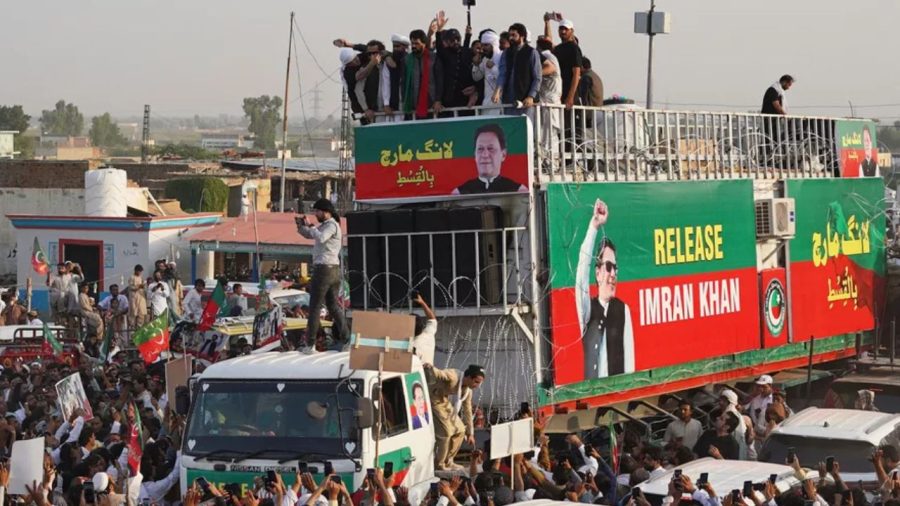
Information Minister Ataullah Tarar further alleged collusion between the provincial government and armed groups. Pakistan Tehreek-e-Insaf strongly rejected these assertions, pointing out that federal action was triggered not by security threats, but by Chief Minister Afridi launching a mass protest march towards Islamabad on 4 October to demand Imran Khan’s release.
Party leaders also questioned why governor’s rule was enforced across the entire province rather than targeted at specific high-risk areas, contrasting the decision with Balochistan where security challenges remain similarly severe.
Restructuring administrative framework
Alongside political changes, federal authorities executed sweeping administrative reorganisations.




The provincial law department removed 57 law officers from the advocate general’s office, including 26 additional advocate generals and 31 assistant advocate generals, and appointed 27 replacement officers.
Simultaneously, a massive reshuffle occurred across administrative departments, transferring key provincial secretaries, divisional commissioners, and deputy commissioners.
In a separate order, the federal government established a special secretariat for 12 designated districts, primarily in former tribal areas, under an additional chief secretary.
Within these districts, the constitutional requirement separating the judiciary from the executive has been suspended, allowing executive officials to perform judicial roles.
Legal mechanics and constitutional limits
Invoking Articles 232 and 234 simultaneously combines distinct legal frameworks. Emergency under Article 232 addresses severe security or internal disturbances and allows Parliament to pass overriding legislation, while fundamental rights may be suspended under Article 233.
Emergency declarations require parliamentary approval within 10 days and a joint parliamentary sitting within 30 days to remain valid.
Governor’s rule under Article 234 applies when constitutional machinery breaks down, transferring assembly legislative powers to Parliament for up to six months.
Legal experts and Supreme Court precedents, including the landmark 1994 Pir Sabir Shah v. Federation decision, establish that governor’s rule does not permanently dissolve the provincial mandate; upon the expiration or revocation of the order, the elected chief minister and assembly are legally restored.
Historical context of frontier governance
Federal intervention in Khyber Pakhtunkhwa aligns with a long-standing pattern of central control over the northwestern region. Originally designated as the North-West Frontier Province by British colonial rulers in 1901 and renamed in 2010, the area was historically governed through exceptional regulations, serving as a strategic buffer zone.
Political instability followed Pakistan’s independence, beginning in August 1947 when Muhammad Ali Jinnah dismissed the elected ministry of Khan Sahib.
Subsequent decades saw repeated resort to governor’s rule, including interventions in 1975 and 1994.
Despite 2018 merger of Federally Administered Tribal Areas into Khyber Pakhtunkhwa to integrate the region, unresolved local grievances and central overreach continue to perpetuate political contestation.