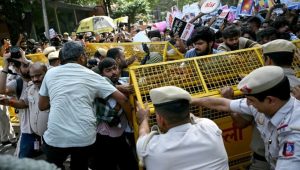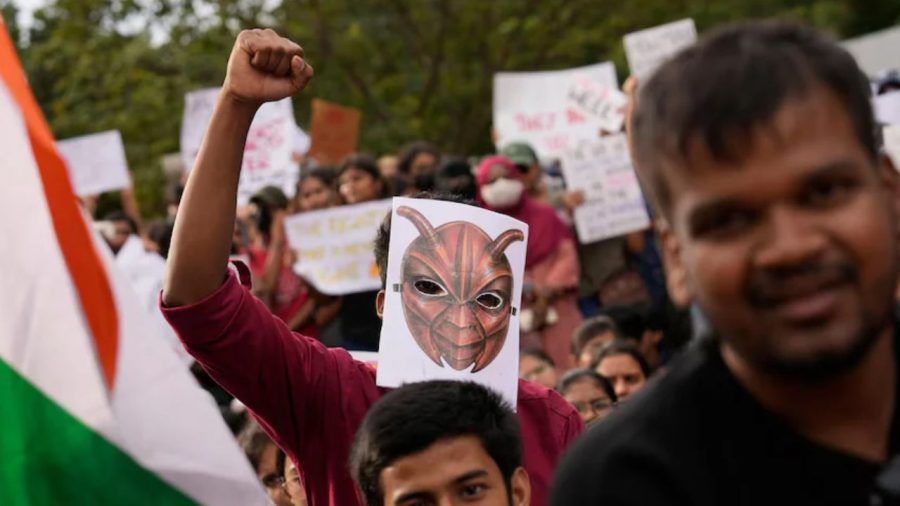



New Delhi was placed under a massive security blanket on Saturday, with more than 30,000 police personnel deployed across the capital and at least 1,000 people detained overnight ahead of a protest called by the Cockroach Janta Party (CJP) and the All India Students’ Association, demanding the resignation of Chief Election Commissioner Gyanesh Kumar.
The Delhi Police intensified security across the capital after refusing permission for the proposed demonstration at Jantar Mantar, while CJP leaders remained determined to proceed with the protest. Key roads and administrative corridors were barricaded, transport services were disrupted, and surveillance was stepped up to prevent demonstrators from entering restricted areas and to maintain law and order.
According to police sources, nearly 250 people had been detained in South East Delhi, particularly in sensitive areas around Shaheen Bagh, as of 12:30 am on Saturday. More than 100 others were reportedly picked up from Shahdara and East Delhi districts bordering Uttar Pradesh, while around 50 people were detained near Connaught Place.
A senior police official said the detentions were preventive measures intended to maintain law and order. According to the official, individuals with a history of mobilising crowds and inciting unlawful assemblies had been identified and taken into custody. The detainees were to be transferred to 13 designated detention centres established across different districts.
Inter-district border checkpoints and multiple barricades were set up between Central Delhi and New Delhi, while important roads, including Ashoka Road and Tolstoy Road, were blocked with successive layers of barricades to prevent protesters from entering high-security administrative zones.
In an unusual development, municipal sanitation workers were seen unloading garbage from trucks onto several key roads in what appeared to be an attempt to obstruct the movement of CJP supporters.

The security operation extended beyond police deployment and roadblocks, with extensive restrictions affecting public transport and internet access.
Around 250 long-distance trains scheduled to travel to Delhi from different parts of the country were cancelled, while services at 45 Delhi Metro stations were temporarily suspended. Internet services were also disrupted in sensitive areas as authorities sought to prevent large gatherings.
Administrations in other states were reportedly instructed to identify CJP supporters within their jurisdictions and prevent them from travelling to Delhi to participate in the demonstration.




The measures followed directions from the Union Home Ministry for a coordinated security operation aimed at preventing protesters from entering restricted areas of the capital.
Amid the restrictions, CJP founder Abhijeet Dipke, while leaving Mumbai for Delhi by air, said that Indian Prime Minister Narendra Modi and the central government were afraid of the country’s youth and ordinary citizens and had effectively conceded defeat even before the protest began.
Questioning the government’s support for Chief Election Commissioner Gyanesh Kumar, he asked why police and special forces were being deployed against citizens to protect the election chief.
Dipke also claimed that Central Reserve Police Force (CRPF) personnel from Naxal-affected areas, along with additional forces from Jammu and Kashmir, had been withdrawn from their existing deployments and sent to Delhi to suppress the voices of ordinary people.
The claims were allegations made by the CJP founder and could not be independently verified from the information available.
The proposed demonstration has also triggered political and religious debate, with several prominent religious leaders urging Muslim youths to stay away from the protest.
Among them was Umar Ahmed Ilyasi, head of the All India Imam Organisation. The leaders argued that political parties had repeatedly used ordinary Muslims to advance their own interests and maintained that the movement did not serve the interests of any particular community.
They cautioned young people against becoming instruments of politically motivated campaigns and warned against attempts to destabilise the country’s atmosphere.
Meanwhile, CJP co-convenor Saurabh Das accused the Delhi Police of deliberately targeting the party’s leadership.
Das alleged that while circulating notices prohibiting the demonstration and documents containing previously submitted undertakings to the media, the police had failed to conceal his personal phone number.
He claimed that the disclosure had subjected him to severe harassment over several hours, with hundreds of phone calls and messages reaching him.
The allegation added another dimension to the growing confrontation between the protest organisers and the authorities ahead of the planned demonstration.
With the police determined to prevent an unauthorised gathering and CJP leaders insisting on proceeding with their programme, the proposed protest at Jantar Mantar has become a major law-and-order challenge for the national capital.
The extensive deployment, overnight detentions and restrictions on transport underscore the scale of the preparations as authorities seek to prevent a potential escalation.