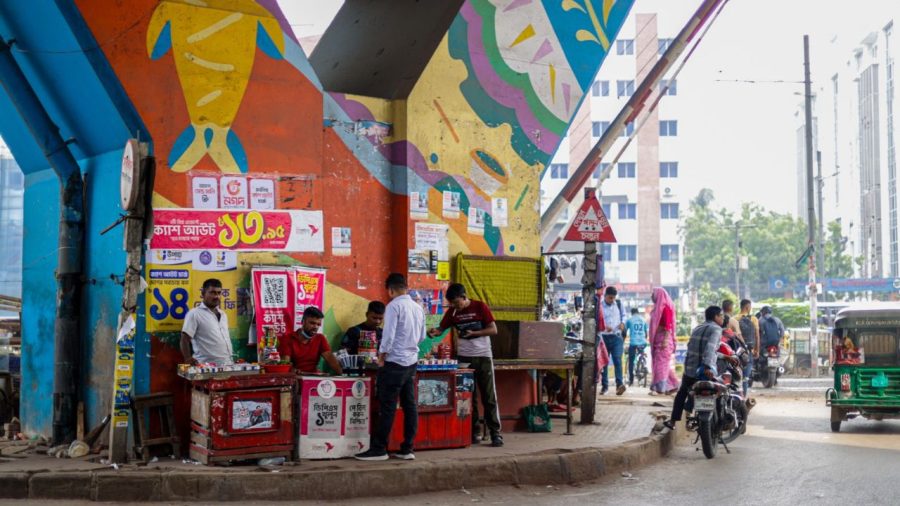



Colourful murals that once transformed Dhaka’s drab flyover pillars into public artwork are rapidly disappearing beneath layers of political posters and commercial advertisements, even as the Dhaka North City Corporation (DNCC) launches another ambitious campaign to decorate metro rail pillars in Mirpur.
Graffiti created at places under the DNCC’s 2023 beautification initiative has been systematically defaced or covered by posters promoting political leaders, coaching centres, local businesses, and upcoming events. Many pillars around Mohakhali and Moghbazar have deteriorated into unsightly patches of overlapping advertisements, with torn paper obscuring the original street art.
This rapid decline raises serious questions over the city authorities’ ability to protect public art, particularly as the DNCC embarks on a new initiative – “Let’s Remake July Graffiti” – to commemorate the July 2024 uprising through murals on metro rail pillars.
In 2023, the DNCC launched its “Rang Badle Rangin Kori” campaign to transform the undersides and pillars of flyovers through vibrant graffiti and street art. Beginning in Mohakhali, the initiative later extended to the Moghbazar flyover, successfully replacing poster-covered concrete with lively artwork. For several years, the murals enhanced the urban landscape, while illegal poster pasting temporarily ceased.

However, the political shift following the July 2024 mass uprising disrupted those gains. In the changed political climate, posters featuring newly emerging political leaders and activists began appearing on the pillars. As political material spread, advertisements from commercial entities followed suit, eventually spilling over onto metro rail pillars despite explicit bans.
During the interim government’s tenure, artwork depicting critical events under the former Awami League administration was painted on several metro rail pillars. Today, many of those murals have also been buried under banners and posters, particularly those affiliated with BNP-aligned activists.
A visit to Mohakhali and Moghbazar revealed posters pasted over one another across numerous flyover pillars, leaving the underlying artwork obscured beneath scraps of paper. Open spaces used by pedestrians crossing roads have effectively turned into commercial display zones.

Along the route from Hatirjheel towards Karwan Bazar, pillars carry posters advertising the “Clemon Indoor University Cricket 2026” tournament.
In Moghbazar, posters featuring Saiful Haque, general secretary of the Revolutionary Workers Party, appear alongside advertisements for higher education consultancy firms promoting opportunities to “Study in Europe and China”.
Near the Moghbazar intersection, advertisements for the Udvash educational group and Upay’s “Upay Unmadona” campaign occupy prominent spaces. Beneath the Satrasta and Mohakhali flyovers, posters advertise job vacancies, removals services, barbershops, and the film Abar Hothat Brishti, alongside campaign material for Jamaat-e-Islami and BNP candidates.
Pedestrians have voiced frustration over the visual pollution. Tarikul Islam, crossing at the Satrasta zebra crossing, lamented the degradation: “It used to look beautiful. Now they have ruined everything by putting up these ugly posters. It looks awful.”
The widespread poster pasting continues despite clear statutory prohibitions. Section 3 of the Wall Writing and Poster Pasting (Control) Act 2012 prohibits wall writing and poster pasting without prior permission from local authorities or outside designated areas. Under Section 6, individual violators face fines of Tk 5,000 to Tk 10,000, with 15 days’ simple imprisonment in default. For organisations, penalties range from Tk 10,000 to Tk 50,000, alongside up to 30 days’ imprisonment. Offenders are also legally required to remove unauthorised material at their own expense, and mobile courts hold summary jurisdiction to enforce the law. High Court directives have similarly instructed strict action against offenders.
Against this backdrop, the DNCC inaugurated its “Let’s Remake July Graffiti” campaign on Friday, aiming to decorate metro rail pillars in Mirpur with artwork commemorating the July movement. DNCC Administrator Md Shafiqul Islam Khan launched the drive by painting metro rail pillar 248 at the Mirpur-10 roundabout.
Shafiqul noted that during a recent cleanliness drive in Kazipara, political and commercial posters were removed from metro rail pillars within 72 hours through local cooperation. He stated that the new campaign aims to preserve history, confirming that portraits of former Prime Minister Khaleda Zia, martyrs of the uprising, and student and political leaders would be incorporated into the artwork.
However, as past experience shows, without strict and continuous legal enforcement, new public artwork in Dhaka remains at constant risk of being buried under the next wave of unauthorised paper.