


For road repair worker Ismail, breakfast once meant two eggs.
Now he eats just one, saving what little he can to ensure his nine-year-old child gets enough to eat.
Working under a sweltering sky on a road in Dhaka’s Karwan Bazar, Ismail is among a rapidly growing number of low-income labourers forced to ration eggs, long considered the most affordable and accessible source of animal protein, as relentless food inflation squeezes household budgets to breaking point.
“My child is nine years old and needs nutritious food. So, I sometimes give him two eggs and reduce my own portion,” Ismail told TIMES.
His daily struggle reflects a grim reality as Bangladesh marks World Egg Day on Friday: eggs are becoming increasingly unaffordable for the very people who depend on them most.
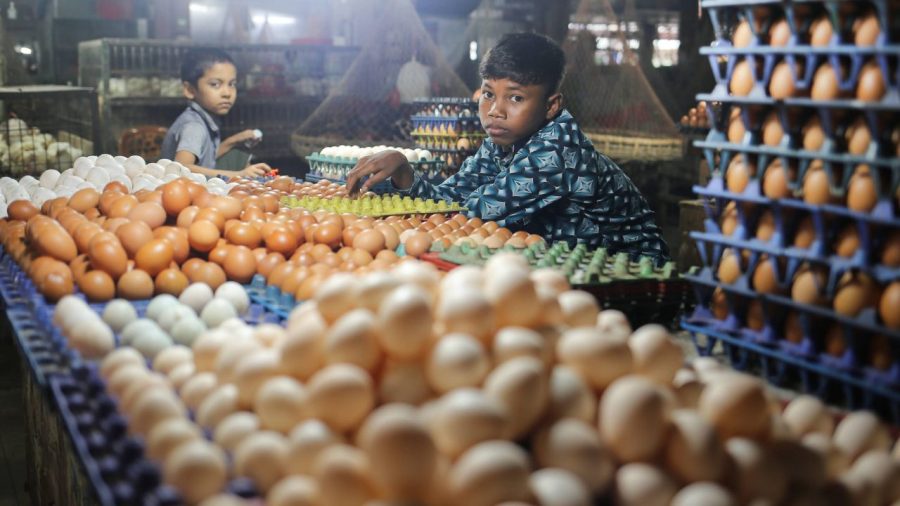
At retail shops across Merul Badda, Rampura, and Banasree, commercially farmed eggs were selling for between Tk165 and Tk180 a dozen.
Meanwhile, roadside eateries in the capital were charging Tk30 for a single egg with breakfast.
For daily wage earners operating on threadbare margins, even that modest expense has become prohibitive.
Jamal Islam, an employee at Salauddin Restaurant in Karwan Bazar, noted a sharp drop in breakfast orders.
“People are ordering far fewer eggs with their morning meal. We used to regularly see customers ordering two eggs at a time, but that has become exceptionally rare,” he observed.
“Overall, egg sales at our establishment have fallen by roughly 30 per cent.”
The economic squeeze has fundamentally shifted the focus of this year’s World Egg Day.

The 30th annual observance carries the official theme “Protein that Powers and Protects”, aiming to highlight the vital nutritional benefits of eggs.
Yet for workers like Ismail, the primary concern is not celebration, but basic survival, and whether they can continue to afford even a single egg.
AHM Shafiquzzaman, president of the Consumers Association of Bangladesh (CAB), voiced deep concern over the unmonitored market dynamics.
“Poor and low-income people are suffering enormously because of the uncontrolled rise in egg prices. Yet there is no effective or visible government monitoring of the market to curb exploitation,” he said.
A daily struggle for fuel
For Ramzan Mia, a driver’s assistant on a Bihanga Paribahan bus, the working day starts at dawn and is spent almost entirely on the road. Breakfast is a vital source of stamina.
“We cannot afford chicken or beef. What else can we eat in the morning if not eggs?” he asked.
“But once I add an egg, my breakfast bill reaches Tk70 to Tk80. I spend the whole day on the road and cannot even eat properly.”
Rickshaw puller Sobhan Islam faced a similar dilemma whilst stopping for lunch at a roadside food stall in the rain.
The menu displayed egg bhuna for Tk50, chicken for Tk100, and beef for Tk120.




The absolute cheapest option was a simple spicy egg omelette costing Tk30.
“If one person has to spend Tk150 just to eat, what are we supposed to do?” Sobhan asked.
He eventually settled for a modest plate of rice accompanied by a single fried egg.
Asked if the meal was sufficient, he shrugged, “What difference does a full stomach make? I am not getting proper nutrition. By evening, I feel utterly exhausted.”
Children’s nutrition under threat
The ramifications of shrinking dietary budgets extend far beyond exhausted adults; children are facing heightened risks of malnutrition.
A study published in the international Journal of Nutritional Science revealed that 73.3 per cent of Bangladeshi infants aged six to 23 months consumed animal-source foods, including eggs, fish, meat, and milk, in 2022.
While that metric had steadily improved over previous years, recent survey data indicates a worrying downward trajectory.
Researchers highlighted that children who had recently fallen ill were 24 per cent less likely to consume animal-source foods, citing illness, poverty, and restricted access to nutritious food as key factors depriving infants of essential micronutrients.
Abu Torab Md Abdur Rahim, a professor at the Institute of Nutrition and Food Science at the University of Dhaka, warned that persistent food inflation is forcing low-income families to cut consumption to alarming levels, with potentially devastating long-term consequences for physical and mental development.
“Where households previously bought one kilogramme of food, they are now buying half a kilogramme or even less,” Professor Rahim explained.
“As a result, their bodies are starved of essential nutrients, including protein, fat, and carbohydrates.
Prolonged reductions in food intake leave people merely surviving without maintaining full working or cognitive capacity. It is effectively a form of slow poisoning.”
Paradox of rising prices amid high production
Curiously, egg prices continue to spiral upward despite Bangladesh reporting robust domestic production.
At Karwan Bazar, wholesale farm eggs were selling for Tk155 to Tk160 a dozen on Wednesday.
Traders noted that retail prices across Dhaka jumped by Tk5 to Tk10 per dozen over the past week alone, following a recent Tk20-per-litre surge in fuel costs.
According to the Department of Livestock Services (DLS), Bangladesh currently produces roughly 24.46 billion eggs annually, yielding an average availability of 137 eggs per person per year.
While the government aims to elevate that figure to 200 eggs per capita by 2030, spiralling prices cast serious doubt on whether that target remains achievable.
Agricultural economist and researcher Jahangir Alam Khan argues that the underlying problem stems from poor market management.
“Farmers are struggling with escalating feed, fuel, and transport costs, whilst consumers are forced to pay exorbitant prices due to market instability,” Khan observed.
“Meanwhile, large corporations operating between primary producers and end consumers are reaping enormous profits.”
Farmers and mill owners squeezed
Poultry farmers insist that surging operational expenses are threatening the industry’s viability.
Usmani Islam, a farmer based in Chattogram, revealed that an acute shortage of day-old chicks and soaring production costs forced between 20 and 30 per cent of farms in his district to shut down over the past year.
“Unless farmers are afforded protection and security, increased overall production cannot be viewed as sustainable development,” he warned.
Tahir Ahmed Siddiqui, president of the Bangladesh Egg Producers Association, noted that reduced farm capacity is constricting wholesale supply, putting further upward pressure on retail prices.
In Rajshahi’s Paba, poultry farmer Mohammad Hafiz explained that rising feed, medicine, and overhead expenses have completely wiped out his profit margins.
Fellow local farmer Abu Yusuf concurred, stating that managing feed costs has become virtually impossible.
Suppliers face similar pressures. Mohammad Ahsanuzzaman, senior vice-president of the Feed Industries Association Bangladesh, pointed out that raw material prices have surged in both global and local markets.
“Feed production costs have jumped dramatically. In some instances, the cost of manufacturing a 50kg bag of feed has risen from Tk26 to Tk40. Transport costs have similarly escalated, leaving feed mill owners suffering severe losses,” he said.
Government scrutinises supply chain gaps
The widening disparity between producer and consumer prices has drawn criticism from government ministers.
During a high-level meeting with poultry industry representatives on 27 September, Commerce Minister Khandaker Abdul Muktadir expressed strong dissatisfaction over the massive price gap separating farm gates from retail counters.
He called for an immediate investigation into abnormal costs and excessive profit margins across the supply chain.
“We must urgently identify at which stage of the supply chain abnormal costs are being tacked on, or who is extracting excessive profits,” Muktadir said.
“Producers, wholesalers, commission agents, and retailers must cooperate to ensure the market becomes transparent and efficient.”
For Ismail, however, policy debates bring little immediate relief.
As Bangladesh officially celebrates the nutritional virtues of the egg, the road repair worker is already contemplating a harsher compromise: surrendering his remaining breakfast egg entirely so his young child can continue to eat.