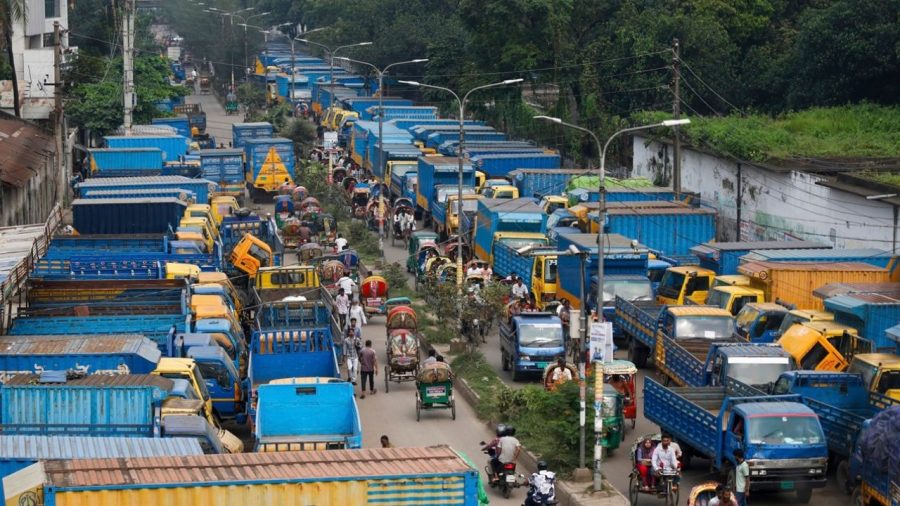



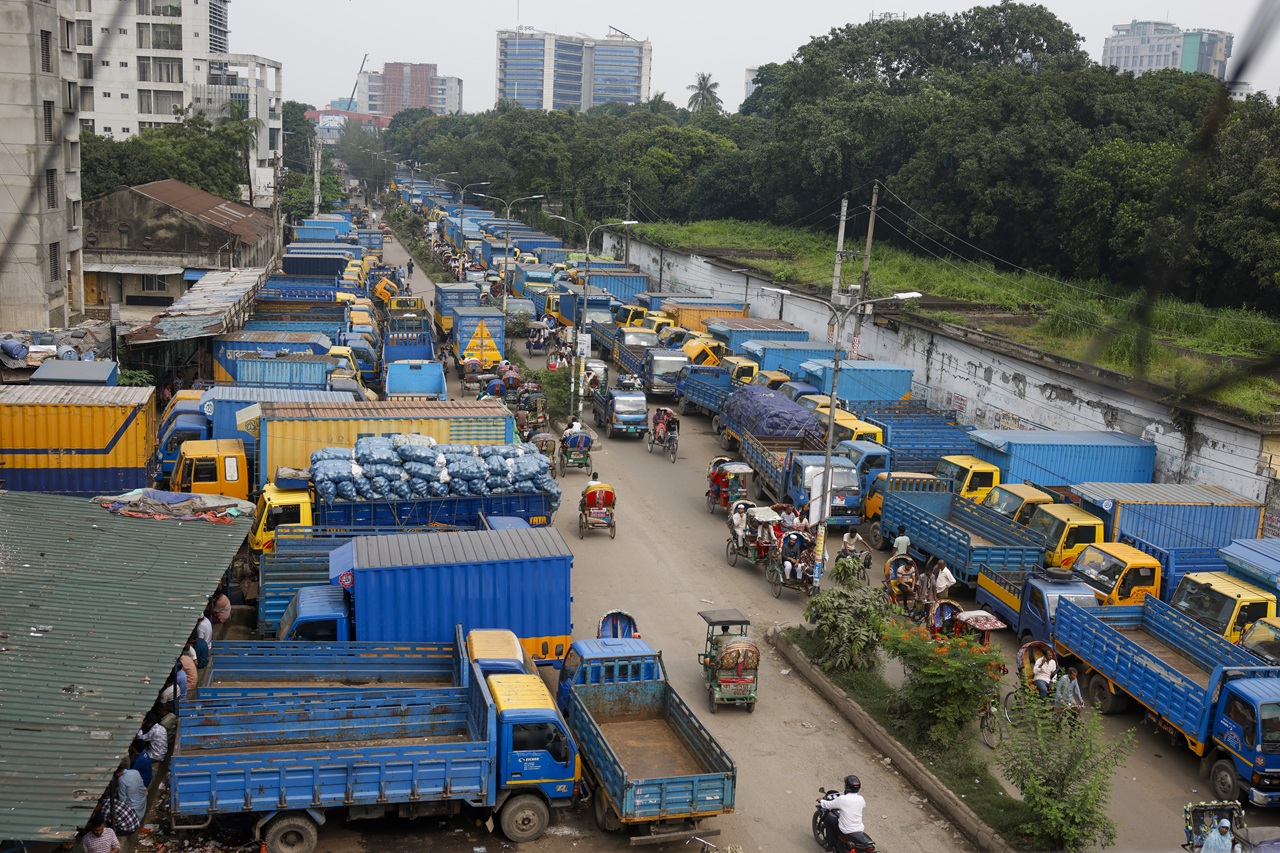
Nearly a decade after Tejgaon’s truck stand was cleared from the road in a widely discussed eviction drive, trucks, covered vans, and pickups have once again taken over large parts of the Satrasta–Karwan Bazar corridor.
Several lanes of the nearly 100-foot-wide road are now routinely occupied by parked goods vehicles, while nearby footpaths and connecting roads are also being used as makeshift parking and repair spaces.
In some stretches, trucks stand two or three rows deep, leaving so little room that even two vehicles struggle to pass side by side. Most of the iron barriers that once separated a rickshaw lane have disappeared.
The encroachment has also pushed pedestrians off the footpath. In many places, trucks are parked sideways with their rear ends extending onto the pavement, forcing people to walk on the main road.
The problem has persisted for years because Tejgaon sits beside the industrial zone and Karwan Bazar, drawing large numbers of cargo trucks, covered vans, and pickups from across the country. With no adequate permanent terminal, parking has spread from the Karwan Bazar level crossing towards Satrasta, Begunbari, and surrounding roads.
The roadside has also turned into an open-air workshop. Engine repairs, welding, denting, painting, and wheel removal are carried out beside parked trucks, with vehicle parts and repair equipment often scattered across the road.

The congestion affects an area crowded with major public institutions, including BSCIC, Essential Drugs Company Limited, the Survey of Bangladesh, the Department of Land Records and Surveys, and the Central Storage Depot. Dhaka Polytechnic Institute, Bangladesh University of Textiles, the National Institute of ENT, newspaper offices, printing presses, and numerous public and private organisations are also located nearby.
Officials and residents say the disorder is not only slowing traffic but also raising security concerns around important government and KPI-listed installations.
Murad Sarkar, a grocery shopkeeper in Begunbari, said the problem becomes particularly difficult after dark. “People sit behind the trucks on the footpath and take drugs. So I have to walk on the road,” he told TIMES.
An official at BSCIC said parked trucks often made it difficult for office vehicles to enter and exit. “Sometimes only one lane remains usable. Even turning a vehicle becomes difficult,” he said.


Masum Hossain of Essential Drugs said workers often ignored requests to move their vehicles. “Sometimes they behave badly,” he said.
Residents and pedestrians also complained of drug users and muggers gathering behind parked trucks.
Fahim Hasan, a student who regularly uses the road, said, “There is always fear about when something might happen.”
Truck owners and workers, however, say they have little choice.
The terminal was built around seven decades ago on lands owned by the Bangladesh Railway. While the terminal is intended for parking vehicles, various illegal structures, including shops, markets, garages, and workshops, have been set up on the site over time.
Before the 2025 eviction driver, then DNCC mayor Annisul Huq said that the railway had not leased its land to anyone. Because so much of the terminal space has been seized by land grabbers, numerous vehicles are forced to park on the adjacent road, severely obstructing traffic.
Mohammad Abdullah, office secretary of the Bangladesh Bus-Truck Covered Van Owners Association, claimed the space had been allocated to their organisation during Annisul Huq’s tenure as Dhaka North mayor and therefore should not be treated as illegal occupation.
He estimated that the stand could hold 400 to 500 trucks, but said many more vehicles remained after it filled up, forcing some onto the road.
Abdul Motaleb, general secretary of the Bangladesh Truck-Covered Van Transport Agency Owners Association, said the shortage of parking was at the heart of the problem. “If a permanent and planned truck terminal is built, there will be no need to park on the road,” he said.
Md Rafiqul Islam, deputy commissioner of DMP’s Traffic-Tejgaon Division, acknowledged that roadside parking was causing congestion and public suffering. Around 2,500 to 3,000 trucks stay in the area, he said.
“It is not possible to solve the problem simply by filing cases against or seizing such a large number of vehicles. An alternative and long-term arrangement is needed,” he said. He suggested dedicated freight terminals and designated routes outside the city or towards bypass roads.
The Tejgaon truck stand has been the focus of repeated eviction drives. The most prominent came in November 2015, when then DNCC mayor Annisul Huq led an operation to clear trucks from the roads. The move triggered hours of clashes between police and workers. After Annisul’s death in 2017, the road from Satrasta to Karwan Bazar was named Mayor Annisul Huq Road the following year. Nearby roads were also cleared, and authorities moved to widen the Satrasta-Tejgaon level-crossing stretch.
Traffic police again removed illegally parked trucks and vans in 2024. But the vehicles gradually returned. A plan for a multi-storey truck terminal in Tejgaon was also taken up, but the initiative became uncertain after approval for the allocated land was cancelled following the political change of 5 August 2024.