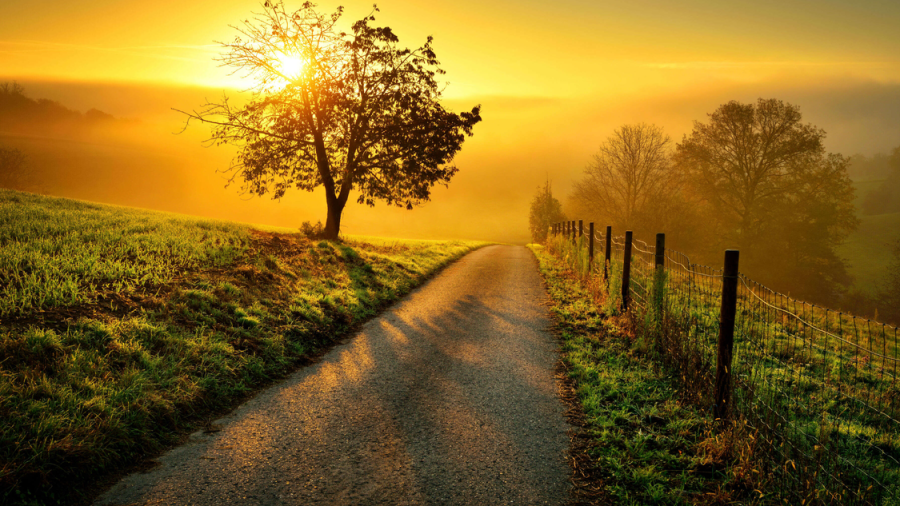



Every morning, nature begins the day with quiet precision. Birds start singing, roosters crow, livestock awaken, and sunlight gradually spreads across the horizon. Human beings, like most living creatures, are biologically programmed to respond to this light. We wake, our hormones shift, and our bodies prepare for work, learning, and social interaction. Yet the clock tells us something entirely different.
According to the modern timekeeping system, a new day begins at 12:00 am – the darkest and quietest moment of the night, when most people are asleep. By the time the sun rises, six hours of the ‘new day’ have already passed. In effect, the first quarter of every day disappears while the majority of humanity is unconscious. This raises an important question: why does our civilisation begin the day in darkness rather than in daylight?
The answer lies in history. Thousands of years ago, the Babylonians developed the base-60 numerical system that still governs hours, minutes, and seconds. The Egyptians divided the day and night into twelve parts each. The Romans organised calendars for taxation and administration. During the Middle Ages, astronomers and religious scholars found it convenient to use midnight as a neutral boundary between two dates. In 1884, the International Meridian Conference (IMC) standardised global timekeeping and formally established midnight as the start of the civil day. These decisions were practical in their historical context. But the people who shaped them had no modern understanding of the Solar System, Earth’s rotation, or Circadian rhythm. Today, science confirms that human physiology is deeply synchronised with sunlight. In other words, our bodies begin the day when the sun rises – not when the clock strikes midnight.

The current system has also shaped our culture. We celebrate birthdays at 12:01 a.m. We welcome the new year in the middle of the night. Important observances are often marked at midnight. Symbolically, we have elevated darkness as the official beginning of time. Meanwhile, sunrise – the most visible and biologically meaningful event of each day – receives little formal recognition.
This midnight-centred system subtly changes how we think. It disconnects time from nature and teaches us to view the day as an abstract numerical sequence rather than a lived experience tied to the movement of the Earth and the sun. A more natural alternative would be to begin the civil day at 6:00 a.m., or more broadly, at local sunrise. Under this approach, a day would run from sunrise to the following sunrise. The benefits would be both symbolic and practical.




Each hour could represent the number of hours that have passed since sunrise. Noon would occur six hours after sunrise, when the sun is near its highest point. Sunset would arrive around the twelfth hour. What is currently 3:00 p.m. would correspond to the ninth hour of the day. The clock would once again reflect the visible progression of daylight.
This could also transform education. Children would learn time not merely as numbers on a dial, but as a direct relationship between the Earth, the sun, and their own daily lives. Looking at the clock would help them understand astronomy, biology, and the passage of time in intuitive terms.
The first hour after sunrise could be recognised as the ‘Golden Hour.’ Such a concept could encourage early rising and inspire people to use the opening moments of the day more purposefully. Public observances could become more humane as well. Many national and international commemorations currently begin at midnight, requiring people to gather when they are tired and less alert. If these occasions started at sunrise, participants would be rested, emotionally present, and better able to engage with the meaning of the event. Birthdays, anniversaries, and personal milestones could also be welcomed in the calm light of morning rather than in the middle of the night.
The proposal is simple, but its implications are profound. It asks whether the clock should remain merely a mechanical tool for counting hours, or evolve into a system that reflects the rhythms of nature and the biological realities of human life.
For centuries, the modern clock has quietly drawn our attention away from the morning sun. Perhaps the time has come to bring it back.
The writer is the Assistant News Editor, Channel24