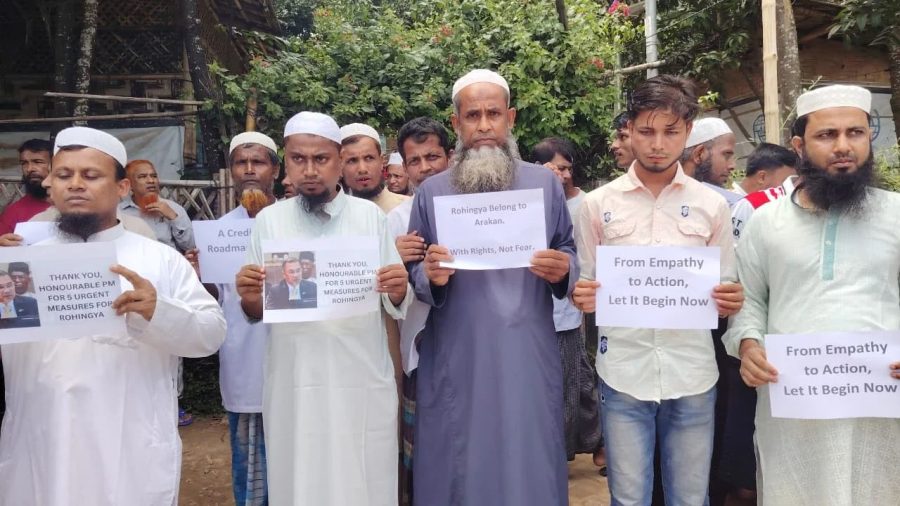



Rohingya leaders have urged the international community to take immediate steps to facilitate their safe, voluntary and dignified repatriation to Myanmar, saying they have spent far too long in displacement and are ready to return as soon as a safe environment is ensured.
The call was made by the United Council of Rohingyas (UCR) on Thursday, as world leaders gathered in New York for the ongoing 81st session of the UN General Assembly.
“Nine years is too long. There should be no more indefinite displacement. Now is the time to create conditions for Rohingyas to return home,” the organisation said at a human chain and rally held around noon outside the UCR’s temporary office at Camp 15 in Jamtoli, Ukhiya.
They said the community had spent nearly a decade in displacement in Bangladesh, while international efforts to resolve the crisis had yet to produce any tangible progress.
“Solidarity and promises are not enough anymore. We need a clear and credible roadmap for repatriation,” they said.
The leaders said the ongoing UN General Assembly session offered an opportunity to renew international attention to the Rohingya crisis.
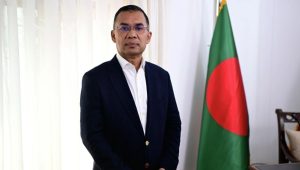
They referred to Bangladesh Prime Minister Tarique Rahman’s remarks at a high-level event on the Rohingya crisis at the UN headquarters on 23 September, where he called for a clear and credible roadmap for the rapid, safe, voluntary, dignified and sustainable repatriation of Rohingyas.
The speakers also called for an end to violence against Rohingyas, guarantees of their fundamental rights and security, continued humanitarian assistance, and stronger efforts to ensure justice and accountability.

The UCR leaders said the crisis originated in Myanmar and therefore its sustainable solution must also be found there.
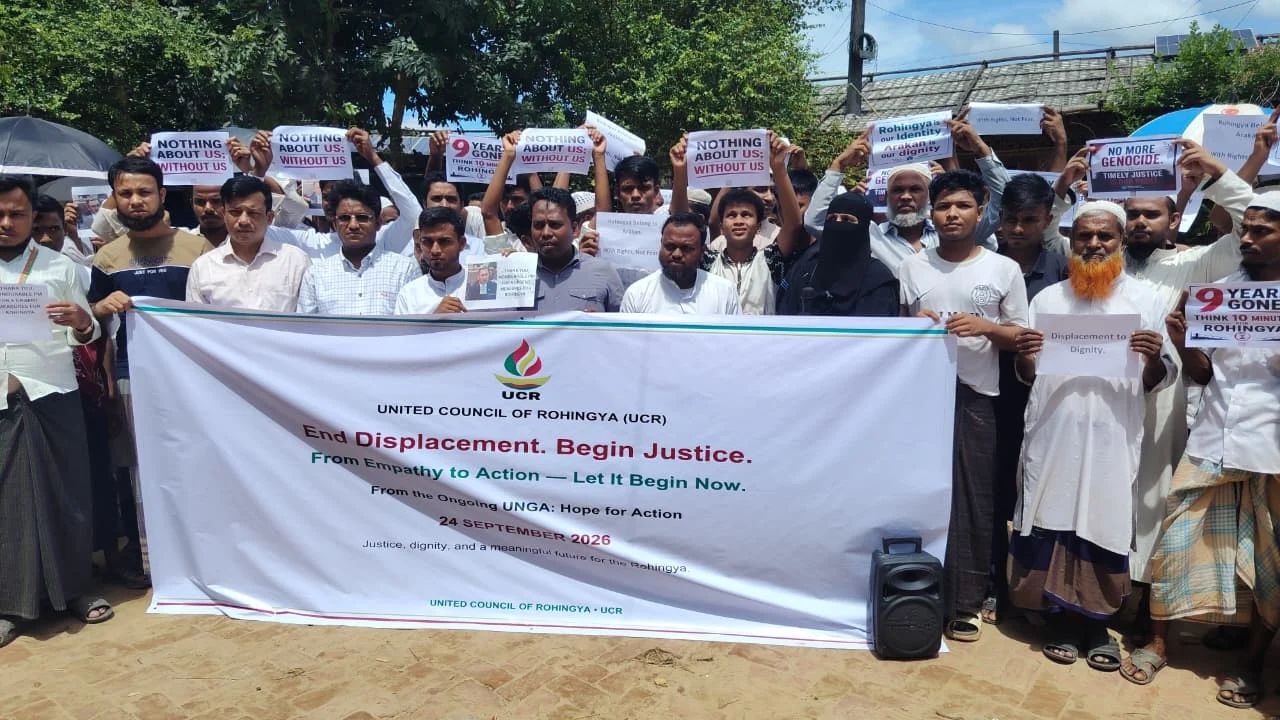
They said Rohingyas must be guaranteed security, citizenship rights, freedom of movement and the right to live with dignity before any repatriation can become sustainable.
The organisation called for a time-bound and credible repatriation roadmap, along with accountability for violence and persecution against Rohingyas.
It also urged stronger international judicial efforts, including through the International Court of Justice and the International Criminal Court.




UCR founding president Maulvi Syed Ullah said Rohingyas had been relying on international assistance while living in the camps for years.
“The time has come to make concrete decisions about our future. The crisis cannot be resolved by keeping Rohingyas confined to camps indefinitely,” he said.
Rohingya leader Anwar Hossain said the community had no direct participation in the ongoing UN General Assembly.
“We want Prime Minister Tarique Rahman to highlight the issue of Rohingya repatriation before world leaders so that they can take effective decisions,” he said.
Rohingya leader Master Mohammad Soib said negotiations alone would not be enough to facilitate repatriation.
“An environment must be created in Myanmar so that Rohingyas can return home with security and dignity,” he said.
Another Rohingya leader, Mohammad Rafique, said the international community had repeatedly recognised the Rohingyas’ right to return home.
“But in reality, we are still in the camps. A specific, time-bound roadmap for repatriation must now be prepared through the UN,” he said.
Women, children face prolonged hardship
Rohingya women’s leader Sajida Begum said women had been facing multiple hardships as a result of prolonged displacement.
“Unless conditions are created for Rohingyas to return to their homeland safely and with dignity, this crisis will continue,” she said.
Nuruzzama, a resident of Camp 15, said Rohingyas were grateful to Bangladesh for providing shelter but wanted to return to their homeland.
“We want to go back to our country, homes and relatives. Arrangements should be made for us to return safely,” she said.
Rohingya leader Md Saleh said generations of Rohingyas were growing up in the camps without adequate access to education, food, clothing and healthcare.
“This situation is threatening the future of our next generation. Arrangements must be made for our repatriation as soon as possible,” he said.
Another Rohingya, Nur Alam, said the crisis was not only an issue for Bangladesh and Arakan but had become a regional and global concern.
“If the crisis is not resolved quickly, it could become more prolonged and affect Bangladesh and neighbouring regions. There can be no lasting solution without repatriation,” he said.
The speakers said Myanmar’s internal situation, security and guarantees of rights must be carefully considered before any repatriation.
They stressed that Rohingyas could not return sustainably without credible assurances that the violence and persecution that forced them to flee would not be repeated.
The UCR called on the UN, regional stakeholders, member states and the international community to take coordinated steps to resolve the crisis.
It also urged the continuation of humanitarian assistance for Rohingyas in the camps and called for justice and accountability for abuses committed against them.
“Rohingyas do not want to remain refugees permanently. They want to return to their homeland with security, freedom and dignity,” the leaders said.