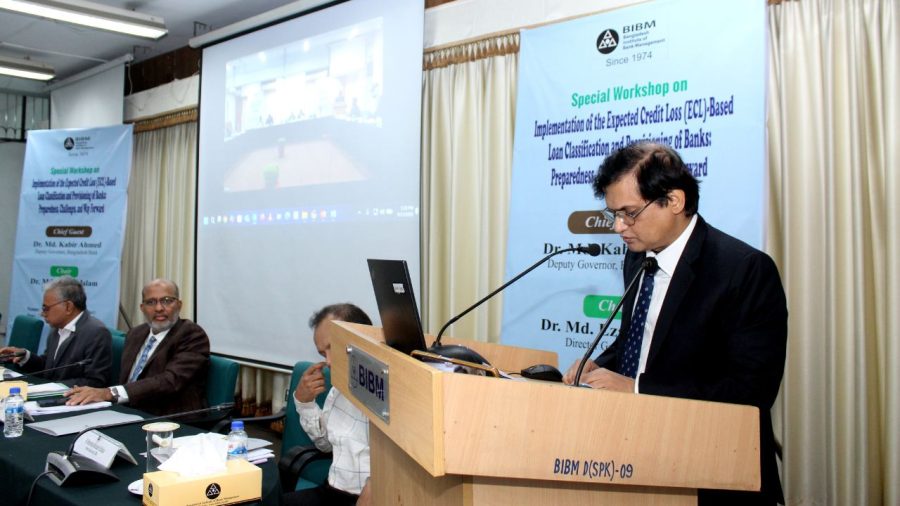



An indicative model developed by Bangladesh Bank (BB) could ease the banking sector’s transition to the Expected Credit Loss (ECL) framework for loan classification and provisioning, experts said on Wednesday, noting that many lenders currently lack the capacity to build robust ECL models on their own. The assessment emerged from a workshop titled “Implementation of Expected Credit-Loss (ECL) Loan Classification and Provisioning of Banks: Preparedness, Challenges and Way-outs,” held at the Dhaka campus of the Bangladesh Institute of Bank Management (BIBM).
Deputy Governor of Bangladesh Bank Md Kabir Ahmed attended as chief guest, while BIBM Director General Dr Md Ezazul Islam chaired the closing session. Mohammad Tazul Islam, Professor and Director (Training) at BIBM, delivered the welcome address, and Prashanta Kumar Banerjee, a Professor at the institute, presented a research paper on behalf of a team that included Md Mohiuddin Siddique, Md Mahabbat Hossain, Md Iqbal Hossain — CFO and Head of Treasury at Sonali Bank PLC — and Najeefa Kabir. Md Ali Hossain Prodhania, a Supernumerary Professor at BIBM, Bangladesh Bank Executive Director Md Ashraful Alam, and Pubali Bank PLC Managing Director Mohammad Ali served as discussants, with the presentation followed by an open-floor discussion and question-and-answer session.
Chairing the closing session, Ezazul Islam said the shift to the ECL framework should be treated as a risk-governance reform rather than simply a compliance exercise. He said Bangladesh had made a meaningful start on implementation, though credible progress would hinge on data quality, systems, professional judgement, governance and model validation. A phased, proportionate approach could ease the transition, he added, while full and consistent coverage under IFRS 9 should remain the ultimate goal.

Islam also highlighted the importance of industry-wide consistency given uneven modelling capacity across banks, suggesting a standardised indicative framework with limited scope for bank-specific customisation could merit serious consideration. He said BIBM stood ready to support the process through targeted training, certification, applied research, technical guidance and a continuing platform for dialogue among regulators, banks, auditors and experts, adding that recommendations from the workshop would feed into the finalisation of the research paper and the wider implementation process.




In his address, Deputy Governor Kabir Ahmed said the reform should remain time-bound but must be grounded in demonstrable institutional readiness. He stressed that data quality and governance underpin the ECL framework, noting that even sophisticated models cannot produce credible estimates without reliable historical, credit-performance and recovery data. The banking industry, he said, appeared to need greater methodological consistency, potentially through an indicative or minimum framework that still allowed room for bank-specific judgement. He also called for immediate attention to model validation, technical capacity, automation and capital planning to ensure a sustainable transition, adding that success would require coordinated efforts, with Bangladesh Bank providing regulatory clarity and supervision, banks strengthening internal governance and systems, and BIBM and professional bodies offering sustained capacity building. He thanked participants for a constructive, solution-oriented discussion.
The research paper presented at the workshop found that shifting from Bangladesh’s existing rule-based loan classification and provisioning system to the ECL framework would involve far more than an accounting change, requiring significant improvements in credit-risk assessment, data architecture, governance, modelling, technology, capital planning and supervisory practices. Under IFRS 9, which is principle-based, ECL estimates must reflect the characteristics and credit risk of individual portfolios, and Bangladesh Bank has accordingly advised banks to develop their own frameworks proportionate to the nature, size and complexity of their credit exposures.
However, the study identified significant doubts among banks about their capacity to develop robust ECL models independently. A survey found only 31.25 per cent of participating banks supported building their own models, while 68.75 per cent did not favour the approach. Respondents said a Bangladesh Bank-developed indicative model could improve consistency, comparability, auditability and supervisory oversight, while also lowering implementation costs.
The workshop brought together representatives from Bangladesh Bank, commercial banks, BIBM and other stakeholders to discuss the sector’s preparedness, the challenges ahead, and possible ways forward for adopting the ECL framework in Bangladesh.