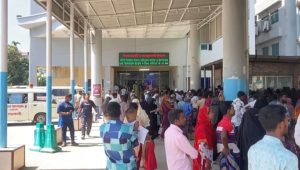
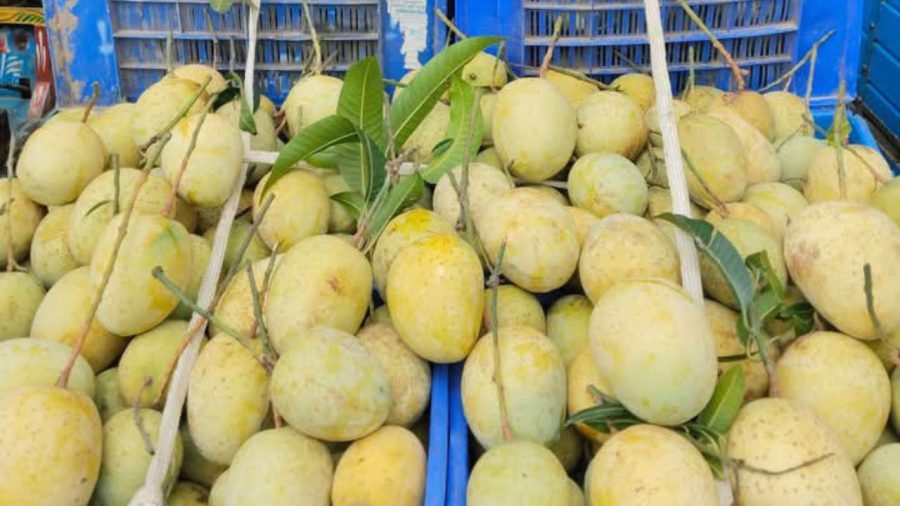

The famous Kansat mango market in Chapainawabganj’s Shibganj Upazila remains vibrant even after the end of the main mango season, with late and year-round varieties dominating trade.
Ashwina, Bari-4, Gaurmati, Katimon, Banana Mango and Khirsapat are now being sold at premium prices, creating new opportunities for growers and traders in the country’s mango hub.
Thousands of maunds of mangoes are being traded daily at the market as farmers from different parts of the district bring late-season varieties to buyers. The strong demand has kept the largest mango market in the region busy despite the decline in seasonal supply.
At present, Ashwina mangoes are selling at Tk80-Tk100 per kg, Bari-4 at Tk150-Tk180, Gaurmati at Tk160-Tk180, Katimon at Tk170-Tk180 and Banana Mango at Tk180-Tk200 per kg at Kansat.
Farmers said Katimon mangoes are fetching Tk6,000-Tk8,000 per maund at the end of the season, while Bari-4 is selling for around Tk7,000-Tk8,000 and Banana Mango for nearly Tk8,000 per maund.
“Compared with production costs, the price is satisfactory at this stage of the season,” said farmer Ashraful Islam, who brought Katimon mangoes to the market.

However, the biggest surprise this year is the production of off-season Khirsapat, locally known as Himsagar, a Geographical Indication (GI)-recognised variety. Usually available in May-June, the mango has been harvested in August from several orchards in Shibganj.
Buyers are showing interest in purchasing these off-season Khirsapat mangoes directly from orchards at Tk20,000-Tk25,000 per maund.
Farmer Golam Mostafa of Argara village said he achieved the unusual production after experimenting with grafting techniques.




“I changed parts of Khirsapat trees by grafting Katimon branches. Later, the original parts of the trees produced Khirsapat mangoes outside the usual season,” he said.
Mostafa said he had already sold mangoes worth around Tk80,000 and hoped to expand the method in the future.
Another grower, Sajib Ali of Bhangabridge area, also found off-season Khirsapat hanging alongside Katimon mangoes in his orchard. He said buyers were coming directly to the orchard after seeing the quality of the mangoes.
Shibganj Mango Producers Cooperative Society General Secretary Ismail Khan Shamim said Khirsapat mangoes sometimes sold for only Tk1,000-Tk1,500 per maund during the regular season, while the same variety earned several times more when produced off-season.
He said the method of producing two varieties from the same tree could open new opportunities, but scientific validation was needed before commercial expansion.
Regional Horticulture Research Centre Chief Scientific Officer Md Sharaf Uddin said although Khirsapat had strong domestic and international demand, farmers often failed to get fair prices due to oversupply during the peak season.
“The sustainability of off-season production, the scientific effectiveness of producing different varieties on one tree and its commercial viability require further research,” he said.
Department of Agricultural Extension Deputy Director Md Atiqul Islam said mangoes were cultivated on 37,487 hectares in Chapainawabganj this season, with production targeted at 458,912 tonnes.
He said late-season varieties continued to enter the market, extending the trading period beyond the traditional mango season.
Online mango trader Md Walid said rising costs of fertiliser, pesticides, labour and orchard management had reduced growers’ profit margins.
“Farmers are shifting towards varieties like Katimon and Gaurmati because they offer better prices and higher returns,” he said.
Grower Ismail Hossain Khan said Shibganj alone produces more mangoes than the combined output of the district’s other four upazilas. He added that many farmers were replacing traditional Fazli orchards with newer varieties due to changing market demand.
For traders and growers, the late-season mango market in Kansat is no longer just the final chapter of the annual harvest. It is becoming a sign of changing cultivation patterns and new possibilities for Chapainawabganj’s mango economy.