
It was a bright, unbelievably humid autumn morning. My 17kg backpack dug into my shoulder, and I was already soaked in sweat, but I didn’t care. I had taken local trains before, but this was my first real intercity journey, and I was too excited to let the heat bother me.
I hurried towards the Shahartali platform at Dhaka Railway Station, only to be stopped by two railway employees. They asked, “Where are you going?”
“I will take the Ruposhi Bangla Express to Benapole,” I said, showing my ticket. “It is on the other side. Platform 14,” one of them replied.
It was 9:50am, nearly an hour before departure, but the train was already waiting. The platforms were a theatre of organised chaos. Passengers spilled from incoming trains, staff shouted over the hiss of water tanks being refilled, and young boys raced across the roofs of commuter trains.
My ticket said seat 55 in coach Neo, but finding the carriage was another challenge. A porter named Sumon Mia eventually pointed it out. Now in his 40s, he had left Narsingdi 30 years ago to make a living on these platforms.
“It was worse before,” he said of the crowds. “During festivals and mango season, it goes mad.”

He earns Tk 700 to 800 a day, he told me, rising to around Tk 2,000 during festivals. He smiled when he spoke about his family, saying he had recently married off his daughter, who now lives happily in Barishal.
Before I could board, my colleague and travel companion Khaled Arafat arrived. We were beginning a week-long assignment through Khulna, Jashore, Satkhira and the Sundarbans to document how marginalised communities were benefiting from the government’s digital transformation efforts.
Another familiar face appeared on the platform, former colleague and TV producer Shatil Ahamed, travelling the same route. We exchanged memories until the final whistle.
At precisely 10:45am, the Ruposhi Bangla Express lurched forward. As we left Kamalapur, the train curved through Sayedabad, Jurain and Shyampur. Markets, craftsmen, traffic-clogged level crossings, mosques, abandoned factories and black mounds flashed past the windows.



Then came the Buriganga River. The train crossed the striking royal-blue bridge of the Padma Bridge rail link and continued towards Keraniganj.
From the vestibule, the train looked like a long steel spine curving through the landscape. I leaned towards the open doorway to feel the wind, only for an electric pole to flash inches from my face. I quickly pulled back.
By Bhanga in Faridpur, the landscape had transformed. On one side were concrete buildings and the spread of the town; on the other, endless paddy fields and scattered villages.
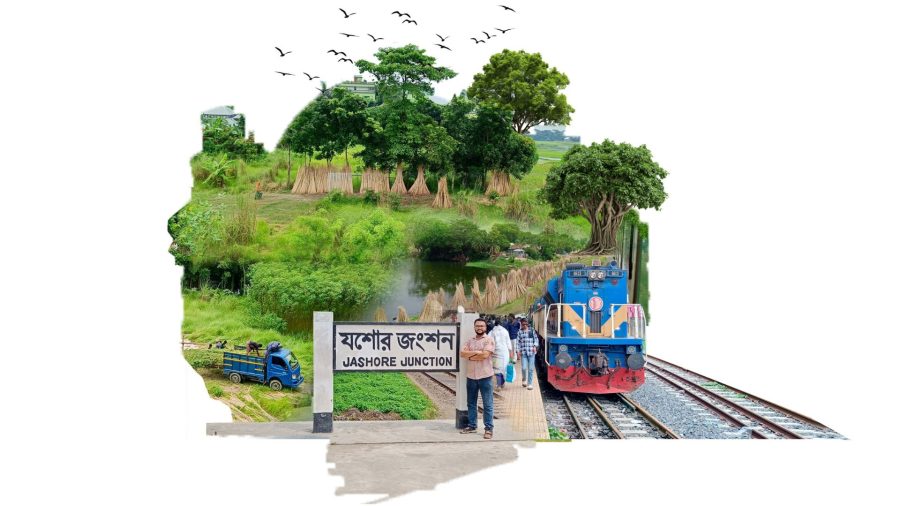
It was just after the jute harvest. Farmers had stacked jute stalks along the railway embankments to dry, resembling hundreds of tiny golden tents.
The sight took me back 20 years to my childhood, when I watched farmers strip golden fibres from green stalks. The process was mesmerising, though the smell of rotting vegetation was unforgettable.
Khaled and I watched the fields, rivers and small homes pass by. “Imagine if this was it,” one of us said. “Fresh food from those fields. A quiet life.”
For city dwellers dependent on Dhaka, it was a familiar fantasy. We spent the next hour debating whether such a life was actually possible. The internet has made rural living more plausible, but schools, hospitals and infrastructure remain difficult questions.
Our conversation was interrupted by a catering worker carrying takeaway boxes of fish cutlets, chicken fry and jelly-filled bread. Each cost Tk 190. I settled for Tk 30 coffee and Tk 25 chips, quickly regretting the coffee, which tasted like hot, stale water.
Still, the train itself was a revelation. “This ride is incredibly smooth,” I told our seatmates. “I usually avoid trains because I expect chaos. I have flown to Jashore twice, but after this, I might never fly again.”
A passenger across from me agreed. Dhaka to Jashore, he said, once took eight or nine hours. Now, using the Padma Bridge route, the journey takes less than three hours.
The difference is the new broad-gauge rail link. Previously, trains had to make a long northern detour across the Jamuna River on older tracks. Now they can travel much more directly and at higher speeds.
I checked the speedometer on my phone. We were moving at 94 kilometres per hour. Across the aisle sat Mahat Gouranga Das, an ISKCON priest from Chattogram who has served at Rupa Sanatan Dham in Jashore for 15 years. He had studied the Bhagavad Gita in Dhaka before travelling to Mayapur in West Bengal for advanced Vedic courses.
“The people here are incredibly calm and cordial,” he said. “The environment has a natural peace to it. For spiritual practice, it is perfect.”
Before I could ask more, my phone rang. Another colleague said a team was already waiting for us in Jashore and suggested we get off there instead of continuing to Benapole.
Khaled was already reaching for his bag. You can buy a ticket to the end of the line. But sometimes, the journey decides where you get off.