
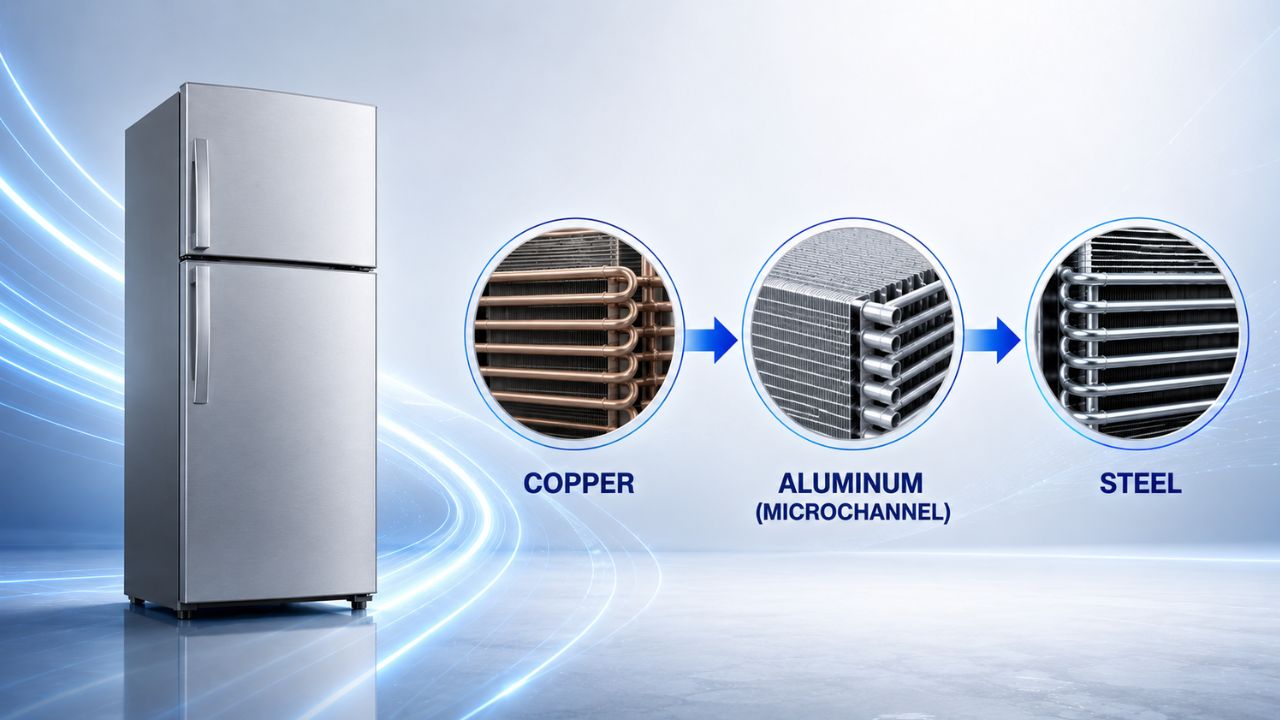



Copper dominated refrigerator condensers for decades because of its high thermal conductivity, corrosion resistance and repairability. But manufacturers are now balancing heat transfer with energy efficiency, refrigerant use, weight, durability and environmental impact.
That is driving adoption of aluminium, zinc-aluminium-magnesium (ZAM)-coated steel and all-aluminium microchannel heat exchangers. The shift is not simply about changing materials but redesigning the cooling system.
Condenser performance depends on tube geometry, surface area, fin design, airflow, refrigerant flow and overall system configuration.
Microchannel technology is a major development. Flat aluminium tubes with multiple small channels provide a large heat-transfer area in a compact, lightweight structure while reducing internal volume and potentially refrigerant requirements.

A study in the International Journal of Refrigeration found that optimising microchannel condenser geometry for domestic R600a refrigerators could reduce total refrigerant charge by around 14 per cent.
Steel and aluminium require effective protection, particularly in humid and saline environments.
ZAM coating applies zinc, aluminium and magnesium to steel to protect against moisture and corrosion. Salt-spray data published by Nippon Steel showed ZAM-coated steel achieving 10 to 20 times greater corrosion resistance than conventional hot-dip zinc-coated steel.




Copper is also susceptible to corrosion under humidity, salinity, pollution and chemical exposure. Some newer condensers add heat-shrink polymer sleeves or other protective layers to create further barriers against moisture, dust and salt-laden air.
Refrigerants reshape system design
Many household refrigerators now use R600a, or isobutane, which has relatively low global warming impact compared with older refrigerants.
Research by Oak Ridge National Laboratory and US Department of Energy-supported projects has focused on optimising R600a systems while reducing refrigerant charge and improving efficiency.
The condenser is therefore being engineered alongside the compressor, refrigerant and evaporator rather than as an isolated component.
Copper’s repairability remains an advantage, as skilled technicians can fix some leaks. Newer designs instead place greater emphasis on preventing failures through automated manufacturing, protective coatings and tighter quality control.
Aluminium is well suited to lightweight microchannel systems, while steel can integrate efficiently into automated production. Depending on the design, both can reduce appliance weight and material use.
Bangladesh’s climate changes the durability equation
Bangladesh’s heat, humidity, dust and saline air in coastal areas create demanding conditions for refrigerator components. ZAM coatings and polymer barriers can provide added protection, while high-temperature cooling depends on the combined performance of the condenser, compressor, refrigerant and evaporator.
For consumers, condenser material alone is therefore an inadequate measure of refrigerator quality. Energy consumption, cooling performance, corrosion protection, refrigerant type, compressor technology, warranty and after-sales service all matter.
Copper remains important, but the industry is moving towards lighter, more efficient and better-protected heat exchangers designed as part of an integrated refrigeration system.