


Nearly six years after Bangladesh began relocating Rohingya refugees to Bhasan Char, official figures show a 5,083-person gap between the number sent to the island and those now living there, raising fresh questions over the sustainability of the Tk3,000 crore settlement built to house 1 lakh people.
Since the relocation programme began in December 2020, 33,819 Rohingyas have been moved to Bhasan Char, according to official data obtained by TIMES of Bangladesh.
The Office of the Refugee Relief and Repatriation Commissioner (RRRC), however, says only 28,736 are currently living on the island.
But officials acknowledge that refugees continue to move from the island to Cox’s Bazar through both authorised and unauthorised channels, while interviews with residents suggest limited livelihoods, education opportunities, freedom of movement and separation from relatives remain key reasons for leaving.
The movement has also raised concerns over irregular migration and human trafficking. Officials say some refugees return to Cox’s Bazar, where they have stronger family networks and greater livelihood opportunities, while others can become vulnerable to trafficking networks and exploitation.
UN Refugee Agency figures broadly reflect the same population gap, although its calculations differ.
UNHCR said 33,819 refugees were registered on Bhasan Char as of 30 June 2026, while its latest Presence Confirmation Exercise physically verified 29,125 people on the island. Its current operational estimate puts the population at about 29,215.
The disparity between the number relocated and those now present poses a central question for the project: why is a settlement built to provide safer and better living conditions than the overcrowded Cox’s Bazar camps struggling to retain residents?

An ambitious relocation plan
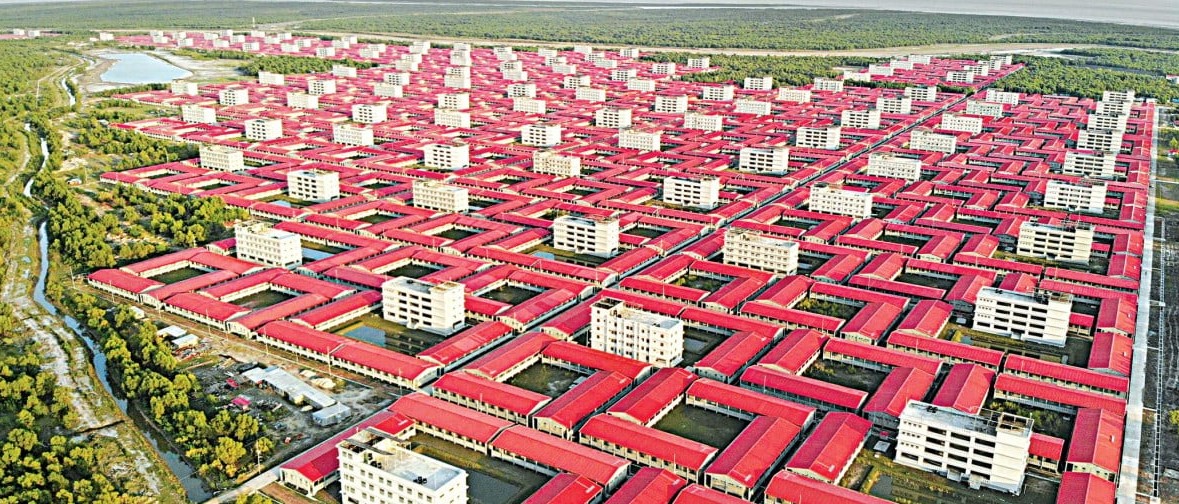
Located in the Bay of Bengal near Sandwip Island, Bhasan Char was developed by the government to ease pressure on the world’s largest refugee settlement in Cox’s Bazar after more than 7.4 lakh Rohingya fled violence in Myanmar in 2017.
Around Tk3,000 crore was spent transforming the once-uninhabited island into a planned settlement with cyclone-resistant housing, embankments, roads, schools, healthcare centres, solar-powered facilities, warehouses and other infrastructure.
Designed to accommodate up to 1 lakh refugees, Bhasan Char was presented as a safer and more dignified alternative to the congested mainland camps.
Yet nearly six years after relocations began, authorities appear to be facing a different challenge: not simply bringing Rohingya to the island, but persuading them to stay.
‘There is no future here’
Interviews conducted by TIMES of Bangladesh with Rohingya residents point to a common set of frustrations.
Mohammad Arifur Rahman, a resident of Cluster 80, said Bhasan Char offered better housing but few opportunities to build a future.




“The houses are better, but our lives are isolated. We have almost no opportunities to earn an income, education is limited, and we are separated from our relatives in Cox’s Bazar.”
Senowara Begum of Cluster 10 voiced similar concerns.
“Our children have fewer educational opportunities here. Many families leave because they cannot see a future on the island.”
Refugees interviewed said food assistance, healthcare and security remained available, but restricted movement, limited livelihood opportunities, fewer educational options and separation from extended family continued to push some households towards Cox’s Bazar.
Returning to the mainland
Government officials acknowledge that movement between Bhasan Char and Cox’s Bazar takes place through both authorised and unauthorised channels.
According to RRRC officials, refugees are sometimes permitted to visit relatives in the mainland camps.
Around 500 refugees were officially allowed to travel to Cox’s Bazar for family reunification in 2025. Many later returned to Bhasan Char, although some stayed behind.
Others are believed to have left the island without official approval.
One Rohingya refugee now living in Ukhiya after previously residing on Bhasan Char said returning to the mainland had been difficult but worthwhile.
“Life on Bhasan Char was safe, but there were very few opportunities. We wanted to reunite with our relatives and hoped our children would have better access to education.”
Officials said many returnees are subsequently readmitted to the Cox’s Bazar camps following approval from the relevant government authorities and humanitarian agencies.
Project ‘not fully utilised’
Refugee Relief and Repatriation Commissioner Mizanur Rahman acknowledged that occupancy remained far below Bhasan Char’s intended capacity.
“The fact that only around 28,000 people are living in a settlement built to accommodate 100,000 indicates that the project has not been fully utilised. To a considerable extent, it can be regarded as a failure.”
He said many of those leaving Bhasan Char eventually return to the Rohingya camps in Cox’s Bazar, where they are re-enrolled subject to approval from the relevant authorities and humanitarian agencies.
The commissioner said the government remained committed to improving education, healthcare, humanitarian services and overall living conditions on the island to encourage refugees to stay.
UNHCR: Movement is normal
Responding to questions from TIMES, Shari Nijman, Communications Officer at UNHCR Bangladesh, said movement between Bhasan Char and Cox’s Bazar was an ongoing phenomenon.
“Population movements between Bhasan Char and Cox’s Bazar continue to occur, as is common in any large refugee setting. Refugees move for a variety of reasons, including family circumstances, livelihood or education opportunities. We also occasionally see spontaneous arrivals to the island.”
UNHCR said it continued to work with the Government of Bangladesh to provide registration, protection and humanitarian assistance on Bhasan Char while consulting refugee communities about their needs.
The agency also stressed that sustained international funding remained essential to support humanitarian operations on both Bhasan Char and Cox’s Bazar until a durable solution was found.
The figures suggest that safer housing alone may not be enough to sustain a refugee settlement.
For many Rohingya, access to livelihoods and education, family networks and greater freedom of movement appear to matter as much as physical infrastructure.