


Bangladesh’s ambition to become a $1 trillion economy by 2034 is colliding with slowing growth, weak investment, energy shortages and factory closures, prompting economists and business leaders to question whether the target is achievable.
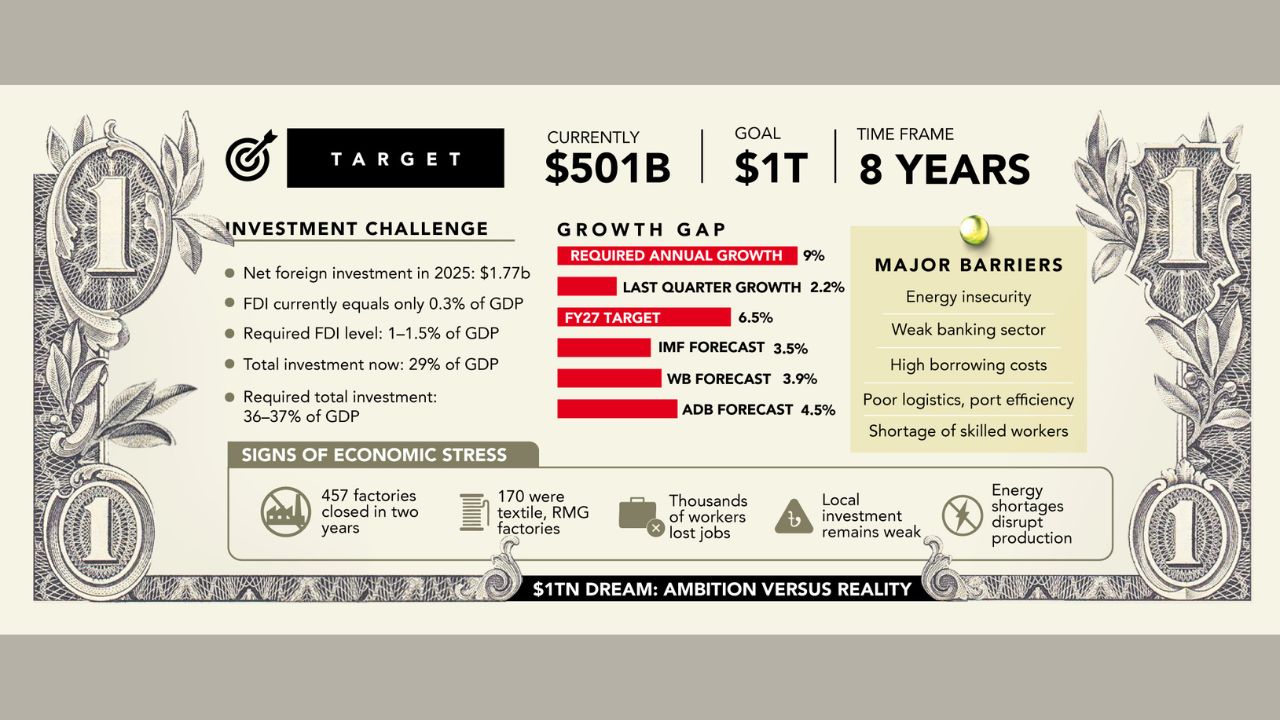
Doubling the economy from about $501 billion to $1 trillion within eight years would require average annual compound growth of more than 9 per cent—more than four times the latest quarterly GDP growth rate of 2.2 per cent.
Economists say achieving such growth would require a near-complete turnaround in energy security, a sharp rise in foreign and domestic investment, sweeping financial-sector reforms and major improvements in infrastructure, education, governance and productivity.
Yet the economy is moving in the opposite direction.
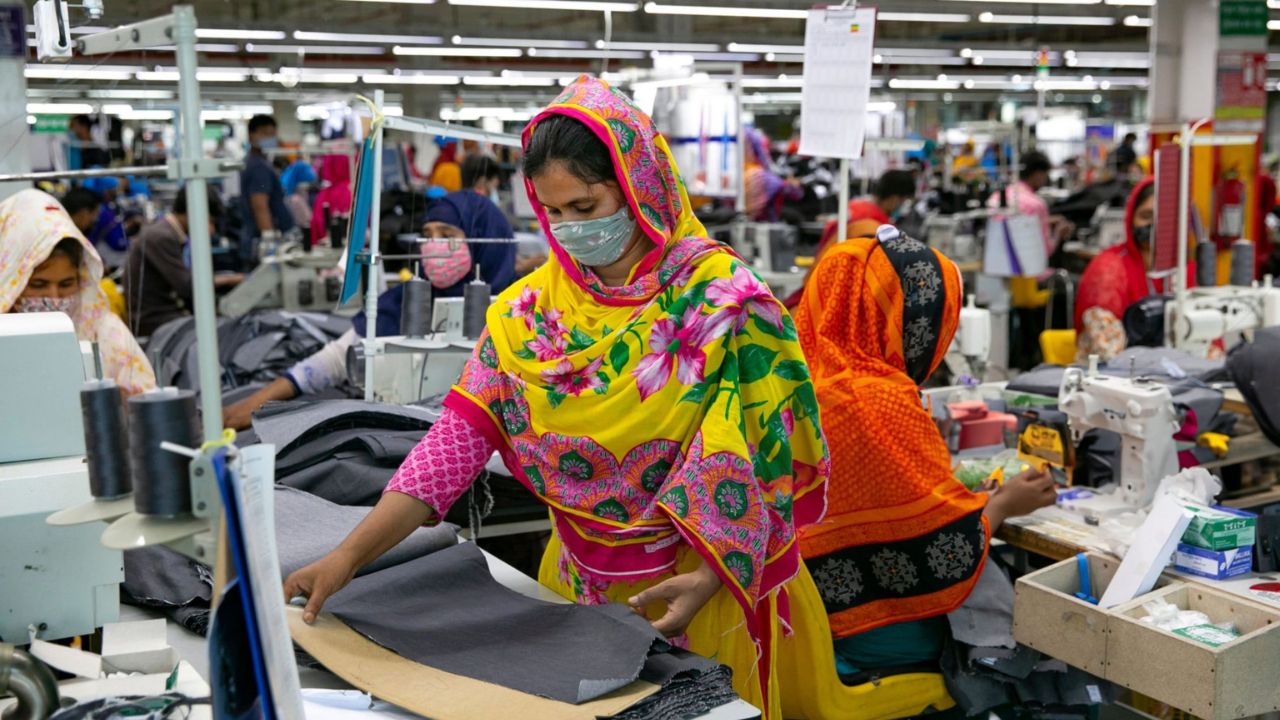
While the government aims to create one crore formal jobs, Industrial Police data show 457 factories have closed over the past two years, including 170 textile and ready-made garment units, leaving hundreds of thousands of workers unemployed.
Foreign investment has remained sluggish. Bangladesh attracted about $1.77 billion in net foreign investment in 2025, less than half the amount received by Uganda, an emerging African economy, while domestic investment also remains weak.
The government has set a GDP growth target of 6.5 per cent for the current fiscal year. The International Monetary Fund projects 3.5 per cent growth, the World Bank forecasts 3.9 per cent and the Asian Development Bank expects 4.5 per cent, underscoring the gulf between official ambition and independent forecasts.
Bangladesh sustained GDP growth above 7 per cent for four consecutive years through FY2018-19, peaking at 8.15 per cent. Economists say today’s combination of high inflation, stagnant investment, energy shortages, banking-sector fragility and global uncertainty makes repeating that performance far more difficult.
‘Extremely difficult’
Shahadat Hossain Siddiquee, professor of economics at the University of Dhaka, said building a $1 trillion economy by 2034 would be “extremely difficult” under current conditions.

“The key preconditions for high economic growth are investment and energy security,” he told TIMES of Bangladesh. “Many industries still cannot operate at full capacity because of inadequate gas and electricity supplies.”
Bangladesh remains heavily dependent on imported energy.
Siddiquee said other import-dependent countries have achieved high growth by overcoming challenges in innovation, governance and environmental protection, and how much Bangladesh progresses in these regards will remain important.
He added that global conflicts, geopolitical tensions and volatile oil prices continue to threaten production costs and export competitiveness.
Mustafizur Rahman, distinguished fellow at the Centre for Policy Dialogue, said Bangladesh would need simultaneous reforms in investment, revenue collection, banking and institutions.
Total investment, now about 29 per cent of GDP, must increase to 36-37 per cent, he said. Public investment should rise from 8 per cent to 10 per cent of GDP, while private investment needs to approach 30 per cent.



He also called for faster logistics reforms, a single-window service for investors, uninterrupted gas supplies, reliable electricity for industry, improved port efficiency and shorter port turnaround times.
Economists say high borrowing costs are discouraging entrepreneurs from making new investments. They argue the banking sector must become more efficient, transparent and competitive to reduce financing costs and restore financial stability.
Revenue mobilisation remains another major obstacle. Bangladesh’s tax-to-GDP ratio is around 8 per cent, well below the 13-14 per cent economists say is needed to sustain higher growth.
Bangladesh’s graduation from least developed country status presents another challenge. While the transition marks international recognition, it will also end many duty-free and preferential market access benefits.
Bangladesh must therefore rely less on trade preferences and more on productivity, higher efficiency and technology-driven competitiveness, supported by a skilled workforce, labour-market reforms and incentive systems more closely tied to production and efficiency.
The graduation is scheduled for later this year, although the government has asked the United Nations to postpone it by three years.
Bangladesh Textile Mills Association President Showkat Aziz Russell said the country was becoming increasingly import-dependent at a time when LDC graduation demanded stronger manufacturing competitiveness for both exports and import substitution.
“The economy can regain momentum only if unprecedented steps are taken to remove business bottlenecks and help industries remain afloat,” he said.
Foreign Investors’ Chamber of Commerce and Industry President Rupali Haque Chowdhury said there was no alternative to foreign direct investment if Bangladesh was to achieve a $1 trillion economy.
“To achieve this target, infrastructure development, energy security and policy stability must receive the highest priority,” she said.
Foreign direct investment currently amounts to only 0.3 per cent of GDP, she said, adding that it must rise to between 1 and 1.5 per cent over the next few years to make a meaningful contribution to the economy.
Humayun Rashid, president of the International Business Forum of Bangladesh, said Bangladesh also needed to strengthen its international branding to position itself as a reliable destination for global investors.
“Governance should receive the highest priority. Effective reforms in port management, the National Board of Revenue, licensing systems and the banking sector are essential,” he said. “Without addressing these fundamental problems, simply setting ambitious targets will not deliver the desired results.”
High interest rates and financing constraints continue to discourage industrial investment. Businesses still rely heavily on bank borrowing as the capital, equity, bond and debt markets remain underdeveloped, limiting access to long-term and diversified financing.
M Masrur Reaz, chairman and chief executive of Policy Exchange Bangladesh, said Bangladesh’s growth had largely been driven by the ready-made garment industry and the country must now build new engines of growth.
“We must develop new export sectors,” he said. “If these sectors generate several billion dollars in additional export earnings over the next three to five years, economic growth will accelerate.”
Employment is another challenge, with 22 lakh to 23 lakh young people entering the labour market every year. Reaz said Bangladesh must create higher-income jobs both at home and abroad to fully capitalise on its demographic dividend, while investing more in education and skills development to build a workforce capable of meeting the needs of emerging industries.
Government plan
The government’s new five-year plan broadly reflects many of these priorities. It begins with controlling inflation, rebuilding foreign exchange reserves, addressing weaknesses in the banking sector and strengthening social protection.
The plan also seeks to revive private investment, reform the banking and logistics sectors, tackle non-performing loans, expand access to finance, accelerate manufacturing, promote higher value-added industries, integrate Bangladesh into global value chains and attract greater foreign investment.
Economists and business leaders, however, argue that implementation remains the biggest challenge. Bangladesh has repeatedly adopted ambitious plans but made limited progress in addressing energy insecurity, banking-sector weaknesses, high borrowing costs, bureaucratic complexity, policy uncertainty and deficiencies in the investment climate.
Siddiquee said the United States’ new tariff structure could nevertheless offer Bangladesh an opportunity.
As Bangladesh faces comparatively lower tariffs than China, India and Pakistan, improvements in technology, productivity and manufacturing efficiency could help expand ready-made garment and leather exports to the US market.
Technology remained a key leapfrogging opportunity, and Bangladesh should leverage it to accelerate growth, said Fahim Mashroor, a technology entrepreneur and a former president of Bangladesh Association of Software and Information Services.