Finance Minister Amir Khosru Mahmud Chowdhury is set to propose a new 35 per cent income tax rate on annual income above Tk3 crore from fiscal 2028-29, as part of a five-year tax roadmap accompanying the expected Tk9.38 lakh crore national budget for the upcoming fiscal year on Thursday.
Government officials say the measure would affect a small number of high-income taxpayers, leaving middle-income earners outside the new tax slab. Economists and tax experts, however, have cautioned that excessive taxation of the wealthy could trigger brain drain and capital flight.
The finance minister is expected to propose retaining existing personal income tax rates of zero to 30 per cent until 30 June 2028. From fiscal year 2028-29, annual income exceeding Tk3 crore would be taxed at 35 per cent under the proposed roadmap.
The budget proposal would also keep the tax-free income threshold unchanged at Tk3.75 lakh until June 2028, before gradually raising it over the following four years. Under the roadmap, the threshold would increase to Tk4 lakh in fiscal years 2028-29 and 2029-30, and to Tk4.5 lakh in fiscal years 2030-31 and 2031-32.
Women and taxpayers aged 65 years and above would continue to receive an additional Tk50,000 tax-free income allowance. The additional exemption would remain Tk1.25 lakh for persons with disabilities and third-gender taxpayers, and Tk1.5 lakh for wounded freedom fighters and July warriors. Guardians of persons with special needs would continue to receive an additional Tk50,000 tax-free allowance for each dependent.
The roadmap forms part of a broader strategy to improve predictability in the tax system, widen the tax base, and create room for lower tax rates over the medium term. Officials said the government’s objective is to increase revenue through stronger compliance and a larger taxpayer base rather than imposing higher tax rates on existing taxpayers.
To support that objective, the finance minister is set to propose mandatory taxpayer identification number (TIN) submission for opening bank accounts, except for student and no-frills accounts.
The budget would also introduce a withholding identification number (WIN), integrate tax databases with national identity, banking, utility and land registration records, and require TINs for registration of motorcycles with engine capacities of 150cc and above.

The government has, however, dropped an earlier plan to impose advance income tax (AIT) on motorcycle and battery-run rickshaw owners.
As part of efforts to broaden the tax net, the budget would introduce a 0.20 per cent advance tax on supplies to retailers, equivalent to Tk2 on every Tk1,000 transaction. The amount would be adjustable against final tax liabilities.
Withholding taxes to be refundable
The budget proposal would introduce a major change in the treatment of taxes deducted at source, ending their status as a mandatory minimum tax liability for businesses. Instead, withholding taxes would be treated as advance tax payments that could be adjusted against final tax liabilities. Excess payments would become eligible for refunds after three years.
Officials argue that the current system often locks up working capital, including for businesses with low taxable income, creating unnecessary liquidity pressures. The proposed reform would bring Bangladesh’s tax framework closer to international practice, improve business cash flow, and strengthen the investment climate.
According to officials, reductions in withholding tax rates across multiple sectors, combined with the revised treatment of source taxes, are expected to increase business liquidity, reduce production costs, and ease inflationary pressures at the consumer level.




The government expects the measures to support higher industrial investment in the coming years. Corporate tax rates would remain unchanged in fiscal year 2026-27 under the proposal, providing greater certainty for investors.
The finance minister is also expected to signal that sectors currently subject to relatively high tax rates could see gradual reductions if revenue collection improves through successful expansion of the tax base. Only telecom companies with 20 per cent equity sharing with the public may enjoy a 5 percentage-point cut in corporate tax—from 45 to 40 per cent.
The budget package is set to include proposed tax reductions and exemptions for essential commodities, healthcare, renewable energy, electric vehicles, exporters, manufacturers, start-ups, freelancers, and small businesses.
The incentives planned
The budget will reduce advance tax on around 60 essential commodities—including rice, wheat, potatoes, livestock, fish, onions, garlic, sugar, edible oil and seeds—to 0.5 per cent, down from existing rates of 5 per cent, 2 per cent and 1 per cent, aiming to ease inflationary pressure and strengthen supply chains.
It will fully waive import advance tax on kidney dialysis filters to lower treatment costs, while reducing advance tax on 15 assistive products for persons with disabilities from 2 per cent to 1 per cent.
The budget is also set to propose broad-based tax relief across multiple supply chains. Advance tax on gold and jewellery supply will be cut from 5 per cent to 0.5 per cent, while recycling activities and raw materials will be reduced from 3 per cent to 1 per cent. Transport and vehicle rental services will be taxed at 2 per cent instead of 5 per cent, and packaging materials will be brought down from 5 per cent to 3 per cent.
In the energy sector, it is set to reduce advance tax on electricity purchases from power producers from 6 per cent to 3 per cent, alongside a cut in refinery fuel supply tax from 1.5 per cent to 1 per cent.
Export incentives are set to be adjusted, with withholding tax on cash incentives reduced from 10 per cent to 5 per cent.
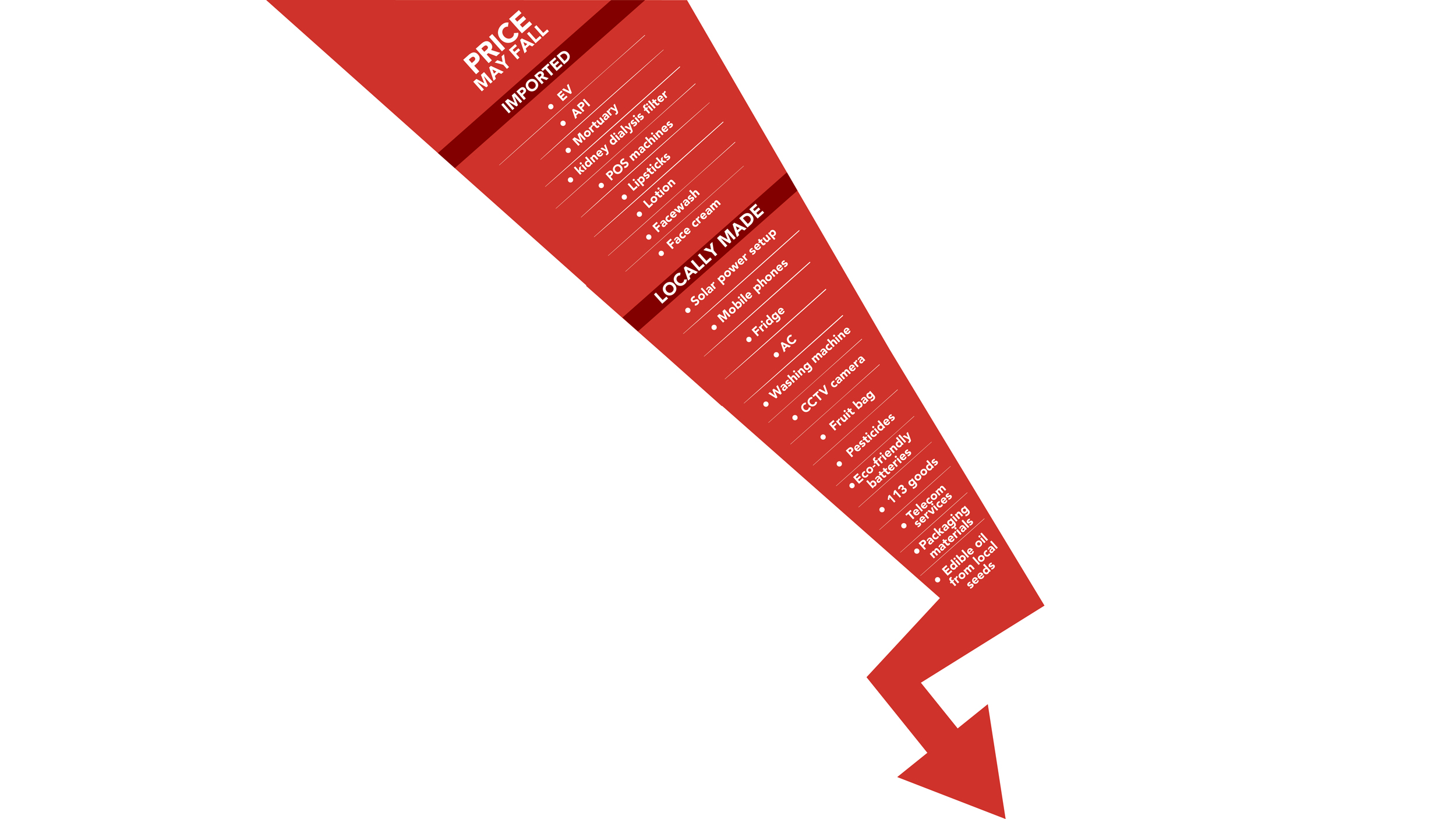
To support domestic manufacturing, the budget will extend tax exemptions on raw materials used in local production of mobile phones, refrigerators, air conditioners, washing machines, ATMs and CCTV equipment until 2030.
It will also revise customs valuation of cosmetics imports, lowering assessed values per kilogram of lipsticks from $40 to $30, and lotions, face creams and face wash from $10 to $7.
To promote digital payments, import duty on POS machines will be cut from 10 per cent to 5 per cent, while related advance tax is set to be withdrawn.
On trade policy, it will withdraw regulatory duty on 113 imported products and impose 15 per cent VAT on 20 previously VAT-exempt items.
Several strategic sectors are set to receive targeted incentives. Semiconductor raw materials will be exempt until 2031, battery manufacturing inputs until 2030, pesticide raw materials covering 36 items, and 51 active pharmaceutical ingredients.
Import duty on fruit fillets will be reduced to a 20 per cent supplementary duty, while mortuary equipment import duty will be slashed from 25 per cent to 1 per cent.
In renewable energy, the budget is set to keep solar power generation fully tax-free until 2035 and introduce a 5 per cent tax rebate on solar electricity bill payments.
Electric mobility will also see major restructuring. It will set zero duty on imports of EV charging stations, electric buses and electric trucks.
EV registration and renewal tax is set to be restructured from a flat Tk2 lakh to a capacity-based system: Tk25,000 for up to 200 kW, Tk50,000 for up to 300 kW, Tk75,000 for up to 400 kW and Tk1 lakh for vehicles above 400 kW.
EV import duty is set to be revised from around 93 per cent, with vehicles priced up to $25,000 taxed at 64 per cent and up to $50,000 at 80 per cent. It will also withdraw regulatory duty on hybrid vehicles up to 1,800cc and reduce tugboat import duty from 10 per cent to 5 per cent.
In agriculture-linked value addition, the budget is set to offer a 10-year tax exemption for domestic edible oil production using locally sourced oilseeds.
Finally, it will extend full VAT exemption until 2035 for startups, freelancers and content creators, alongside turnover tax relief for SMEs, women entrepreneurs and persons with disabilities, and introduce accelerated depreciation of 60 per cent in year one and 40 per cent in year two for investments outside Dhaka and Chattogram in manufacturing, tourism and sports infrastructure.