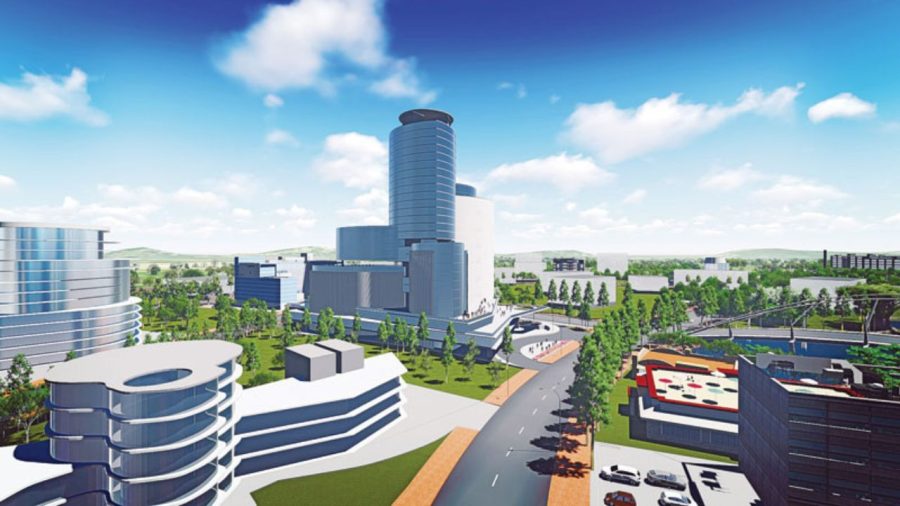

Bangladesh has built 39 Hi-Tech and software technology parks between 2009 and 2023, but the infrastructure has failed to produce the envisioned technology boom, investment and jobs because the supporting ecosystem, skilled workforce and industry linkages were not developed alongside the facilities, experts observed on Saturday.
Speaking at a discussion titled “Hi-Tech Parks: What is the Mission? What is the Reality?” organised by the Power and Participation Research Centre (PPRC) under its ‘Ajker Agenda’ virtual series, industry leaders, academics and policymakers said the country’s approach focused too heavily on physical infrastructure while overlooking the economic and institutional conditions needed to make the parks viable.

North South University Professor of Electrical and Computer Engineering M Rokonuzzaman said, “The assumption was that infrastructures alone would trigger a hi-tech boom and investment. Results so far clearly show that the assumption was not the right one.”
He said successful models in Taiwan, South Korea and Malaysia were linked to targeted industries, research, technology transfer and skilled labour, whereas Bangladesh largely expected better infrastructure, utilities, training and tax incentives to automatically attract companies.

Faiz Ahmad Taiyeb, former special assistant to the chief adviser of Bangladesh’s Ministry of Posts, Telecommunications and Information Technology, observed, “The core failure of Bangladesh’s High-Tech Parks stems from placing heavy physical infrastructure in regions lacking a viable local economy.” Software parks should be located near existing economic hubs where companies can access skilled workers, transport, accommodation and other resources.
The government now needs to focus on making existing infrastructure functional rather than continuing to expand physical facilities without ensuring their economic utility, he said.
Mohammad Mohidul Islam, managing director of Ongsho, said Jashore Software Technology Park, which began operations in 2017, currently houses around 40 companies, while space remains available for about 15 more. But companies have largely been left to grow on their own instead of receiving ecosystem support needed to expand, attract investment or enter international markets.


“The authority treats them as tenants rather than as entrepreneurs,” he said, adding that trained manpower quickly leaves, maintenance is poor and utility costs are high. The park’s startup zone has not effectively nurtured new startups in recent years, he said.
Farhana A Rahman, chairperson and CEO of UY Systems Ltd, said Bangladesh’s problem is partly excessive fragmentation- the country has continued to announce and build numerous Hi-Tech parks without creating a single highly visible and concentrated technology hub.
At Kaliakoir Hi-Tech Park, entrepreneurs were allocated land but did not receive roads, electricity and other supporting services necessary to develop their plots. Many subsequently surrendered their allocations because they could not see a clear path towards developing the sites, she said.
Rafel Kabir, managing director of DNS Software Ltd, who said he has been involved in the IT sector for about 35 years, said government policy has often failed to keep pace with technological innovation.
He cited Uber and foodpanda as technology-driven business models that require policymakers to adapt quickly rather than rely on existing regulatory frameworks. Rafel said Bangladesh’s original Hi-Tech park vision should have focused more clearly on foundational technology manufacturing and EPZ-grade infrastructure, including motherboards and chip fabrication. Instead, the country moved towards constructing large amounts of infrastructures without establishing the ecosystem and industrial demand needed to use it.
Ashafuddoza Shishir, co-founder and chief operating officer of Netro Systems Ltd and Telzen, Hi-Tech Park Rajshahi, said his company began in an incubation centre before moving into the main park building and now develops software for domestic and international clients.
The biggest tangible benefit of operating from the park has been tax exemption, he said. But the company has not received significant direct government support as a startup, while commercial banks have also not provided financing for IT-sector infrastructure. It has instead relied largely on its own funds, while maintaining links with Rajshahi University of Engineering & Technology and Rajshahi University for student and part-time work opportunities, he observed.
The panellists also called for reforms to the legal and institutional framework governing the parks.
Taiyeb said the existing definition of a Hi-Tech park should be broadened to cover emerging fields such as artificial intelligence, frontier technologies, data science and Internet of Things applications.
He identified four areas requiring reform- legal frameworks, skills development, the startup ecosystem, and coordination among the National Board of Revenue, the commerce and finance ministries and the Hi-Tech Park Authority.
Taiyeb also proposed greater involvement of the National Skills Development Authority in certifying ICT and technology training, saying vendor-issued certificates often have limited value in the job market.
PPRC Executive Chairman Hossain Zillur Rahman, who moderated the discussion, said the long-term success of the programme would require a shift away from simply building physical real estate towards developing soft infrastructure, skilled human capital and industry-driven training.