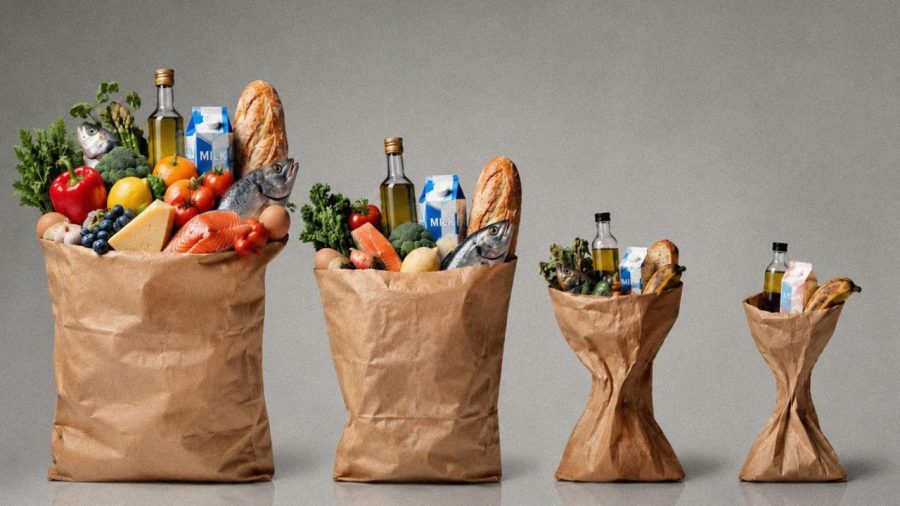

Yusra Khandaker was leaving a super shop in Hatirpool with several packets of packaged food. At first glance, prices appeared unchanged. But the real change was hidden inside the packets – companies had reduced quantities instead of raising prices.
The strategy has increased her expenses. “A few years ago, one packet of chips was enough. Now I need to buy two or three packets to get the same quantity. Many companies have not increased prices, but they have reduced packet sizes or the amount inside. These smaller packets do not satisfy us, so we have to buy more,” she told TIMES.
Rickshaw puller Harish Das at Karwan Bazar shared a similar experience. He bought a dry cake to eat with tea but found the smaller packet was no longer enough.
“Earlier, one packet was enough. Now I have to buy two. Companies have reduced the size. We are the ones losing out,” he said.
The practice of keeping prices unchanged or increasing them only slightly while reducing the quantity inside a packet is known as shrinkflation. Companies often use this strategy to maintain sales when rising costs of raw materials, fuel and production make direct price increases difficult.
Market observations show that shrinkflation is changing consumer behaviour. Customers who previously bought one packet are now purchasing two to get the same quantity, effectively turning a Tk10 purchase into Tk20. For consumers whose purchasing power has fallen due to inflation, the practice has created additional pressure.
The trend is not limited to packaged goods. Street food items such as singara, samosa, puri and jilapi have also become smaller, forcing many consumers to buy more pieces.
Mohammad Tanvir Alam Himel, assistant professor of the Marketing Department at Dhaka University, told TIMES that the practice could be linked to companies’ efforts to protect profits as well as rising production and supply costs.

“However, without sufficient data and evidence, it would not be right to directly call it unfair business practice,” he said.
According to him, inflation, production costs, logistics expenses and market competition together explain the broader business reality behind shrinkflation.
The shift towards smaller packs is also visible in the fast-moving consumer goods (FMCG) market. PRAN-RFL Group, one of the country’s major suppliers, said sales of smaller biscuit packets have increased fivefold over the past two years.
Kamalur Zaman Kamal, director (marketing) of PRAN-RFL Group, told TIMES that consumers had increasingly moved from larger packets to smaller ones after the impact of the Russia-Ukraine war began affecting markets.
“Demand for products priced at Tk5, Tk10 and Tk20 has also increased,” he said.




He said companies were reducing product weight to cope with rising raw material costs and dollar-denominated expenses.
“If prices are increased, it will create additional pressure on consumers,” he said.
Meghna Group of Industries (MGI) has also seen a similar trend. Since 2024, sales of smaller products priced between Tk10 and Tk20 have increased, with growth currently around 25 per cent.
Bakery producers are also considering reducing product weight as costs continue to rise.
The Bangladesh Bread, Biscuit and Confectionery Manufacturers Association has announced that prices of bakery products may increase by up to 20 per cent from Saturday.
Mohammad Jalal Uddin, president of Bangladesh Bread Biscuit and Confectionery Makers Association, said, “The price of oil has increased from Tk25,000 to Tk36,000. Flour prices have also risen, along with gas and electricity problems. There is no alternative but to adjust prices. However, in some cases, prices will be adjusted by reducing weight.”
Explaining the approach, he said, “A Tk50 loaf of bread will remain Tk50, but its weight may be reduced from 400 grams to 350 or 320 grams.”
Trading Corporation of Bangladesh (TCB) data shows that the price of loose flour increased by 3.16 per cent in one month, while loose refined flour rose by Tk5 per kilogram.
Although the government approved a Tk5 per litre increase in bottled soybean oil prices, supply has not returned to normal.
Suman Islam, a grocery shop owner at Merul Badda kitchen market, said, “Companies are not supplying oil according to demand. There is no oil in the shop, and customers are leaving without buying.”
Rifat Hossain, owner of Rifat Messers Store at Karwan Bazar, also reported similar shortages.
On 2 September, the commerce ministry approved an increase in bottled soybean oil prices from Tk199 to Tk204 per litre.
Vegetable seller Mohammad Osman at Karwan Bazar said prices had increased due to several days of rain.
He said round brinjal was selling at Tk140 per kilogram, while long brinjal was priced between Tk70 and Tk100 depending on quality. Green papaya was the cheapest vegetable at his shop, selling at Tk30 per kilogram.
The monsoon vegetable season is ending, while winter vegetables have not yet arrived in sufficient quantities. As a result, most vegetables are selling between Tk60 and Tk80 per kilogram, while early winter beans cost Tk180 to Tk200.
Imon Islam, a vegetable seller in South Banasree, said prices of brinjal, yardlong beans and green chillies had increased when he went to Karwan Bazar for wholesale purchases.
Farm chicken eggs are selling at Tk150 to Tk155 per dozen, while broiler chicken costs Tk200 per kilogram.
Mohammad Gafur, a chicken seller at Karwan Bazar, said many farms had reduced production due to load-shedding, contributing to higher prices.
Anis Ahmed, a seller in Merul Badda, said Sonali chicken prices had fallen by Tk10 per kilogram.
Chandan Islam, who visited Karwan Bazar to check essential commodity prices, expressed frustration.
“The cost of eggs, broiler chicken, oil, flour, rice, lentils and everything else has increased. The pressure on us is growing every day,” he said.